Table of Contents
ToggleBorder Security Force: India’s First Line of Defence
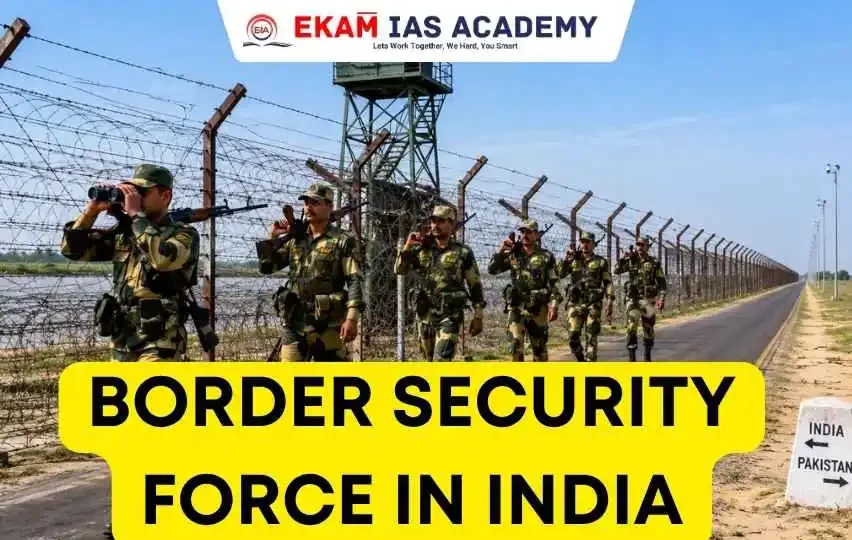
Maintaining the territorial integrity of a nation with diverse geopolitical borders requires a highly specialized, resilient security force. The Border Security Force (BSF), widely known as India’s “First Line of Defence,” stands as a core pillar of the country’s Internal Security framework.
Historical Background
The BSF was raised on December 1, 1965, following the Indo-Pakistani War, which exposed the structural limits of relying on uncoordinated state police units to guard international boundaries. Under the leadership of its founding Director General, K.F. Rustamji, the BSF was designed as a unified central force capable of securing frontiers during peacetime and assisting the military during active conflicts.
Organizational Structure
Today, the BSF operates as one of the largest Central Armed Police Forces (CAPFs) under the administrative control of the Ministry of Home Affairs (MHA). Headquartered in New Delhi, it is led by a civilian Director General from the Indian Police Service (IPS) and commands an extensive network of air, water, and artillery wings.
Roles, Responsibilities & Operational Importance
The primary statutory mandate of the BSF involves securing two of India’s most politically sensitive and logistically challenging international land boundaries:
1. The India–Pakistan Border
Along this front, the BSF Role includes patrolling the volatile International Border (IB) stretching across Gujarat, Rajasthan, Punjab, and Jammu. The force acts as a major deterrent against cross-border infiltration, weapon smuggling via automated drones, and localized ceasefire violations.
2. The India–Bangladesh Border
Managing the 4,096 km India–Bangladesh Border presents complex terrain challenges, featuring riverine sectors, low-lying wetlands, and dense population pockets along the boundary line. The BSF Functions here focus heavily on stopping cattle rustling, checking undocumented migration, and dismantling transnational syndicates running fake currency and drug routes.
During active wartime conditions, the force shifts its operational posture to support the Indian Army. It holds defensive positions on the frontline, guards vital supply lines, and manages prisoner-of-war camps.
Government Initiatives & Tech Integration
To counter evolving hybrid security threats, the state has continually upgraded the defensive capabilities of the force:
- Comprehensive Integrated Border Management System (CIBMS): Shifting away from basic physical barriers, the government has deployed CIBMS along high-risk border sectors. This system integrates thermal imagers, underground acoustic sensors, and fiber-optic communication lines to enable round-the-clock automated tracking.
- Smart Fencing Systems: The installation of high-tech Smart Fencing setups, which use laser walls to secure riverine and marshy gaps where traditional wire fences cannot be built, has dramatically improved interception rates along the border.
Component Function Laser Walls + Infrared Sensors Detects cross-border movement instantly. Tactical Operations Centre Analyzes real-time video feed via AI. BSF Quick Reaction Team (QRT) Neutralizes infiltration threat on the spot.
Challenges Faced by BSF
Despite deploying automated surveillance networks, the force deals with significant operational issues:
- Drone-Based Threats: Transnational networks increasingly use low-flying commercial drones to drop narcotics and weapons deep inside Indian territory, bypassing traditional ground sensors.
- Difficult Geographical Conditions: Patrolling extreme landscapes—from the sub-zero snowfields of Jammu to the burning sand dunes of the Thar desert and the dense mangrove forests of the Sundarbans—places severe physical strain on personnel.
- Evolving Jurisdiction Debates: Recent legislative expansions updating the BSF’s operational jurisdiction up to 50 km inside certain border states have sparked discussions regarding the balance of responsibilities between central forces and local state police units.
Way Forward
To optimize India’s border defense matrix, future strategies must prioritize deploying automated anti-drone systems equipped with electronic jamming capabilities. Additionally, introducing rotating deployment schedules will help reduce personnel fatigue, while establishing real-time data integration links between the BSF and regional police forces will streamline investigations into cross-border crime networks.
Conclusion
In conclusion, the Border Security Force remains an indispensable element of India’s sovereign defense strategy. By systematically upgrading its technological infrastructure through Smart Fencing and maintaining strong coordination with other Central Armed Police Forces, the BSF successfully protects the country’s international borders, supporting long-term economic development and internal peace.
UPSC Prelims: PYQs & Practice Questions
Previous Year Questions (Prelims)
Q: Consider the following statements regarding the Central Armed Police Forces (CAPFs) and Paramilitary forces of India:
1. The Assam Rifles is under the dual control of the Ministry of Home Affairs and the Ministry of Defence.
2. The Border Security Force (BSF) is responsible for guarding India's international borders with both Pakistan and Myanmar.
Which of the statements given above is/are correct?
(a) 1 only
(b) 2 only
(c) Both 1 and 2
(d) Neither 1 nor 2
Answer: (a) 1 only
Explanation:
Statement 1 is correct. The Assam Rifles follows a dual control model where administrative control is under the Ministry of Home Affairs (MHA) and operational control rests with the Ministry of Defence (MoD).
Statement 2 is incorrect. The BSF is designated to guard India's international borders with Pakistan and Bangladesh. The Indo–Myanmar Border is guarded by the Assam Rifles.
Q: With reference to the Central Armed Police Forces (CAPFs) in India, consider the following statements:
1. The Border Security Force (BSF) was raised immediately after the Sino-Indian War of 1962 to secure the northern frontiers.
2. BSF is the only CAPF to possess its own dedicated Air Wing, Marine Wing, and artillery regiments.
Which of the statements given above is/are correct?
(a) 1 only
(b) 2 only
(c) Both 1 and 2
(d) Neither 1 nor 2
Answer: (b) 2 only
Explanation:
Statement 1 is incorrect. The BSF was raised on December 1, 1965, following the Indo-Pakistani War of 1965, which exposed the limits of using state police forces for border security. The Indo-Tibetan Border Police (ITBP) was raised after the 1962 war.
Statement 2 is correct. The BSF is unique among the Central Armed Police Forces for operating its own specialized Air Wing, Marine/Water Wing deployed in areas such as the Rann of Kutch and Sundarbans, and dedicated artillery regiments.
Practice Questions
Q: Under the Border Security Force Act, 1968, the BSF is granted specific powers to arrest, search, and seize to curb cross-border crimes. In this context, consider the following statements:
1. The BSF possesses independent prosecuting powers to try and convict civilian suspects arrested within its operational jurisdiction.
2. The Central Government holds the authority to alter the local limits of the area adjoining the borders of India where the BSF can exercise its powers.
Which of the statements given above is/are correct?
(a) 1 only
(b) 2 only
(c) Both 1 and 2
(d) Neither 1 nor 2
Answer: (b) 2 only
Explanation:
Statement 1 is incorrect. The BSF does not have independent prosecuting authority over civilians. After arresting suspects or seizing contraband under central laws such as the Customs Act or NDPS Act, the BSF is legally required to hand over suspects and evidence to the local state police within the prescribed time.
Statement 2 is correct. Section 139(1) of the BSF Act, 1968 empowers the Central Government to notify and modify the local operational limits where the force can exercise its jurisdiction.
Q: The Government of India is implementing the Comprehensive Integrated Border Management System (CIBMS) to secure porous sections of international borders. Which of the following technologies form core components of this infrastructure?
1. Under-ground acoustic sensors
2. Laser walls for riverine gaps
3. Micro-aerostat balloons fitted with thermal imagers
Select the correct answer using the code given below:
(a) 1 and 2 only
(b) 2 and 3 only
(c) 1 and 3 only
(d) 1, 2 and 3
Answer: (d) 1, 2 and 3
Explanation:
CIBMS is a technology-driven border security system that integrates multiple surveillance and detection tools. It uses underground acoustic sensors to detect tunneling attempts, laser walls to secure unfenced riverine gaps, and thermal cameras mounted on micro-aerostats for uninterrupted aerial surveillance along sensitive stretches of the India–Pakistan and India–Bangladesh borders.
UPSC Mains – Previous Year & Practice Questions
Mains Previous Year Questions
UPSC CSE 2016 | GS-3
Question: Border management is a complex task due to difficult terrain and hostile relations with some countries. Elucidate the challenges and strategies for effective border management.
Marks: 12.5 Marks | Word Limit: 200 Words
UPSC CSE 2016 | GS-3
Question: Analyze the internal security challenges along India's borders with Myanmar and Bangladesh. Discuss the role of border guarding forces in tackling these issues.
Marks: 10 Marks | Word Limit: 150 Words
UPSC CSE 2024 | GS-3
Question: “The illegal influx of refugees, combined with arms and narcotics trafficking, has complicated internal security management in India's border states.” Discuss with special reference to the strategic developments in Myanmar.
Marks: 15 Marks | Word Limit: 250 Words
UPSC CSE 2019 | GS-3
Question: Cross-border movement of insurgents is only one of the several security challenges facing the policing of the border in North-East India. Examine the various challenges currently as well as some of the measures to counter them.
Marks: 15 Marks | Word Limit: 250 Words
UPSC CSE 2022 | GS-3
Question: “Effective border management is the core of internal security.” Discuss the structural and logistical modifications required to make border guarding forces more resilient in handling hybrid threats.
Marks: 15 Marks | Word Limit: 250 Words
Mains Practice Questions
[15 Marks | 250 Words]
Question: “The expansion of the operational jurisdiction of the Border Security Force (BSF) from 15 km to 50 km in certain border states has sparked intense debates on federalism.” Critically evaluate this step in light of emerging national security challenges.
[15 Marks | 250 Words]
Question: “The increasing use of commercial and automated drones by transnational syndicates has revolutionized asymmetric threats along the India-Pakistan border.” Discuss the operational limits of traditional physical barriers and analyze how the BSF can leverage anti-drone technologies to secure the border.
[10 Marks | 150 Words]
Question: Explain the role of the Comprehensive Integrated Border Management System (CIBMS) in transforming India's border security from physical guarding to smart surveillance.



Border Security Force-FAQs
What is the Border Security Force?
The Border Security Force is a Central Armed Police Force responsible for guarding India’s international borders with Pakistan and Bangladesh.
When was the BSF established?
The BSF was established on December 1, 1965, after the Indo-Pakistani War.
Why is BSF called India’s First Line of Defence?
BSF is called India’s First Line of Defence because it guards India’s sensitive international borders during peacetime and supports the Army during wartime.
What is the role of BSF on the India-Bangladesh Border?
BSF checks undocumented migration, cattle smuggling, fake currency networks, drug trafficking and other cross-border crimes along the India-Bangladesh Border.
Why is BSF important for UPSC GS 3?
BSF is important for GS 3 Internal Security because it covers border management, CAPFs, smart fencing, drone threats, cross-border crime and national security.