Table of Contents
ToggleCommunity Participation for Border Management in India
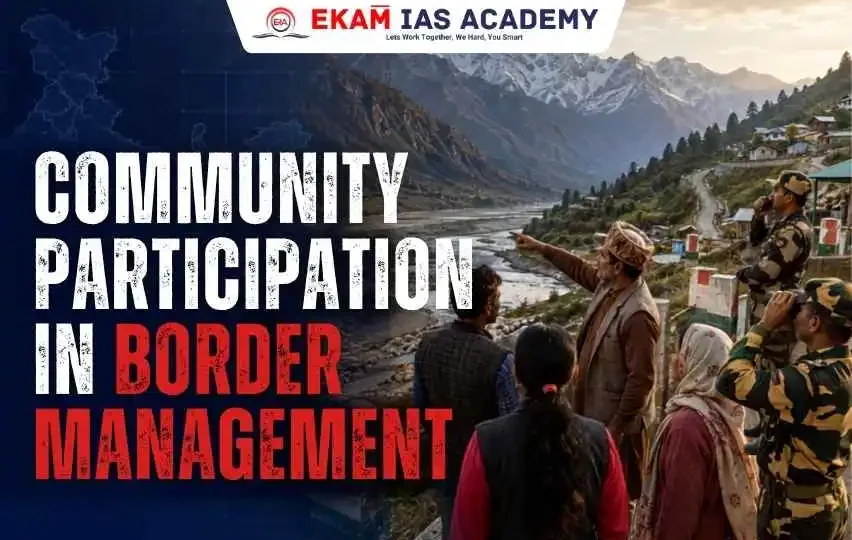
Securing a nation’s frontiers requires a strategy that goes beyond physical barriers and military deployment. For a nation with diverse and challenging frontiers, achieving absolute Border Security cannot rely solely on fences and technology. Integrating local populations into the national defense architecture through Community Participation for Border Management has emerged as a strategic necessity. For aspirants preparing for the Internal Security syllabus, analyzing how citizens act as force multipliers is crucial to understanding modern, comprehensive security strategies.
Understanding Border Management in India
The landscape of Border Management in India is exceptionally complex, spanning thousands of kilometers of international land borders and coastlines shared with multiple neighboring nations. These frontiers range from the icy terrains of the Himalayas to the marshy lands of the west and the riverine channels of the east. Guarding these regions are dedicated central forces like the Border Security Force (BSF), Indo-Tibetan Border Police (ITBP), and Sashastra Seema Bal (SSB). However, harsh weather conditions, difficult terrains, and cross-border asymmetric threats mean that traditional military guarding must be reinforced by a socio-economic approach.
Need for Community Participation in Border Management
Traditional methods are frequently tested by topography and climate. Even advanced frameworks like the Comprehensive Integrated Border Management System (CIBMS) encounter operational limitations in dense forests or shifting riverbeds. This is where the local population becomes vital.
Local border communities are the first to spot unusual activities, zero-line breaches, or unfamiliar faces. Neglecting these populations can lead to forced migration due to a lack of livelihood avenues, creating empty border zones that hostile actors can easily exploit for infiltration, drug smuggling, and weapons transit.
Role of Border Communities
Border populations serve as the eyes and ears of state law enforcement. Their presence provides several distinct advantages to the national security architecture:
- Human Intelligence (HUMINT): Providing real-time, actionable local intelligence regarding infiltration attempts or cross-border smuggling networks.
- Mitigating Transnational Threats: Acting as a primary deterrent against localized radicalization, fake currency circulation, and illegal immigration.
- Logistical Support: Assisting security forces with terrain navigation and local knowledge during emergencies or extreme weather conditions.
Government Initiatives
To prevent migration from frontier regions and foster a sense of belonging, the government has launched targeted initiatives to build sustainable infrastructure:
Vibrant Villages Programme: A flagship scheme designed to transform select northern border villages by modernizing Border Infrastructure, improving connectivity, and generating local livelihood opportunities.
Border Area Development Programme (BADP): A long-standing initiative focused on meeting the special developmental needs of people living in remote areas near international borders, filling gaps in health, education, and road connectivity.
Community Policing Initiatives: Interactive platforms run by forces like the Border Security Force to build trust, conduct medical camps, and train local youth.
Models and International Best Practices
Effective border defense models demonstrate that true security requires a balanced approach. Smart Border Management successfully combines technological assets with civilian cooperation frameworks.
Internationally, countries like Israel leverage localized civil-defense units in border settlements to ensure rapid, first-line responses to security breaches. Similarly, the United States employs community-watch initiatives along its northern and southern frontiers to report irregular movements to border patrols, keeping the civilian population actively engaged in national defense.
Impact on National Security
When frontier populations are economically stable and socially secure, national resilience increases. Strong community participation chokes the local support networks that cross-border criminals rely on. It improves the speed of intelligence collection, reduces the cost of continuous surveillance, and ensures that border regions remain populated, active buffers against external threats.
Important Reports & Data
- Kargil Review Committee Report: Explicitly highlighted that border populations are a vital link in the intelligence chain and recommended improving their socio-economic well-being to prevent alienation.
- Task Force on Border Management: Emphasized the urgent need to expand the Border Area Development Programme to address infrastructure deficiencies and build community resilience.
Way Forward
To maximize the impact of community integration, India must look toward forward-thinking strategies:
- Technological Literacy: Training local border youths in basic digital reporting tools to share real-time inputs with security grids.
- Skill Development: Creating local cottage industries and promoting eco-tourism through schemes like the Vibrant Villages Programme to stem outward migration.
- Formal Security Roles: Absorbing eligible youth from border regions into local state police and central paramilitary forces to tap into their native understanding of the terrain.
Conclusion
A comprehensive approach to border security requires balancing military capabilities with civilian engagement. By strengthening Community Participation for Border Management alongside deploying advanced systems like CIBMS, India can build a resilient, multi-layered defensive grid. Empowering border communities ensures that the nation’s outer boundaries are protected not just by physical barriers, but by the shared commitment of its citizens.
UPSC Prelims: PYQs & Practice Questions
Previous Year Questions (Prelims)
Q: With reference to the Vibrant Villages Programme (VVP) launched by the Government of India, consider the following statements: (UPSC CSE 2024)
1. It is a Centrally Sponsored Scheme aimed at the comprehensive development of select villages along India's northern land borders to check out-migration.
2. The programme aims to integrate border populations with mainstream national development and enable them to act as the "eyes and ears" for border guarding forces.
Which of the statements given above is/are correct?
(a) 1 only
(b) 2 only
(c) Both 1 and 2
(d) Neither 1 nor 2
Answer: (c) Both 1 and 2
Explanation:
Both statements are correct. The Vibrant Villages Programme was launched to develop infrastructure, livelihoods, and public services in select villages along India’s northern borders. It aims to reverse out-migration and strengthen community participation by engaging local residents as a civilian support network for border guarding forces.
Q: The Border Area Development Programme (BADP) is a primary policy instrument utilized to address regional imbalances along international frontiers. Which of the following administrative ministries serves as the nodal agency for its implementation? (UPSC CSE 2018)
(a) Ministry of Defence
(b) Ministry of Home Affairs
(c) Ministry of Rural Development
(d) Ministry of Panchayati Raj
Answer: (b) Ministry of Home Affairs
Explanation:
The Border Area Development Programme is implemented by the Department of Border Management under the Union Ministry of Home Affairs. The programme aims to meet developmental and infrastructure needs of people living near international land borders, thereby strengthening both local welfare and border security.
Practice Questions
Q: The Government recently expanded its border outreach with the approval of the Vibrant Villages Programme-II (VVP-II). Consider the following statements regarding this updated scheme:
1. VVP-II shifts from a Centrally Sponsored model to a 100% centrally funded Central Sector Scheme.
2. Unlike the first phase, VVP-II expands its geographical footprint to intensively develop strategic villages abutting all international land borders, including borders with Bangladesh, Myanmar, and Pakistan.
Which of the statements given above is/are correct?
(a) 1 only
(b) 2 only
(c) Both 1 and 2
(d) Neither 1 nor 2
Answer: (c) Both 1 and 2
Explanation:
Both statements are correct. While VVP-I was a Centrally Sponsored Scheme focused mainly on northern border villages, VVP-II is a Central Sector Scheme with 100% central funding. It extends the infrastructure and livelihood development model to strategic villages along other international land borders, including Bangladesh, Myanmar, Nepal, Bhutan, and Pakistan, strengthening unified Border Security.
Q: In the context of Smart Border Management, how does the deployment of the Comprehensive Integrated Border Management System (CIBMS) interact with local border communities?
1. CIBMS relies on physical community patrols to manually reset laser-mesh fences and thermal imaging grids in riverine terrains.
2. Community participation acts as a vital backup layer by providing Human Intelligence (HUMINT) when technical sensors face line-of-sight limitations due to dense vegetation or extreme weather.
Which of the statements given above is/are correct?
(a) 1 only
(b) 2 only
(c) Both 1 and 2
(d) Neither 1 nor 2
Answer: (b) 2 only
Explanation:
Statement 1 is incorrect because CIBMS is an automated technology-driven border surveillance system and does not depend on local citizens to reset its physical infrastructure. Statement 2 is correct; during fog, heavy rainfall, dense vegetation, or riverine terrain limitations, local communities provide crucial ground-level Human Intelligence to help security forces detect and respond to cross-border breaches.
UPSC Mains – Previous Year & Practice Questions
Mains Previous Year Questions
UPSC CSE 2023
Question: Secure borders are a product of both military vigilance and the socio-economic well-being of the frontier population. In light of this, discuss the role of the Vibrant Villages Programme in mitigating internal security threats along India's northern borders.
GS-3 | 15 Marks | 250 Words
UPSC CSE 2021
Question: Analyze the various operational and administrative challenges encountered in the management of borders in India. How can community-based policing frameworks minimize cross-border smuggling and radicalization?
GS-3 | 15 Marks | 250 Words
UPSC CSE 2019
Question: The emigration of border populations due to lack of economic opportunities creates a security vacuum that is easily exploited by hostile state and non-state actors. Elaborate on the significance of the Border Area Development Programme (BADP) in reversing this trend.
GS-3 | 10 Marks | 150 Words
UPSC CSE 2018
Question: Cross-border movement of insurgents, illegal weapons, and narcotics along the Indo-Myanmar border highlights the weakness of traditional territorial fencing. Suggest a blueprint for a smart border management model that integrates technology with local tribal communities.
GS-3 | 15 Marks | 250 Words
UPSC CSE 2015
Question: Examine how the Eyes and Ears policy of central paramilitary forces helps counter asymmetric warfare and intelligence-gathering by hostile neighbors in border districts.
GS-3 | 10 Marks | 150 Words
Mains Practice Questions
[15 Marks | 250 Words]
Question: While advanced technical surveillance through systems like CIBMS forms the spine of modern border management, technology cannot substitute the organic intelligence provided by stable border communities. Critically analyze the necessity of community integration for defending India’s porous riverine and mountain frontiers.
[15 Marks | 250 Words]
Question: The transition from the Border Area Development Programme (BADP) to the targeted Vibrant Villages Programme (VVP-II) represents a strategic shift from passive infrastructure creation to active strategic demographic settlement. Evaluate how this shift strengthens India's internal security framework.
[10 Marks | 150 Words]
Question: Community Policing along international borders demands high levels of mutual trust between central paramilitary forces and local indigenous populations. Identify the primary friction points between border guarding forces and civilians, and suggest institutional measures to improve civil-military cooperation.



Community Participation for Border Management-FAQs
What is community participation in border management?
Community participation in border management means involving local border populations in supporting security, intelligence sharing, development and vigilance along India’s frontiers.
Why are border communities important for national security?
Border communities act as the eyes and ears of security forces by reporting suspicious movements, infiltration attempts, smuggling networks and unusual cross-border activities.
Which government schemes support border communities in India?
Major schemes include the Vibrant Villages Programme and Border Area Development Programme, which focus on infrastructure, livelihood, connectivity and welfare in border areas.
How does community participation help border security?
It improves human intelligence, reduces migration from border villages, prevents local support for smugglers and strengthens trust between citizens and security forces.
Why is this topic important for UPSC?
It is important for UPSC because it connects with internal security, border management, community policing, CIBMS, Vibrant Villages Programme, BADP and national security.