Table of Contents
ToggleDemonetisation and Its Impact on Black Money in India
The intersection of state intervention and structural economic cleanup reached a milestone with the Impact of Demonetisation on Black Money. Evaluated as a critical turning point under the Internal Security and macroeconomic governance framework of the Indian Economy, this sweeping structural intervention sought to completely disrupt the unmonitored flow of shadow capital.
Understanding Demonetisation & Its Core Objectives
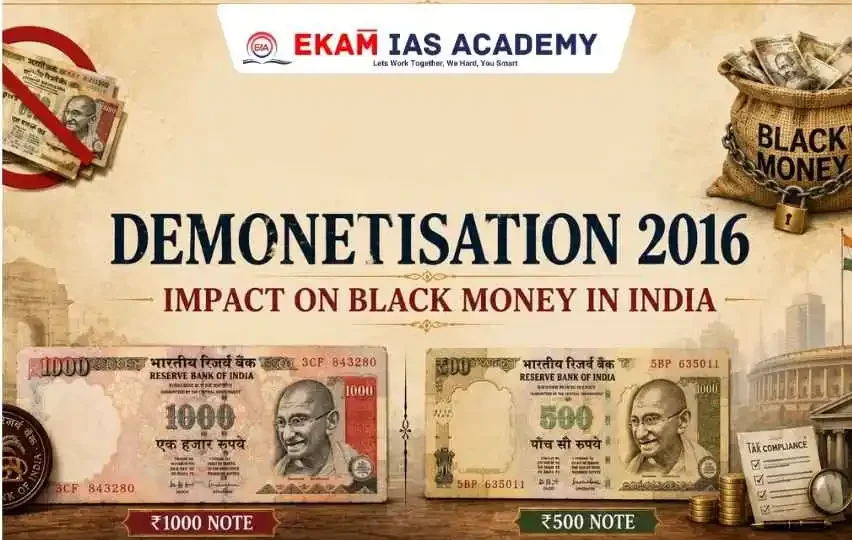
Demonetisation is the administrative process of stripping a specific currency unit of its status as legal tender. During Demonetisation 2016, the Government of India suddenly withdrew the legal status of all ₹500 and ₹1,000 banknotes, which effectively deactivated 86% of the country’s physical currency in circulation.
According to Demonetisation UPSC analysis, this intervention was driven by four interconnected operational goals:
Dismantling Black Money in India: Forcing individuals to account for massive pools of hidden, untaxed cash.
Neutralizing Counterfeit Currency: Damaging the networks producing fake Indian currency notes (FICN) used to destabilize economic stability.
Starving Terror Financing: Cutting off the hidden physical cash routes used by left-wing extremists and cross-border insurgent modules.
Accelerating a Formal Economy: Transitioning the domestic marketplace from an anonymous cash system to an auditable, digitized infrastructure.
Black Money and Demonetisation: The Positive Impact
The immediate connection between cash availability and parallel economic operations yielded several notable results:
- Eliminating Financial Anonymity: Reserve Bank of India data confirmed that nearly 99% of the deactivated currency notes returned to the banking grid. While critics highlighted this high return rate, it effectively stripped that capital of its anonymity, forcing depositors to tie large cash holdings to specific permanent account numbers (PAN).
- A Quantum Jump in Tax Compliance: Data analytics run through Operation Clean Money identified over 1.8 million accounts with deposit patterns that did not match their stated tax profiles. This accelerated long-term Tax Compliance, driving individual e-filed returns up by over 25% in the immediate post-demonetisation cycle.
- The Transition to Digital Payments: The forced lack of physical cash permanently shifted consumer habits toward electronic infrastructure. The rapid growth of the Unified Payments Interface (UPI) helped reduce the economy’s reliance on unmonitored physical currency, supporting anti-evasion systems.
Initiative Key Outcome Demonetisation Cash forced into banks and stripped of anonymity. Operation Clean Money 1.8M+ mismatched profiles flagged using Big Data analytics. GST Implementation Real-time invoice matching linked B2B supply chains.
Limitations, Criticisms, and Economic Shockwaves
Despite its structural goals, the implementation faced real operational challenges. The central premise that the parallel economy existed primarily as idle physical cash was a major point of criticism; the vast majority of wealth in Black Money in India is held in non-cash assets like real estate, gold bullion, and offshore shell companies.
The abrupt withdrawal of liquidity also created clear short-term costs for the broader economy. The informal sector—which relies heavily on cash cycles for daily wages, agricultural trade, and supply logistics—experienced sudden disruptions. This drop in immediate demand led to a temporary decline in industrial production and a short-term reduction in quarterly GDP growth rates.
Government Measures After Demonetisation
To build on the formalization process started by the note ban, the state deployed consecutive regulatory layers:
- Introduction of GST: The launch of the Goods and Services Tax (GST) established a digital, self-policing invoice ecosystem that directly builds on the cash reduction efforts of demonetisation.
- Stringent Asset Laws: The government strengthened enforcement of the Black Money Act alongside the revised Benami Transactions Act to systematically identify, freeze, and seize proxy real estate assets.
Challenges & Way Forward
A comparative analysis with global cash-cleanup exercises shows that currency manipulation alone cannot permanently eliminate tax evasion. As physical currency volumes eventually rebounded to meet the demands of economic growth, new challenges emerged. Modern tax evasion methods have evolved past physical cash, shifting toward digital structures like decentralized cryptocurrencies, trade-inflated shell invoicing, and encrypted darknet transactions.
To sustain a transparent economy, India must implement the following structural updates:
- Predictive AI Auditing: Moving beyond retrospective reviews to use real-time machine learning models that can flag tax evasion as it occurs across interlinked banking networks.
- Real Estate Formalisation: Mandating complete digital registration and matching land registry databases with individual PAN frameworks to stop the generation of unregistered wealth.
- Global Enforcement Alliances: Working closely with bodies like the FATF to quickly track and freeze assets moved through offshore shell configurations.
Conclusion
Analyzing the Impact of Demonetisation on Black Money reveals that its primary value was not simply seizing physical currency, but accelerating structural economic change. When combined with systems like GST, demonetisation acted as an entry point for advanced data tracking. This transition from an unmonitored cash model to an auditable, digitized framework continues to protect the fiscal sovereignty and domestic security of the country.
UPSC Prelims: PYQs & Practice Questions
Previous Year Questions (Prelims)
Q: Which of the following is/are the most likely advantages of implementing Goods and Services Tax (GST)?
1. It will replace multiple indirect taxes collected by multiple authorities and will thus create a single market in India.
2. It will drastically reduce the Current Account Deficit of India and will enable it to increase its foreign exchange reserves.
3. It will enormously increase the growth and size of economy of India and will enable it to overtake the Chinese economy in the near future.
Select the correct answer using the code given below:
(a) 1 only
(b) 2 and 3 only
(c) 1 and 3 only
(d) 1, 2 and 3
Answer: (a) 1 only
Explanation:
Statement 1 is correct. GST was implemented shortly after Demonetisation as a structural reform to unify India's fragmented indirect tax regime into a single common national market, improving tax transparency and creating data trails across business chains.
Statements 2 and 3 are incorrect. These are speculative, overly broad, and exaggerated statements. GST does not directly manage the Current Account Deficit, which depends on export-import balances, nor does it guarantee that India will overtake the Chinese economy in the near future.
Q: With reference to digital payment platforms introduced to reduce the economy's cash dependence after Demonetisation, consider the following statements regarding BHIM (Bharat Interface for Money) app:
1. BHIM app allows the user to transfer money to anyone with a UPI-enabled bank account.
2. While a chip-pin debit card has four factors of authentication, BHIM app has only two factors of authentication.
Which of the statements given above is/are correct?
(a) 1 only
(b) 2 only
(c) Both 1 and 2
(d) Neither 1 nor 2
Answer: (a) 1 only
Explanation:
Statement 1 is correct. The BHIM app uses the Unified Payments Interface (UPI) infrastructure, allowing users to make instant bank-to-bank transfers using a mobile number, UPI ID, or QR code.
Statement 2 is incorrect. BHIM has multiple layers of authentication, including device binding/mobile number verification, bank account linkage, and the user-set UPI PIN required to authenticate transactions.
Practice Questions
Q: Following Demonetisation 2016, the Ministry of Finance launched "Operation Clean Money". What was the primary operational objective of this administrative drive?
(a) To systematically clean physical bank lockers suspected of holding counterfeit currency notes.
(b) To leverage big data analytics to cross-examine large cash deposits made during the note ban window against taxpayers' known income profiles.
(c) To provisionally attach offshore properties owned by non-resident Indians under the Black Money Act.
(d) To automate the collection of direct taxes from agricultural income above specified thresholds.
Answer: (b)
Explanation:
Operation Clean Money was an advanced e-governance data initiative launched by the Income Tax Department. It used data mining to cross-reference tax filings of citizens against high-value cash deposits made during the late 2016 demonetisation window, flagging more than 1.8 million accounts showing significant mismatches for further investigation.
Q: From an internal security perspective, the abrupt removal of high-denomination banknotes during Demonetisation UPSC analysis highlights which primary mechanism for controlling asymmetric warfare?
(a) Enhancing the tactical capabilities of border patrol forces through state-funded infrastructure.
(b) Forcing the sudden devaluation and structural liquidation of stagnant, unmonitored physical currency networks utilized for Counterfeit Currency and terror logistical supply chains.
(c) Capping the maximum credit allocation accessible by defense public sector undertakings.
(d) Bypassing the intelligence-gathering requirements of the Financial Action Task Force (FATF).
Answer: (b)
Explanation:
High-denomination currency notes, especially ₹500 and ₹1,000 notes, historically formed the primary vehicle for cash-heavy security threats such as Fake Indian Currency Notes (FICN) and left-wing extremist funding. Deactivating these notes disrupted liquid cash chains immediately, rendering existing stashes of black wealth and counterfeit currency held by hostile non-state actors obsolete.
UPSC Mains – Previous Year & Practice Questions
Mains Previous Year Questions
UPSC CSE 2021 | GS-3
Question: Discuss how emerging technologies and globalisation contribute to money laundering. Elaborate measures to tackle the problem of money laundering both at national and international levels.
Marks: 10 Marks | Word Limit: 150 Words
UPSC CSE 2013 | GS-3
Question: Money laundering poses a serious threat to a country's economic sovereignty. What is its significance for India and what steps are required to be taken to control this menace?
Marks: 10 Marks | Word Limit: 150 Words
UPSC CSE 2023 | GS-3
Question: What is the menace of terror funding and what are the major sources of terror funding in India? Also, discuss the efforts being made to curtail these sources.
Marks: 15 Marks | Word Limit: 250 Words
UPSC CSE 2016 | GS-3
Question: “The deployment of digital economic tools has structural implications for controlling the parallel black economy.” Analyze how shifting towards a cashless infrastructure affects the capacity of state intelligence networks to trace internal security threats.
Marks: 10 Marks | Word Limit: 150 Words
UPSC CSE 2018 | GS-3
Question: “The interaction between cross-border narcotics trafficking and money laundering fuels parallel underground economies.” Examine the institutional role played by federal economic tracking agencies in dismantling illicit financial flows.
Marks: 15 Marks | Word Limit: 250 Words
Mains Practice Questions
[15 Marks | 250 Words]
Question: “The long-term impact of Demonetisation on Black Money must be evaluated not by the physical currency seized, but by the formalisation of the Indian Economy.” Critically assess this statement, focusing on the growth of tax compliance and digital payment systems.
[15 Marks | 250 Words]
Question: Evaluate how the post-demonetisation transition to digital-first taxation via GST and data mining platforms changed India's approach to tackling structural tax evasion. What challenges remain regarding non-cash assets?
[10 Marks | 150 Words]
Question: “While currency interventions provide short-term shocks to terror networks, they face structural limitations because black money is dynamic and morphs into digital spaces.” Discuss this statement in light of emerging cyber-financial threats and cryptocurrencies.



Demonetisation and Its Impact on Black Money in India-FAQs
What was demonetisation in India?
Demonetisation was the withdrawal of legal tender status of ₹500 and ₹1,000 notes by the Government of India in November 2016.
What were the main objectives of demonetisation?
The main objectives were to curb black money, reduce counterfeit currency, check terror financing, and promote a formal digital economy.
Did demonetisation eliminate black money?
Demonetisation reduced cash anonymity and increased tax scrutiny, but it could not fully eliminate black money because much of it is stored in assets like land, gold, and offshore accounts.
How did demonetisation improve tax compliance?
Large cash deposits entered the banking system, allowing authorities to match deposits with PAN details and identify mismatched income profiles.
Why is demonetisation important for UPSC GS 3?
It is important for GS 3 because it connects Indian economy, internal security, black money, counterfeit currency, digital payments, tax compliance, and governance reforms.