Table of Contents
ToggleIndo-Tibetan Border Police (ITBP) – Guardians of India-China Border
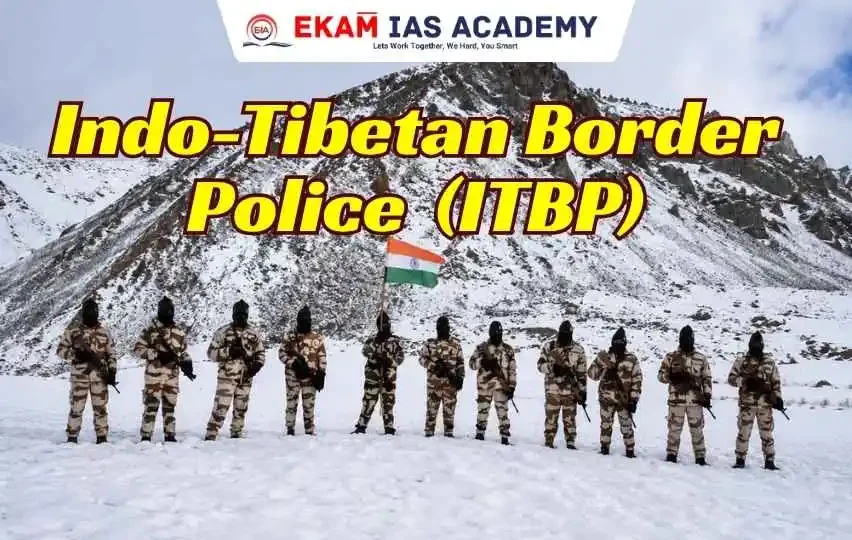
Securing highly volatile mountain frontiers requires specialized survival tactics, structural endurance, and military precision. The Indo-Tibetan Border Police (ITBP) stands as India’s specialized mountain strike force, safeguarding national sovereignty along the rugged trans-Himalayan tracts. Popularly revered as the Himveers, the personnel of this elite force operate under severe climatic conditions.
Historical Background
The ITBP was raised on October 24, 1962, under the Central Reserve Police Force (CRPF) Act, in the immediate aftermath of the Sino-Indian War. The conflict exposed the critical vulnerability of India’s northern frontiers and underscored the need for a dedicated, mountain-trained force to monitor alpine passes. The parliament later enacted the Indo-Tibetan Border Police Force Act in 1992, formalizing its statutory framework.
Organizational Structure
Administratively, the ITBP functions as one of the premier CAPFs (Central Armed Police Forces) under the Ministry of Home Affairs (MHA). Headquartered in New Delhi, the force is commanded by a Director General (DG) from the Indian Police Service (IPS). Structurally, it is organized into tactical frontiers, command sectors, and specialized wings, including:
- An Independent Air Support Matrix
- High-Altitude Mountaineering and Skiing Institutes (Auli, Uttarakhand)
- Dedicated Telecommunication and K9 Combat Units
Mandate, Roles & Responsibilities
The foundational operational charter of the ITBP revolves around a strict peacetime mandate: “One Border, One Force.” This restricts its primary deployment area exclusively to the India-China Border.
| Core Mandate | Responsibility |
|---|---|
| Peacetime Vigilance | Patrolling the Line of Actual Control (LAC). |
| Tactical Defense | Securing high-altitude passes and trade routes. |
| Internal Security | Anti-Naxal operations and VVIP security detail. |
| Disaster Management | First responder for Himalayan flash floods and avalanches. |
The principal ITBP Functions and responsibilities are broken down into specific domains:
Frontier Vigilance: Maintaining round-the-clock surveillance over the 3,488 km long international boundary along the Line of Actual Control (LAC), spanning Ladakh, Himachal Pradesh, Uttarakhand, Sikkim, and Arunachal Pradesh.
Infiltration and Smuggling Control: Preventing cross-border trans-Himalayan crimes, illegal infiltration, and the smuggling of contraband or rare wildlife parts across remote mountain passes.
Civic Action & Public Order: Providing vital security infrastructure for the annual Char Dham Yatra and the Amarnath Yatra, while executing internal security duties like counter-left-wing extremism (LWE) operations in Chhattisgarh.
ITBP and India–China Border Management: Operational Importance
The tactical landscape of India China Border Security forces the ITBP to operate in extreme conditions. Its Border Outposts (BOPs) are situated at high altitudes ranging from 9,000 to over 18,700 feet, where winter temperatures drop below minus 40 degrees Celsius.
The strategic importance of the ITBP lies in its role as a tripwire. Placed at the frontlines along the LAC, ITBP patrols serve as the initial detection mechanism against visual or territorial incursions by China’s People’s Liberation Army (PLA). In times of active military conflict, the ITBP transitions its command lines to join the Indian Army, defending key high-altitude ridges and staging areas.
Government Initiatives & Recent Developments
To counter asymmetric border developments and enhance infrastructure along the LAC, the state has launched several modern initiatives:
- Vibrant Villages Programme: The ITBP works as a key coordinating agency for the scheme along the northern borders. This initiative aims to reverse migration out of isolated border villages by building local economies, expanding connectivity, and setting up eco-tourism hubs.
- Advanced Border Outposts (BOPs): The MHA has introduced temperature-controlled, solar-powered, insulated habitat structures. These smart BOPs protect personnel from extreme sub-zero temperatures, improving long-term deployment capabilities.
- Weaponry and Logistics Modernization: The force has upgraded its inventory with modern all-terrain vehicles (ATVs), high-resolution thermal imagers, satellite communication arrays, and automated anti-drone systems to counter low-flying aerial surveillance threats
Challenges Faced by ITBP & Inter-Agency Coordination
The ITBP operates within a complex web of physical and institutional challenges:
- Physiological and Climate Strain: Prolonged exposure to high-altitude environments causes medical risks like pulmonary edema, hypothermia, and psychological isolation.
- Infrastructure Gaps: Rugged terrain slows down the construction of all-weather lateral roads, creating logistical bottlenecks during emergencies compared to the advanced infrastructure on the civilian side of the LAC.
- Inter-Agency Coordination: Managing overlapping operational zones between the ITBP (MHA) and the Indian Army (Ministry of Defence) requires close coordination. To address this, the government uses joint command centers to synchronize intelligence sharing and patrol schedules along the LAC.
ITBP vs. Other Central Armed Police Forces
To understand the division of labor among India’s security forces, the operational differences between the ITBP and other CAPFs must be clearly distinguished:
| Force Name | Primary Frontier / Mandate | Terrain Specialization | Command Layout |
| ITBP | India-China Border (LAC) | High-Altitude Glaciers, Trans-Himalayan Slopes | MHA (Administrative) / Regular IPS-Armed Officers |
| BSF | Pakistan and Bangladesh Borders | Desert Plains, Riverine Swamps, Mangroves | MHA / IPS-Led Sector Commands |
| SSB | Nepal and Bhutan Borders | Open Plains, Dense Foothill Forests | MHA / Friendly, Soft-Border Policing |
Way Forward
To strengthen India’s northern defense layer, the security framework must prioritize complete road connectivity to every forward ITBP out-post. Introducing automated surveillance networks equipped with satellite-linked radar systems will reduce the reliance on physical foot patrols across dangerous terrain. Furthermore, streamlining the tactical command structure under a unified theater command will ensure seamless operational transitions between the ITBP and the Indian Army during border standoffs.
Conclusion
In conclusion, the Indo-Tibetan Border Police (ITBP) remains vital to India’s sovereign defense matrix. By combining high-altitude survival skills with modern border infrastructure upgrades, the Himveers ensure that the nation’s most challenging frontiers remain secure against evolving external threats.
UPSC Prelims: PYQs & Practice Questions
Previous Year Questions (Prelims)
Q: Consider the following statements regarding the Central Armed Police Forces (CAPFs) and Paramilitary forces of India:
1. The Assam Rifles is under the dual control of the Ministry of Home Affairs and the Ministry of Defence.
2. The Border Security Force (BSF) is responsible for guarding India's international borders with both Pakistan and Myanmar.
Which of the statements given above is/are correct?
(a) 1 only
(b) 2 only
(c) Both 1 and 2
(d) Neither 1 nor 2
Answer: (a) 1 only
Explanation:
Statement 1 is correct. The Assam Rifles is uniquely placed under a dual control model: its administrative control is under the Ministry of Home Affairs (MHA), while its operational control rests with the Ministry of Defence (MoD).
Statement 2 is incorrect. The BSF is designated to guard India’s international borders with Pakistan and Bangladesh. The Indo–Myanmar Border is guarded by the Assam Rifles.
Q: With reference to the "One Border, One Force" policy recommended by the Group of Ministers (GoM) on National Security, consider the following statements:
1. In 2004, the entire 3,488 km India–China border was assigned exclusively to the Indo-Tibetan Border Police (ITBP).
2. Prior to this restructuring, the eastern sector of the India–China border in Sikkim and Arunachal Pradesh was guarded primarily by the Assam Rifles.
Which of the statements given above is/are correct?
(a) 1 only
(b) 2 only
(c) Both 1 and 2
(d) Neither 1 nor 2
Answer: (c) Both 1 and 2
Explanation:
Statement 1 is correct. Following the recommendations of the GoM report after the Kargil War, the government adopted the "One Border, One Force" policy to reduce multi-force overlaps. In 2004, the ITBP was designated as the sole force guarding the entire Line of Actual Control (LAC) from Karakoram Pass in Ladakh to Jachep La in Arunachal Pradesh.
Statement 2 is correct. To ensure single-force uniformity, the ITBP systematically replaced the Assam Rifles in forward areas of Sikkim and Arunachal Pradesh.
Practice Questions
Q: The personnel of the Indo-Tibetan Border Police (ITBP), known as Himveers, are specially trained for trans-Himalayan operations. In this context, consider the following statements:
1. The ITBP is the designated "First Responder" for natural calamities, flash floods, and avalanches in the entire Himalayan region.
2. Unlike other Central Armed Police Forces, the ITBP is restricted by law from participating in internal security operations like anti-Naxal operations.
Which of the statements given above is/are correct?
(a) 1 only
(b) 2 only
(c) Both 1 and 2
(d) Neither 1 nor 2
Answer: (a) 1 only
Explanation:
Statement 1 is correct. Due to its specialized mountaineering, skiing, and high-altitude rescue training, the ITBP acts as an institutional first responder during disasters in the Himalayan region, including flash floods, avalanches, and pilgrimage-route emergencies.
Statement 2 is incorrect. While India-China border security is its primary responsibility, the ITBP is also deployed for internal security duties, including counter-insurgency operations in Jammu & Kashmir and anti-Naxal operations in Left-Wing Extremism affected states.
Q: To strengthen the deployment capabilities of the Indo-Tibetan Border Police (ITBP) along the northern frontiers, the Government of India has introduced several recent initiatives. Consider the following:
1. The construction of temperature-controlled, solar-powered insulated Border Outposts (BOPs).
2. The implementation of the Vibrant Villages Programme to prevent out-migration from border settlements.
3. Placing the operational command of all forward ITBP units directly under the Indian Army's Northern Command during peacetime.
Which of the statements given above are correct?
(a) 1 and 2 only
(b) 2 and 3 only
(c) 1 and 3 only
(d) 1, 2 and 3
Answer: (a) 1 and 2 only
Explanation:
Statements 1 and 2 are correct. The Ministry of Home Affairs has promoted climate-resilient smart habitats and insulated border infrastructure to protect Himveers from extreme sub-zero conditions. The Vibrant Villages Programme strengthens border settlements, reduces out-migration, and supports local communities that act as crucial eyes and ears for frontier intelligence.
Statement 3 is incorrect. During peacetime, the ITBP remains an independent Central Armed Police Force under the administrative and operational control of the Ministry of Home Affairs (MHA), though it maintains close coordination with the Indian Army in forward areas.
UPSC Mains – Previous Year & Practice Questions
Mains Previous Year Questions
UPSC CSE 2016 | GS-3
Question: Border management is a complex task due to difficult terrain and hostile relations with some countries. Elucidate the challenges and strategies for effective border management.
Marks: 12.5 Marks | Word Limit: 200 Words
UPSC CSE 2018 | GS-3
Question: The concept of "One Border, One Force" was introduced to resolve coordination issues among security agencies. Critically examine its success with respect to India's northern borders.
Marks: 10 Marks | Word Limit: 150 Words
UPSC CSE 2021 | GS-3
Question: Analyze the internal security challenges along India's borders. Discuss the role of specialized border guarding forces in tackling these issues under adverse climatic conditions.
Marks: 15 Marks | Word Limit: 250 Words
UPSC CSE 2022 | GS-3
Question: “Effective border management is the core of internal security.” Discuss the structural and logistical modifications required to make border guarding forces more resilient in handling hybrid threats.
Marks: 15 Marks | Word Limit: 250 Words
UPSC CSE 2023 | GS-3
Question: Explain how infrastructural development along the Line of Actual Control (LAC) acts as a multiplier force for border guarding agencies and enhances the overall internal security matrix of the country.
Marks: 15 Marks | Word Limit: 250 Words
Mains Practice Questions
[15 Marks | 250 Words]
Question: “The trans-Himalayan operational zone of the Indo-Tibetan Border Police (ITBP) imposes severe physiological, logistical, and environmental limitations on frontline personnel.” Elaborate on these challenges and analyze the state initiatives implemented to mitigate them.
[15 Marks | 250 Words]
Question: “The infrastructure asymmetry along the Line of Actual Control (LAC) complicates the mandate of India China Border Security.” In light of this statement, examine how the Vibrant Villages Programme can supplement the security efforts of the ITBP.
[10 Marks | 150 Words]
Question: “With the evolving nature of hybrid warfare, the friction between dual command lines—the Ministry of Home Affairs managing CAPFs and the Ministry of Defence managing the Army—presents challenges during border face-offs.” Suggest structural reforms to synchronize coordination along the India–China border.



Indo-Tibetan Border Police (ITBP)-FAQs
What is the Indo-Tibetan Border Police?
The Indo-Tibetan Border Police is a Central Armed Police Force responsible for guarding India’s frontier along the India-China Border and the Line of Actual Control.
When was ITBP raised?
The ITBP was raised on October 24, 1962, after the Sino-Indian War.
Why are ITBP personnel called Himveers?
ITBP personnel are called Himveers because they serve in extremely difficult Himalayan terrain and high-altitude border areas.
What is the main role of ITBP?
The main role of ITBP is to guard the India-China Border, patrol the LAC, prevent border violations, support disaster response and assist in internal security duties.
Why is ITBP important for UPSC GS 3?
ITBP is important for GS 3 Internal Security because it connects border management, India-China relations, LAC security, CAPFs, mountain warfare and national security.