

Table of Contents
ToggleFive Crore Indians Wait When the Courts Take a Break
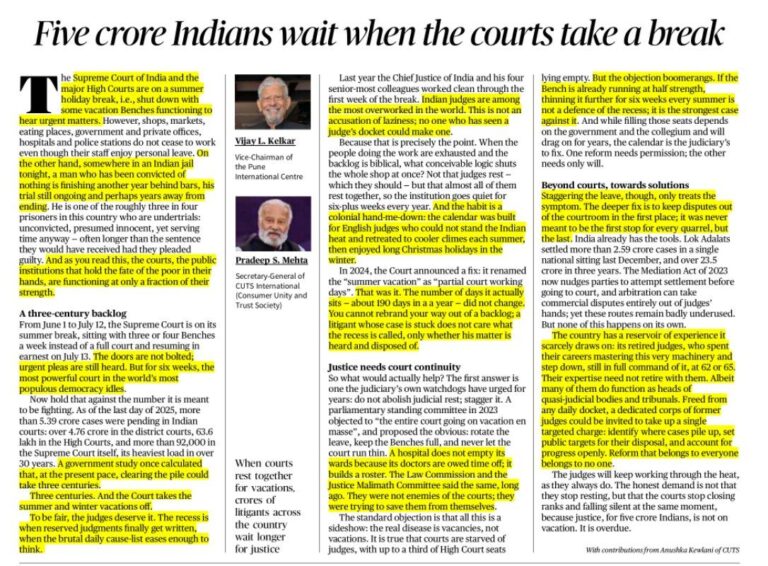
India’s judicial system is facing a serious challenge of case pendency, delayed justice and court vacations. While courts close for summer holidays, lakhs of litigants continue to wait for justice. The article argues that when nearly five crore cases are pending across Indian courts, long judicial breaks raise important questions about access to justice, institutional efficiency and public accountability.
Why Court Vacations Are Being Questioned
Massive Case Backlog
India’s courts are burdened with a huge backlog of cases. District courts, High Courts and the Supreme Court together handle crores of pending matters. For many undertrial prisoners, civil litigants and poor citizens, delay is not just an administrative issue; it directly affects liberty, livelihood and dignity.
When courts remain closed for long vacations, urgent matters may still be heard, but regular disposal of cases slows down. This creates frustration among citizens who already face long delays.
The Problem of Delayed Justice
Impact on Undertrials
A large number of prisoners in India are undertrials, meaning they have not yet been convicted. Many spend years in jail while waiting for their trial to conclude. For such people, judicial delay can become punishment before conviction.
Public Trust in Judiciary
Justice delayed weakens public confidence in the legal system. Courts are expected to protect fundamental rights, resolve disputes and hold institutions accountable. When cases remain pending for years, citizens begin to lose faith in the promise of timely justice.
Need for Court Continuity
Reforming Vacation System
The article suggests that courts need better continuity in functioning. Instead of shutting down large parts of the judiciary together, vacations can be staggered so that benches continue to function throughout the year.
Beyond Courts: Reducing Litigation
Judicial reform should also focus on preventing disputes from reaching courts unnecessarily. Mediation, arbitration, lok adalats, tribunal reforms and better government litigation management can reduce pressure on courts.
Way Forward
India needs more judges, better infrastructure, digitisation, case management systems and stronger alternative dispute resolution mechanisms. Retired judges and experienced legal professionals can also be used to clear specific categories of pending cases.
Conclusion
Court vacations are not the only reason for judicial delay, but they highlight a deeper problem of backlog and access to justice. For UPSC aspirants, this topic is important under polity, judiciary, governance, judicial reforms, undertrial prisoners and rule of law.
Vocabulary Boost
• Undertrial → Person awaiting completion of trial.
• Case Backlog → Accumulation of pending cases.
• Lok Adalat → Alternative dispute resolution forum.
• Judicial Vacancy → Unfilled judicial posts.
• Court Continuity → Uninterrupted functioning of courts.
Frequently Asked Questions (FAQs)
Why are court vacations debated in India?
Court vacations are debated because crores of cases remain pending while regular court functioning slows down during long breaks.
How many cases are pending in Indian courts?
Around five crore cases are pending across district courts, High Courts and the Supreme Court.
How do court delays affect undertrial prisoners?
Undertrial prisoners may remain in jail for years without conviction, making delay itself feel like punishment.
What reforms can reduce judicial backlog?
Staggered vacations, more judges, better infrastructure, digitisation, mediation, Lok Adalats and case management can reduce backlog.
Why is this topic important for UPSC?
It is important for UPSC under polity, judiciary, governance, judicial reforms, rule of law and access to justice.
Source From : The Hindu
Population Spectres Do Harm: Managing Demographic Change Is the Challenge
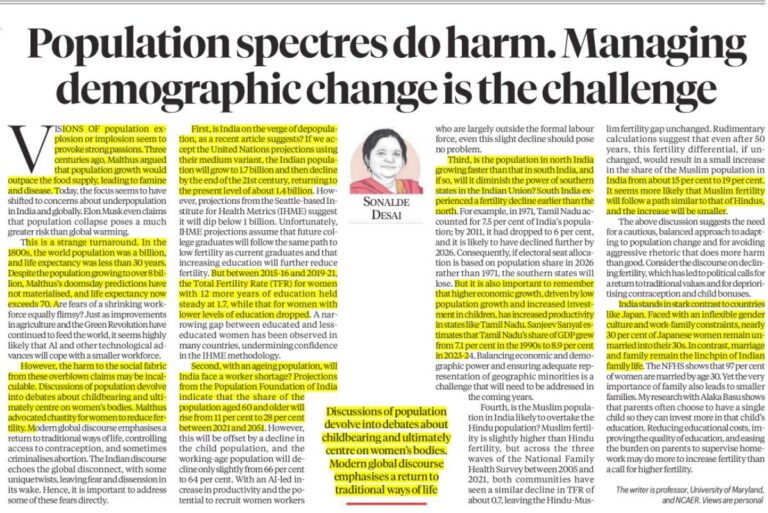
Debates on population growth in India often create fear, anxiety and political controversy. For centuries, thinkers have warned that rising population would outpace food supply and development. However, history shows that improvements in agriculture, health, education and technology have repeatedly helped societies manage demographic change. The real challenge today is not population panic, but building policies that respond to changing fertility, ageing, regional imbalance and workforce needs.
India’s Demographic Transition
India is no longer facing uncontrolled population growth. Fertility rates have declined sharply over the decades, and the country is gradually moving towards population stabilisation. The key question is whether India can use its demographic advantage before ageing becomes a major concern.
Role of Women’s Education
Women’s education plays a major role in lowering fertility rates. Evidence shows that educated women tend to marry later, have fewer children and invest more in child health and education. Therefore, improving female education, employment and healthcare is more effective than coercive population control.
Ageing and Workforce Challenges
India’s elderly population is expected to rise in the coming decades. This may increase pressure on healthcare, pensions and social support systems. However, India can manage this challenge by improving productivity, encouraging women’s workforce participation and investing in skill development.
A shrinking or ageing workforce should not automatically be seen as a crisis. With better technology, education and job creation, India can sustain economic growth even with demographic changes.
Regional and Social Dimensions
North-South Population Divide
Population growth is uneven across India. Northern states continue to have higher fertility rates compared to many southern states. This may affect political representation, resource allocation and federal balance in the future.
Avoiding Communal Narratives
Population debates often wrongly target specific communities. Such narratives create fear and social division. Fertility decline is happening across religious groups, and differences are narrowing over time. Policies must therefore focus on education, health and economic opportunity rather than blame.
Conclusion
Population change is a policy challenge, not a social threat. India must avoid fear-driven narratives and focus on managing demographic transition through education, healthcare, women’s empowerment, jobs and social security. For UPSC aspirants, this topic is important under population studies, social justice, governance, gender, demography and inclusive development.
Vocabulary Boost
• Total Fertility Rate (TFR) → Average children per woman.
• Demographic Dividend → Growth from a larger working-age population.
• Population Ageing → Rising share of elderly population.
• Depopulation → Declining population size.
• Replacement Fertility → TFR needed to maintain population (~2.1).
Frequently Asked Questions (FAQs)
What is demographic change?
Demographic change refers to shifts in population size, fertility rate, age structure, workforce and regional population distribution.
Is India facing uncontrolled population growth?
No. India’s fertility rate has declined significantly, and the country is moving towards population stabilisation.
Why is women’s education important in population management?
Women’s education helps reduce fertility, delays marriage, improves child health and supports better family planning decisions.
What is the North-South demographic divide?
Northern states generally have higher population growth than southern states, which may affect representation, resources and federal balance.
Why is this topic important for UPSC?
It is important for UPSC under population studies, social justice, gender, governance, demography and inclusive development.