Table of Contents
ToggleCentral Industrial Security Force (CISF) – Guardian of India’s Strategic Assets
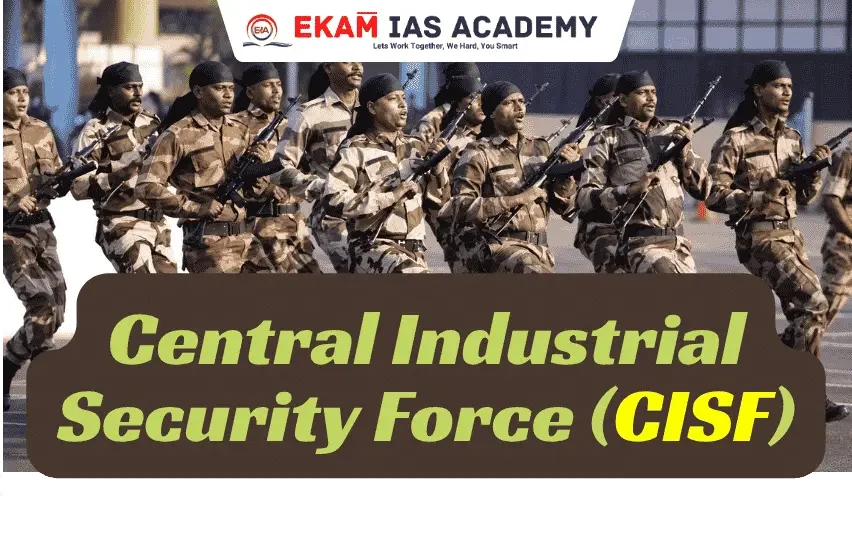
In the modern security landscape, safeguarding critical national infrastructure requires specialized protection that balances physical security with economic continuity. The Central Industrial Security Force (CISF) is India’s premier multi-dimensional security agency, protecting the vital economic and strategic assets of the nation. From high-tech space installations and nuclear power plants to bustling airports and major metro networks, the CISF serves as the shield protecting India’s key infrastructure.
Historical Background
The CISF was established on March 10, 1969, under an Act of Parliament with a modest strength of around 2,800 personnel. Following the rapid diversification of industrial threats, a subsequent amendment in June 1983 officially converted the CISF into an armed force of the Union.
| Level / Sector | Responsibility |
|---|---|
| Ministry of Home Affairs (MHA) | Administrative Ministry |
| Director General (DG) – IPS | Head of the Force |
| Executive Sector | Power, Steel, Space, Seaports, Delhi Metro |
| Aviation Sector | 72+ Airports and BCAS Coordination |
Organizational Structure
Administratively, the Central Industrial Security Force (CISF) is one of the premier CAPFs (Central Armed Police Forces) functioning under the Ministry of Home Affairs (MHA). It is headed by a Director General (DG), traditionally an Indian Police Service (IPS) officer. Structurally, the force is divided into distinct operational branches, including its specialized Fire Wing (the largest professional industrial fire-fighting force in South Asia) and the highly trained Special Security Group (SSG) for VIP protection.
Central Industrial Security Force Functions, Roles & Responsibilities
The CISF Role spans a wide array of protective and preventive mandates across both public and private sectors:
- Critical Infrastructure Protection: Providing physical security to sensitive installations, including space centers (ISRO), nuclear power plants (BARC), seaports, coal fields, and steel plants.
- Aviation Security: Managing total security across 72 civil airports in India. The CISF protects terminal perimeters, regulates access control, and conducts passenger screening.
- Urban Transit Protection: Securing massive rapid transit networks like the Delhi Metro Rail Corporation (DMRC).
- VIP and Parliament Security: In a major restructuring, the CISF was entrusted with the complete, multi-layered security of the Parliament House Complex.
- Consultancy Services: Offering specialized, paid security and fire protection consulting services to private sector entities (e.g., Infosys, Reliance).
Operational Importance & Coordination with Other Agencies
The operational importance of the CISF lies in its role as an economic shield. Any disruption to critical infrastructure—whether by sabotage, cyber-physical attacks, or industrial espionage—can cause massive financial losses and compromise national security.
To ensure seamless Aviation Security, the CISF coordinates with the Bureau of Civil Aviation Security (BCAS), which sets the national standards for civil flights. The CISF works alongside the Ministry of Civil Aviation, local state police forces, and intelligence agencies. This teamwork allows for real-time threat sharing and swift responses during emergencies, such as flight hijackings or bomb threats.
Modernization, Government Initiatives & Recent Developments
The government has launched several key initiatives to keep the CISF ahead of evolving threats:
- Expanded Aviation Mandate: Reflecting heightened security alerts, the BCAS expanded the CISF’s role to include direct oversight of cargo operations and the In-line Hold Baggage Screening System (ILHBSS).
- Tech Integration (Digi Yatra): The CISF has integrated facial recognition technology through programs like Digi Yatra. This speeds up passenger transit at Airport Security checkpoints while maintaining high security standards.
- Anti-Drone Systems: Deploying advanced drone-detection systems and radiofrequency jammers to counter aerial threats around airports and nuclear plants.
- Gender Mainstreaming: The CISF actively promotes female representation, especially at airports and metro stations where passenger interaction is high. This focus has led to a target of reserving up to 33% of constabulary posts for women.
Challenges Faced by the CISF
- Managing High Passenger Volumes: The rapid growth of domestic air travel forces the CISF to balance strict security screenings with smooth passenger flow.
- Emerging Cyber-Physical Threats: The shift toward smart grids and automation makes industrial facilities vulnerable to hybrid cyber-physical attacks.
- Public-Facing Friction: Unlike other CAPFs that operate in isolated border areas, the CISF operates in high-visibility, public-facing environments. This requires personnel to maintain constant vigilance while delivering polite, customer-friendly service.
CISF vs. Other Central Armed Police Forces
To understand how the CISF fits into India’s security framework, it is helpful to compare it to other CAPFs:
| Force Name | Primary Focus | Operational Environment | Primary Inter-Agency Partners |
| CISF | Critical Infrastructure Protection & Airport Security | Public-facing industrial units, airports, and urban metro systems | BCAS, Ministry of Civil Aviation, and State Police |
| ITBP | Border Security (Indo-China LAC) | Remote, high-altitude alpine terrain | Indian Army and local border communities |
| BSF | Border Security (Pakistan & Bangladesh) | Deserts, riverine systems, and open plains | Customs, Narcotics Control Bureau, and State Police |
Way Forward
To strengthen India’s Industrial Security in India, the CISF must prioritize upgrading its technological capabilities. Implementing AI-driven video analytics, automated baggage screening, and advanced cybersecurity protocols will reduce the reliance on manual physical checks and lower human error. Integrating the CISF’s fire wing with regional disaster management frameworks will also improve responses during industrial accidents.
Conclusion
In conclusion, the Central Industrial Security Force (CISF) is a vital pillar of India’s Internal Security architecture. By adapting to modern security needs, utilizing advanced technology, and protecting critical infrastructure, the CISF ensures that India’s economic growth remains safe and resilient.
UPSC Prelims: PYQs & Practice Questions
Previous Year Questions (Prelims)
Q: The Ministry of Home Affairs manages the deployment of several security forces. Which of the following forces has a specialized, dedicated statutory mandate primarily to provide security cover to sensitive public sector undertakings and critical infrastructure of India?
(a) National Security Guard (NSG)
(b) Border Security Force (BSF)
(c) Central Industrial Security Force (CISF)
(d) Indo-Tibetan Border Police (ITBP)
Answer: (c) Central Industrial Security Force (CISF)
Explanation:
The Central Industrial Security Force (CISF) was established under the CISF Act, 1968 and was formally converted into an armed force in 1983. It was created specifically to protect industrial undertakings and later expanded its mandate to secure critical infrastructure such as nuclear plants, space facilities, and airports.
Other forces have distinct mandates: the BSF and ITBP protect borders, while the NSG functions as a specialized federal counter-terrorism unit.
Q: With reference to civil aviation and airport security in India, consider the following statements:
1. The Bureau of Civil Aviation Security (BCAS) acts as the regulatory authority for civil aviation security standards in India.
2. The operational execution of security protocols at major domestic and international airports is carried out by the Central Industrial Security Force (CISF).
Which of the statements given above is/are correct?
(a) 1 only
(b) 2 only
(c) Both 1 and 2
(d) Neither 1 nor 2
Answer: (c) Both 1 and 2
Explanation:
Statement 1 is correct. The BCAS, originally set up as a cell in the DGCA and later reorganized as an independent department under the Ministry of Civil Aviation, is the apex planning, policy, and regulatory body for aviation security in India.
Statement 2 is correct. While BCAS defines policy and security standards, the CISF is the ground force deployed for airport security, perimeter vigilance, passenger screening, and operational security management across major Indian airports.
Practice Questions
Q: The operational and functional landscape of the Central Industrial Security Force (CISF) has undergone significant changes in recent years. In this context, consider the following statements:
1. In a major internal security restructuring, the complete security of the Parliament House Complex was transferred from the Delhi Police to the CISF.
2. The CISF is authorized to extend its security consulting and physical protection services to private sector enterprises on a commercial basis.
3. The CISF Fire Wing is the largest professional industrial firefighting force in South Asia.
Which of the statements given above are correct?
(a) 1 and 2 only
(b) 2 and 3 only
(c) 1 and 3 only
(d) 1, 2 and 3
Answer: (d) 1, 2 and 3
Explanation:
Statement 1 is correct. Following a security breach at the Parliament, the Ministry of Home Affairs transferred the security of the Parliament House Complex from the Delhi Police and other joint groups to the CISF to streamline access control.
Statement 2 is correct. Following a 2009 amendment, the CISF role was expanded to provide security and professional consultancy services to the private sector, including major industrial and corporate establishments, on a paid basis.
Statement 3 is correct. The CISF maintains a highly specialized Fire Wing with over 8,000 personnel, making it the largest professional industrial firefighting force in South Asia.
Q: The Government of India has initiated a transition toward a more integrated approach to protecting national maritime assets. Consider the following statements:
1. The recently approved Bureau of Port Security (BoPS) is designed to coordinate security policies across all major Indian ports.
2. Under new maritime guidelines, the CISF is the primary agency tasked with licensing and training private security guards deployed at commercial ports.
Which of the statements given above is/are correct?
(a) 1 only
(b) 2 only
(c) Both 1 and 2
(d) Neither 1 nor 2
Answer: (c) Both 1 and 2
Explanation:
Statement 1 is correct. The Bureau of Port Security (BoPS) acts as a single statutory body designed to enforce the International Ship and Port Facility Security (ISPS) Code across major Indian ports.
Statement 2 is correct. In a move to optimize port security, only licensed private security guards trained by the CISF are to be deployed at port facilities to ensure high standards of Critical Infrastructure Protection.
UPSC Mains – Previous Year & Practice Questions
Mains Previous Year Questions
UPSC CSE 2017 | GS-3
Question: Analyze the vulnerability of India's critical infrastructure to asymmetric warfare threats and evaluate the preparedness of specialized forces like the CISF.
Marks: 15 Marks | Word Limit: 250 Words
UPSC CSE 2019 | GS-3
Question: The mandate of the Central Industrial Security Force (CISF) has expanded from mere industrial security to urban transit and VIP protection. Critically analyze the challenges arising from this multi-dimensional role.
Marks: 10 Marks | Word Limit: 150 Words
UPSC CSE 2021 | GS-3
Question: Discuss the security challenges faced by the aviation sector in India. Highlight the role played by the Central Industrial Security Force (CISF) and the Bureau of Civil Aviation Security (BCAS) in securing our airports.
Marks: 15 Marks | Word Limit: 250 Words
UPSC CSE 2023 | GS-3
Question: With the physical and digital systems of critical installations becoming increasingly interconnected, how prepared are our Central Armed Police Forces (CAPFs) to counter hybrid threats targeting Indian infrastructure?
Marks: 15 Marks | Word Limit: 250 Words
UPSC CSE 2024 | GS-3
Question: Industrial security is no longer confined to physical guarding; it has transitioned to cyber-physical defense systems. In this light, examine the modernization requirements of the Central Industrial Security Force (CISF).
Marks: 10 Marks | Word Limit: 150 Words
Mains Practice Questions
[15 Marks | 250 Words]
Question: “The recent transition of the Parliament House Complex security to the Central Industrial Security Force (CISF) reflects a strategic shift from localized policing to specialized, unified command architectures.” Analyze the administrative and operational significance of this transition.
[15 Marks | 250 Words]
Question: “Balancing commercial facilitation with stringent physical security is the core challenge of modern Aviation Security.” Evaluate how the integration of advanced technologies like AI-driven facial recognition and automated baggage screening by the CISF helps resolve this dilemma.
[10 Marks | 150 Words]
Question: “The expansion of the CISF's mandate to secure private-sector enterprises has generated concerns over the commercialization of public armed forces.” Discuss this statement and assess the merits of the CISF's revenue-earning consultancy model.



Central Industrial Security Force (CISF)-FAQs
What is the Central Industrial Security Force?
The Central Industrial Security Force is a Central Armed Police Force responsible for protecting India’s critical infrastructure, airports, metro systems, industrial units and strategic establishments.
When was CISF established?
CISF was established on March 10, 1969, under an Act of Parliament.
What is the main role of CISF?
The main role of CISF is to provide security to critical infrastructure such as airports, nuclear plants, space centres, seaports, power plants, metro systems and government buildings.
Why is CISF important for airport security?
CISF manages access control, passenger screening, terminal security and emergency response at major civil airports in India.
Why is CISF important for UPSC GS 3?
CISF is important for GS 3 Internal Security because it connects critical infrastructure protection, aviation security, industrial safety, disaster response and CAPFs.