
Table of Contents
ToggleAI Tutor for Every Child in India: Building a Public Digital Learning Platform
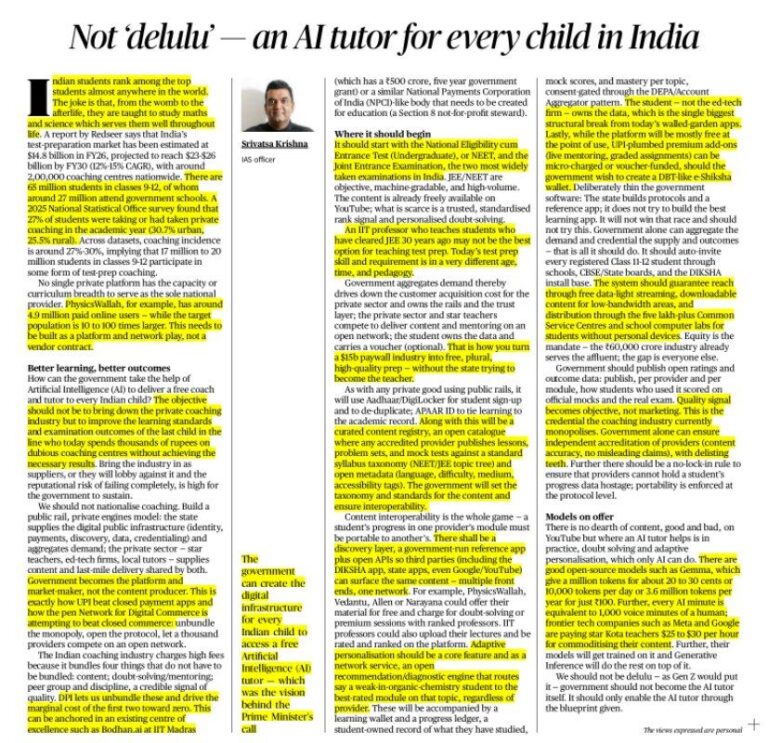
Artificial Intelligence could transform Indian education by making personalised learning accessible to every student, regardless of income or location. The article proposes a government-supported AI tutor for every child in India, built as digital public infrastructure rather than as another commercial ed-tech platform.
Why India Needs AI-Based Personalised Learning
India has millions of students competing for school and entrance examinations, creating a large dependence on private coaching. However, access to quality teaching remains unequal, especially for students in rural and low-income households.
An AI-powered tutor could provide continuous explanations, practice questions, feedback and personalised remediation based on each learner’s weaknesses. The goal should not be to replace teachers but to ensure that every student receives additional academic support.
Government as Platform, Not Coaching Provider
The article argues that the government should not create a single State-controlled AI tutor. Instead, it should build the digital infrastructure and standards that allow multiple educational providers and AI models to compete.
This approach could function like India’s existing Digital Public Infrastructure ecosystem. Identity through Aadhaar, credentials through DigiLocker, interoperable academic records and open educational content could form the foundation.
Where Should the AI Tutor Begin?
A practical starting point would be highly structured examinations such as NEET and JEE, where syllabi, questions and learning outcomes can be clearly measured.
The system could include:
- Personalised study plans and adaptive learning
- Topic-wise mastery tracking
- Practice tests and mock examinations
- AI-generated explanations and remediation
- Multilingual learning support
- A portable student learning record
Ensuring Quality, Safety and Equal Access
Government must establish independent benchmarks for accuracy, learning outcomes, safety and model performance. Platforms should provide transparent ratings rather than allowing marketing claims to determine quality.
The article also stresses universal access. AI tutoring should work across low-bandwidth networks and affordable devices, with multilingual content and distribution through public educational institutions.
Open-Source AI and Affordable Education
Modern open-source AI models could significantly reduce the cost of delivering personalised tutoring at scale. Instead of depending entirely on expensive proprietary systems, India can encourage competition among multiple AI providers while maintaining common standards.
Conclusion
An AI tutor for every child could become a major step towards democratising quality education in India. The government’s role should be to create trusted digital infrastructure, ensure interoperability and measure learning outcomes—not monopolise educational content.
If designed around equity, competition, privacy and measurable learning, AI can supplement teachers and give millions of students access to personalised academic support.
Vocabulary
1. AI Tutor – Personalised digital learning assistant
2. Interoperability – Ability of different systems to work together
3. Open Protocol – Common standards enabling multiple providers
4. Adaptive Learning – Learning tailored to student performance
5. Digital Public Infrastructure (DPI) – Shared digital rails for public services
Frequently Asked Questions (FAQs)
What is an AI tutor for students?
An AI tutor is an artificial intelligence-based learning system that provides personalised explanations, practice questions and feedback. It can adapt learning material according to a student’s progress and weaknesses.
How can AI improve education in India?
AI can provide affordable and personalised learning at scale, especially for students who lack access to quality coaching. It can also support multilingual education and continuous assessment.
Should the government develop its own AI tutor?
The article suggests that the government should primarily build the digital infrastructure and standards. Multiple private and open-source providers could then offer AI tutors through an interoperable ecosystem.
Why can NEET and JEE be starting points for AI tutoring?
NEET and JEE have clearly defined syllabi, objective questions and measurable outcomes. This makes it easier to benchmark AI tutors and evaluate whether they actually improve student learning.
Can AI tutors replace teachers?
AI tutors should supplement rather than replace teachers. Teachers provide mentorship, emotional understanding and classroom interaction, while AI can offer personalised practice and academic support at scale.
Source From : The Hindu
Youth Employment in India: Why Creating Good Jobs Is Essential
India’s young job seekers are not merely looking for employment; they increasingly want stable, salaried and meaningful career opportunities. A survey of more than 3,000 young men and women in Delhi highlights a growing mismatch between youth job aspirations and the realities of India’s labour market. This makes the creation of good-quality jobs a critical economic and social priority.
What Do Young Job Seekers Want?
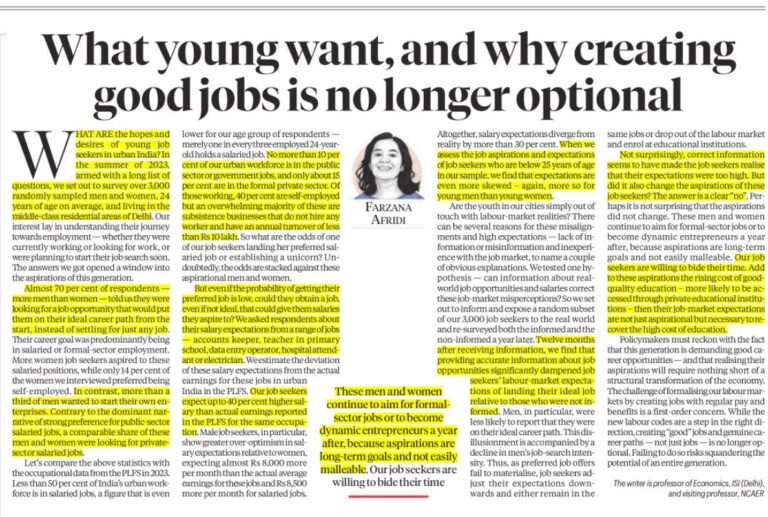
The survey found that nearly 70% of respondents wanted their first job to place them directly on their ideal career path rather than accepting any available employment.
Salaried and formal-sector jobs emerged as the dominant preference. Women showed a particularly strong preference for salaried employment, while more than one-third of male respondents expressed interest in entrepreneurship.
Interestingly, private-sector salaried jobs were also widely preferred, challenging the assumption that young Indians primarily seek government employment.
The Gap Between Aspirations and Labour Market Reality
According to the article, fewer than half of India’s urban workers are in salaried employment. Opportunities are even more limited for younger workers.
A significant mismatch also exists between expected and actual salaries. For occupations such as teachers, accountants, technicians and electricians, surveyed job seekers expected salaries considerably higher than prevailing earnings.
In some cases, expected salaries were around 40% higher than actual earnings for comparable occupations.
Can Better Job Information Help?
Researchers tested whether providing accurate information about employment opportunities and salaries could improve job-search decisions.
After one year, participants who received better labour-market information had more realistic salary expectations and were more likely to progress towards suitable employment than those who did not receive such information.
However, information did not fundamentally change their long-term career aspirations.
Why India Needs More Good Jobs
Young people are often willing to wait for employment that matches their education and career ambitions. Rising educational investment also means many expect jobs that justify the financial and personal cost of obtaining qualifications.
Therefore, merely creating any employment is insufficient. India requires formal, well-paying jobs with career progression, stability and social security.
Conclusion
India’s employment challenge is increasingly about the quality of jobs, not simply their number. Better labour-market information can reduce unrealistic expectations, but it cannot substitute for genuine opportunities.
Creating good jobs with regular wages, career pathways and secure working conditions is essential to harness India’s demographic potential and prevent educated youth from becoming discouraged or leaving the labour market.
Vocabulary
1. Good Jobs – Secure, adequately paid employment
2. Job Aspirations – Desired career outcomes
3. Expectation Gap – Difference between expected and actual outcomes
4. Formal Employment – Jobs with recognised employment protections
5. Labour-Market Information – Information on jobs, wages and opportunities
Frequently Asked Questions (FAQs)
What kind of jobs do young Indians prefer?
Many young job seekers prefer formal, salaried employment with career growth. The survey found that most respondents wanted their first job to align with their long-term career goals.
Why is there a mismatch between youth aspirations and available jobs?
Formal salaried jobs remain limited compared with the number of job seekers. Young workers also often expect salaries higher than prevailing labour-market wages.
Can labour-market information improve employment outcomes?
Yes. Providing accurate information about salaries and job opportunities can make expectations more realistic and help job seekers make better employment decisions.
Do young Indians only prefer government jobs?
No. The article finds that a significant proportion of young people are also interested in private-sector salaried employment, while many men show an interest in entrepreneurship.
Why is creating good jobs important for India?
Good jobs provide stable incomes, career progression and economic security. They are essential for converting India’s large young population into productive human capital.