

Table of Contents
ToggleAI TUTOR FOR EVERY CHILD
TOPIC: (GS2) POLITY: THE HINDU
Recently, Parliament and policy circles have discussed the idea of a national AIenabled tutor platform to provide free coaching for exams like NEET and JEE, reducing dependence on costly private centres.
India’s Coaching Landscape
- India’s testprep market valued at $14.8 billion in FY26, projected to reach $23–26 billion by FY30 (Redseer Report).
- Around 2 lakh coaching centres nationwide, serving nearly 17–20 million students in classes 9–12.
- 27% of students reported attending private coaching (NSO Survey 2025).
- Platforms like PhysicsWallah have 4.9 million paid users, far below the national demand.
Government’s Proposed Model
- Public rails, private engines: government builds digital infrastructure, private sector delivers content, mentoring, innovation.
- Digital Public Infrastructure – Aadhaar, DigiLocker, APAAR ID used for signup, credentialing, and verification, authentication, portability.
- Open content registry: accredited providers publish lessons, mock tests, problem sets with standards, taxonomy, transparency.
- Discovery layer: multiple apps (DIKSHA, state apps, YouTube) access the same content ensuring reach, accessibility, uniformity.
- Adaptive personalisation : AI directs weak students to bestrated modules for learning, mastery, improvement.
Benefits of AIEnabled Tutoring
- Equity: Free access for rural and poor students, bridging digital divide.
- Cost reduction: Marginal cost of content and doubtsolving driven toward zero.
- Transparency: Government publishes open ratings and outcome data per provider.
- Portability: Student progress transferable across platforms, avoiding lockin.
- Scalability: AI models like Gemma offer millions of tokens at low cost.
- Efficiency: AI tutoring equivalent to thousands of human teaching minutes.
Challenges
- Weak digital infrastructure in rural areas; 45 crore Indians lack reliable internet (TRAI 2025).
- Risk of lobbying by private coaching giants against open platforms.
- Quality assurance requires independent accreditation of all content providers.
- Teacher adaptation is difficult as traditional pedagogy may not suit AIdriven prep.
- Data privacy must ensure studentowned progress records under the DEPA framework.
Way Forward
- Expand reach through Common Service Centres, school labs, and offline content.
- Anchor platform in centres of excellence like Bodhan.ai at IIT Madras (₹500 crore grant).
- Ensure independent audits, student feedback, and performance tracking for quality.
- Diversify providers include edtech firms, star teachers, IIT professors.
- Guarantee nolockin rules and enforce portability at protocol level.
- Integrate AIdriven diagnostics for personalised learning pathways.
Conclusion
An AI tutor network can transform India’s $60,000 crore coaching industry into a free, equitable, and highquality learning ecosystem, ensuring the last child in line is not left behind.
INDIA’S INDUSTRIAL SLOWDOWN
TOPIC: (GS3) ECONOMY: THE HINDU
Recently, India’s Index of Core Industries (ICI) growth slowed to 5.4% in July 2026, down from 6% in June, reflecting weak demand conditions and rising external vulnerabilities.
Industrial Performance Trends
- ICI growth at 5.4% in July, secondhighest in seven months but largely baseeffect driven.
- Coal sector grew 7.6% (11month high) but on last year’s contraction of 12.3%.
- Refinery products rose 2.7% after three months of contraction, again baseeffect dependent.
- Iron ore robust at 29.5%, slower than June’s 44.5%, yet stronger than last year’s contraction.
- Steel sector slowed sharply to 2.9% from 15.7% in July 2025.
- Electricity sector grew 9%, lower than doubledigit growth in May–June due to heatwave demand.
- Cement sector accelerated to 13.1%, one of few bright spots.
Energy Dependence and External Risks
- Domestic crude oil and natural gas sectors contracted for 14 consecutive months.
- Crude oil imports rose 13.3% in July, LNG imports up 1.5%.
- Import bill surged 41% in July due to high global oil prices.
- U.S. preparing 100% tariffs on Russian oil imports, burdening Indian exporters.
- Ethanol blending at 20% target yet no significant reduction in oil imports.
Macroeconomic Indicators
- Manufacturing PMI fell to lowest since August 2021, signalling weak domestic demand.
- Growth momentum largely supported by statistical base effects, not structural strength.
- Rising import costs add pressure on Current Account Deficit (CAD) and inflation.
- Slack demand conditions visible across multiple industrial sectors.
Challenges
- Persistent contraction in crude oil and natural gas weakens energy security.
- Rising import dependence increases vulnerability to global price shocks.
- High tariffs and geopolitical risks threaten export competitiveness.
- Weak domestic demand reflected in PMI and core sector slowdown.
- Limited impact of ethanol blending on reducing oil import reliance.
Way Forward
- Diversify crude sources and strengthen strategic reserves (Petroleum Planning & Analysis Cell).
- Accelerate renewable energy adoption to reduce fossil fuel dependence.
- Enhance domestic exploration and production of hydrocarbons.
- Support demand revival through targeted fiscal measures and infrastructure push.
- Strengthen industrial competitiveness via technology upgrades and PLI schemes.
- Monitoring & evaluation through independent audits, student feedback, and performance tracking to ensure quality outcomes.
Index of Core Industries (ICI)
The ICI measures output in nine core sectors: coal, crude oil, natural gas, refinery products, fertilisers, steel, cement, electricity, and iron ore.
- These sectors together account for 40.27% of the weight in the Index of Industrial Production (IIP).
- The base year was recently revised to 202223, expanding coverage from eight to nine sectors with the inclusion of iron ore.
Conclusion
India’s industrial slowdown highlights the urgent need for energy diversification, demand revival, and structural reforms to safeguard growth in a volatile global environment.
RURAL–URBAN DIVIDE IN FEMALE LABOUR FORCE PARTICIPATION
TOPIC: (GS3) ECONOMY: THE HINDU
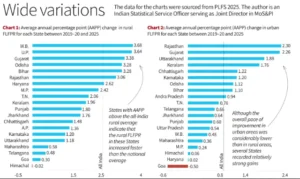
Recently, the Periodic Labour Force Survey (PLFS) 2025 highlighted a sharp rise in Female Labour Force Participation Rate (FLFPR), with rural areas showing stronger gains than urban regions.
National Trends
- Overall FLFPR (15+ years) rose from 30% in 201920 to 40% in 2025.
- Rural FLFPR increased from 33% to 45.9%, showing significant improvement.
- Urban FLFPR rose modestly from 23.3% to 27.7%, reflecting slower progress.
- Improvement linked to postCOVID livelihood shifts, agriculture absorption, and informal work expansion.
Statewise Rural Trends
- Aboveaverage gains: West Bengal, Uttar Pradesh, Gujarat, Odisha, Bihar, Rajasthan, Haryana.
- Belowaverage gains: Madhya Pradesh, Punjab, Jharkhand, Chhattisgarh, Uttarakhand, Maharashtra, Goa, Himachal Pradesh, southern States.
- States like Bihar and Uttar Pradesh started from low baselines but showed faster improvement.
- Odisha and Gujarat had higher baseline levels yet continued strong gains, proving growth is not basedependent.
Statewise Urban Trends
- Strong gains: Rajasthan, Gujarat, Uttarakhand, Bihar (low baseline but aboveaverage pace).
- Moderate gains: Kerala, Karnataka, Chhattisgarh, Odisha, Andhra Pradesh (already higher baseline, yet improving).
- Slower progress: Uttar Pradesh, Jharkhand, Haryana, Punjab despite low starting levels.
- Urban participation remains constrained by limited formal jobs and social norms.
Key Insights
- Rural women increasingly engaged in agriculture, selfhelp groups, and informal work.
- Urban women face barriers in formal sector entry, childcare, and workplace safety.
- AAPP (Average Annual Percentage Point change) must be read with baseline levels for accurate assessment.
- States with higher baseline FLFPR but slower AAPP still reflect saturation effects.
Challenges
- Quality of jobs remains poor; ILO 2024 report shows 70% women in informal work.
- Urban FLFPR stagnates due to low female representation in formal jobs (less than 20%).
- Skill mismatch persists; NSDC data highlights gaps in employability training.
- Social norms and safety concerns restrict women’s mobility in cities.
- Wage disparity continues; Gender Pay Gap Report 2025 shows women earn 20% less than men.
Way Forward
- Expand skill development and vocational training under Skill India Mission.
- Strengthen childcare and maternity support to enable urban participation.
- Promote womencentric entrepreneurship schemes via Mudra and StandUp India.
- Ensure safe transport and workplace conditions in urban centres.
- Enhance social security coverage for informal rural workers.
- Monitoring & evaluation through independent audits, student feedback, and performance tracking to ensure quality outcomes.
Working Age Population
- Refers to people aged 15 years and above (PLFS definition).
- Includes all individuals who are potentially available for work, whether employed or seeking employment.
Labour Force
- Comprises persons who are either employed or unemployed but actively seeking work.
- Excludes those not in labour force (students, homemakers, retired, disabled, etc.).
- Labour Force Participation Rate (LFPR) = (Labour Force ÷ Working Age Population) × 100.
Employment
- Persons engaged in economic activity (paid or unpaid) during the reference period.
- Includes selfemployed, regular wage/salaried, casual labour.
Unemployment
- Persons without work but seeking and available for employment.
- Unemployment Rate = (Unemployed ÷ Labour Force) × 100.
Not in Labour Force
- Individuals not seeking or not available for work.
- Includes students, homemakers, elderly, disabled, and discouraged workers.
Worker Categories
- Selfemployed: Own account workers, employers, unpaid family workers.
- Regular wage/salaried: Employees with fixed wages/salaries.
- Casual labour: Daily wage earners, contract workers.
Conclusion
Bridging the rural–urban divide in female labour participation is vital for inclusive growth and equitable development in India.
VANDE MATARAM AND THE RIGHT TO DISSENT
TOPIC: (GS2) POLITY: THE HINDU
Recently, Parliament passed the Prevention of Insults to National Honour (Amendment) Bill, 2026, extending criminallaw protection to Vande Mataram alongside the national anthem, raising debates on freedom of conscience and constitutional safeguards.
Constituent Assembly Background
- In 1950, Dr. Rajendra Prasad declared Jana Gana Mana as anthem and Vande Mataram as national song.
- Only the first two stanzas were recognised officially, avoiding devotional verses.
- The 1937 Congress resolution restricted usage to secular stanzas to maintain inclusivity.
Key Provisions of 2026 Amendment
- Punishes intentional prevention or disturbance of anthem or song singing.
- Penalty: up to 3 years imprisonment or fine, with minimum one year for repeat offences.
- No mandate to sing all six stanzas; no compulsory participation required.
- Protection applies to any version sung, without prescribing a fixed format.
Freedom of Conscience
- Later stanzas invoke Hindu goddesses Durga, Lakshmi, Saraswati, raising concerns for monotheistic faiths.
- Article 25 guarantees freedom of conscience and religious practice.
- Citizens cannot be compelled to join devotional recitations against their beliefs.
Supreme Court Precedent – Bijoe Emmanuel Case
- 1986 ruling protected Jehovah’s Witness students who refused to sing anthem.
- Court held silence with respect is not disrespect; freedom of conscience prevails.
- Fundamental duties under Article 51A cannot override fundamental rights under Part III.
- This precedent applies equally to Vande Mataram, especially its devotional verses.
Challenges
- Risk of misapplication of law leading to coercion in assemblies.
- Ambiguity over which stanzas are protected may cause disputes.
- Balancing patriotic sentiment with constitutional rights remains sensitive.
- Rising cultural pressures may marginalise minority faith practices.
- Lack of parliamentary debate raises concerns about legislative scrutiny.
Way Forward
- Clarify official recognition of secular stanzas in government notifications.
- Ensure awareness of Supreme Court rulings protecting silent dissent.
- Promote inclusive civic practices respecting India’s religious diversity.
- Independent audits and feedback to monitor misuse of law.
- Strengthen constitutional literacy through NCERT and civic education modules.
Conclusion
The 2026 amendment protects Vande Mataram from disruption but, guided by constitutional principles, ensures that patriotism cannot override freedom of conscience in a plural democracy.
MAURITIUS
TOPIC: (GS1) GEOGRAPHY: THE HINDU
Recently, India and Mauritius signed a longterm fuel supply agreement with Indian Oil Corporation Ltd. to meet Mauritius’s entire import requirement of petrol, diesel, and aviation turbine fuel.
Location and Strategic Importance
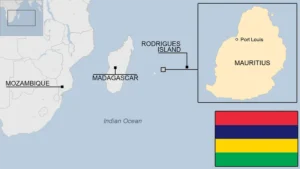
- Island nation in the Indian Ocean, southeast of Africa.
- Member of COMESA and SADC, enhancing regional trade links.
- Headquarters of Indian Ocean Rim Association (IORA) and Indian Ocean Commission located here.
- Capital city: Port Louis, a hub for trade and finance.
Geographical Features
- Part of the Mascarene Islands, formed by volcanic activity ~8 million years ago.
- Terrain includes main island and smaller ones like Ambre, Cerfs, Benitiers.
- Climate: maritime subtropical, with uniform temperatures yearround.
- Highest peak: Piton de la Petite Rivière Noire (828 m).
- Major rivers: Grand River South East and Black River.
- Key water source: Lake Vacoas.
India–Mauritius Relations
- Mauritius hosts a large Indian diaspora, strengthening cultural ties.
- India supports Mauritius through fuel supply, infrastructure projects, and defence cooperation.
- Strategic location makes Mauritius vital for India’s Indian Ocean security architecture.
- Collaboration in blue economy, renewable energy, and maritime connectivity.
Challenges
- Heavy dependence on imported fuel raises energy security risks.
- Vulnerability to climate change and rising sea levels.
- Limited diversification of economy beyond tourism and services.
- Need for stronger disaster resilience and sustainable resource management.
Conclusion
Mauritius remains a strategic partner in the Indian Ocean, with India’s fuel pact reinforcing both nations’ economic and security ties.

LONGTAILED MARMOT
TOPIC: (GS1) GEOGRAPHY: THE HINDU
Recently, the Shri Amarnath Ji Yatra brought thousands of pilgrims into fragile Himalayan ecosystems, home to the longtailed marmot, raising ecological concerns.
About the Species
- Belongs to the Sciuridae family, also called the golden marmot.
- Distinctive features: golden fur, long tail, robust body.
- Herbivorous diet, feeding on alpine vegetation.
- Diurnal and social, thrives in challenging alpine habitats.
- Hibernates from September to April/May to survive harsh winters.
Habitat and Distribution
- Found in alpine meadows and rocky slopes of high altitudes.
- Distribution spans Central and South Asia: Kyrgyzstan, Tajikistan, Kazakhstan, Afghanistan, Pakistan, China.
- In India, occurs in Jammu & Kashmir and Ladakh, between 3200–4850 m elevation.
- Closely linked to seasonal vegetation cycles of the Himalayas.
Conservation Status
- Listed as Least Concern on the IUCN Red List.
- Population stable but vulnerable to habitat disturbance and tourism pressure.
- Human activities like pilgrimage routes, grazing, and infrastructure projects threaten fragile ecosystems.
Challenges
- Habitat degradation due to tourism and pilgrimage influx in alpine zones.
- Climate change altering vegetation cycles and hibernation patterns.
- Increased humanwildlife conflict in pastoral landscapes.
- Limited ecological studies hinder effective conservation planning.
Way Forward
- Strengthen ecosensitive regulation of Himalayan pilgrimage routes.
- Promote communitybased conservation in Ladakh and Kashmir valleys.
- Enhance wildlife monitoring and ecological research under MoEFCC.
- Integrate climate adaptation strategies for alpine biodiversity.
- Monitoring & evaluation through independent audits, feedback, and performance tracking for conservation outcomes.
Conclusion
The longtailed marmot reflects the delicate balance of Himalayan ecosystems, demanding careful management of human activity to safeguard biodiversity.
TERRIER CYBER QUEST 2026 (TCQ 3.0)
TOPIC: (GS3) SCIENCE AND TECHNOLOGY: THE HINDU
Recently, the Territorial Army, in collaboration with CyberPeace, launched the third edition of Terrier Cyber Quest 2026 (TCQ 3.0), a nationallevel hackathon on cybersecurity and defence.
About TCQ 3.0
- National hackathon addressing cybersecurity, defence, and digital threats.
- Organised by the Territorial Army with CyberPeace, a civil society organisation.
- Participants include students, industry experts, researchers, government bodies, and Armed Forces.
- Aim: Develop technologybased solutions for emerging cyber and national security challenges.
Competition Tracks
- Bug Hunting: Identify flaws in simulated critical infrastructure; includes CapturetheFlag and live finals.
- AI Kavach: Use AI/ML to detect threats, unusual activity, and strengthen cyber defence.
- Creators Challenge: Digital campaigns against deepfakes, phishing, scams, misinformation.
Opportunities for Participants
- Showcase skills in realworld cybersecurity challenges.
- Winners may visit defence establishments and contribute to future initiatives.
- Builds synergy between civil society, academia, and defence forces.
Territorial Army
- Part of Indian Army; volunteers serve while retaining civilian jobs.
- Known as “Second Line of Defence”.
- Roles: relieve regular army from static duties, assist civil administration, support disaster relief.
- Motto: Savdhani Va Shoorta (Vigilance and Valour).
- Eligibility: Indian citizens, aged 18–42 years, graduates, physically fit, gainfully employed.
Challenges
- Rising cyberattacks: CERTIn 2025 report noted 13.9 lakh incidents in India.
- Shortage of skilled cybersecurity professionals in defence sector.
- Increasing threats from AIdriven malware and misinformation campaigns.
- Need for stronger collaboration between government, academia, and private sector.
Way Forward
- Expand hackathons to regional and school levels for wider talent pool.
- Integrate outputs into national cyber defence architecture.
- Strengthen publicprivate partnerships for cyber resilience.
- Monitoring & evaluation through independent audits, feedback, and performance tracking.
Conclusion
TCQ 3.0 reflects India’s resolve to harness youth innovation for national cyber defence, bridging civilmilitary collaboration in the digital age.