Table of Contents
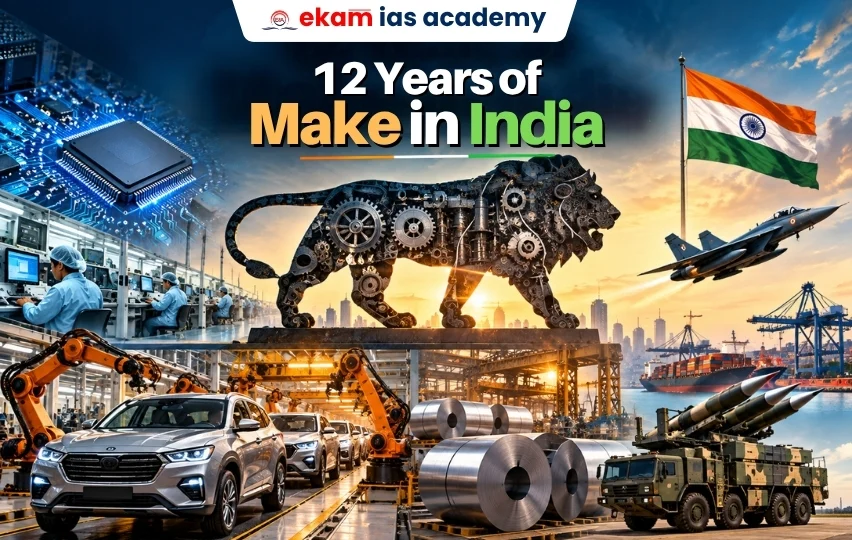
ToggleThe Make in India initiative, launched on 25 September 2014, has completed 12 years. The programme has helped expand India’s manufacturing capabilities in areas such as electronics, automobiles, pharmaceuticals, steel and defence. However, challenges remain in raising private investment, increasing exports and substantially improving manufacturing’s contribution to the economy.
Make in India: Objectives and Evolution
Make in India was introduced to transform India into a global hub for manufacturing, design and innovation. Its initial priorities included attracting investment, improving infrastructure, encouraging innovation and simplifying business processes.
The initiative has subsequently evolved into Make in India 2.0, covering 27 sectors, including 15 manufacturing and 12 services sectors. It is supported by measures such as PLI schemes, the National Single Window System, PM GatiShakti and the India Industrial Land Bank.
Manufacturing Growth and Sectoral Gains
India has witnessed significant expansion in manufacturing capacity. Manufacturing GVA recorded a 10.88% CAGR between 2022–23 and 2025–26 under the revised national accounts series.
Important sectoral developments include:
- Electronics: Production increased from about ₹1.9 lakh crore in 2014–15 to ₹13.11 lakh crore in 2025–26.
- Mobile manufacturing: Output rose from ₹18,000 crore to ₹6.27 lakh crore.
- Automobiles: Vehicle production reached about 31.03 million units in 2024–25.
- Steel: Crude steel production increased from 81.7 million tonnes in 2014–15 to around 170 million tonnes in 2025–26.
- Defence: Indigenous defence production rose to approximately ₹1.78 lakh crore in 2025–26.
These developments indicate growing domestic production capacity across both traditional and strategic industries.
Investment and PLI Schemes
The Production Linked Incentive (PLI) programme has become a major instrument for strengthening manufacturing. Across 14 sectors, PLI schemes had attracted more than ₹2.40 lakh crore of actual investment and generated over ₹22.66 lakh crore in production and sales, while supporting more than 14.15 lakh direct and indirect jobs as of March 2026. Exports exceeded ₹15.20 lakh crore.
However, investment remains concentrated in sectors such as electronics, pharmaceuticals, automobiles, solar modules and speciality steel.
Key Challenges
Despite improvements in manufacturing capacity, its overall economic share has increased only gradually. Manufacturing’s share in GVA stood at around 15.6% in 2025–26.
Key challenges include:
- Limited private-sector investment
- Uneven capacity utilisation
- Dependence on imported components
- Weak domestic value chains in several sectors
- Limited integration with global manufacturing networks
- Need for greater technology and R&D capabilities
Recent Policy Push
The next phase is increasingly focused on high-technology and strategic manufacturing. Semicon 2.0, approved in July 2026, has an outlay of ₹1,27,500 crore to strengthen semiconductor design, manufacturing, equipment, materials, R&D and talent.
Other initiatives are also targeting industrial parks, renewable-energy manufacturing and critical technologies.
Way Forward
India needs to move beyond increasing production volumes towards building competitive domestic value chains. Greater private investment, stronger component ecosystems, technology development, skilled manpower and deeper integration with global value chains will be crucial.
Conclusion
After 12 years, Make in India has significantly expanded India’s manufacturing base, particularly in electronics, automobiles, pharmaceuticals, steel and defence. The next challenge is to convert this increased capacity into higher value addition, stronger exports, greater private investment and technology-intensive employment. The future of Make in India therefore depends not only on producing more, but on producing competitively and integrating India more deeply into global manufacturing networks.


FAQs: 12 Years of Make in India
When was the Make in India initiative launched?
The Make in India initiative was launched on 25 September 2014 to transform India into a global hub for manufacturing, design and innovation.
What is Make in India 2.0?
Make in India 2.0 expands the initiative across 27 sectors, including 15 manufacturing and 12 services sectors, supported by measures such as PLI schemes, PM GatiShakti and the National Single Window System.
What are the major achievements of Make in India?
The initiative has supported significant growth in sectors including electronics, mobile manufacturing, automobiles, steel, pharmaceuticals and defence, contributing to increased domestic manufacturing capacity.
What is the role of PLI schemes in Make in India?
The Production Linked Incentive (PLI) programme supports manufacturing across 14 sectors by encouraging investment, increasing production and sales, generating employment and promoting exports.
What are the major challenges facing Make in India?
Key challenges include limited private investment, imported component dependence, uneven capacity utilisation, weak domestic value chains, limited global manufacturing integration and the need for stronger technology and R&D capabilities.