Table of Contents
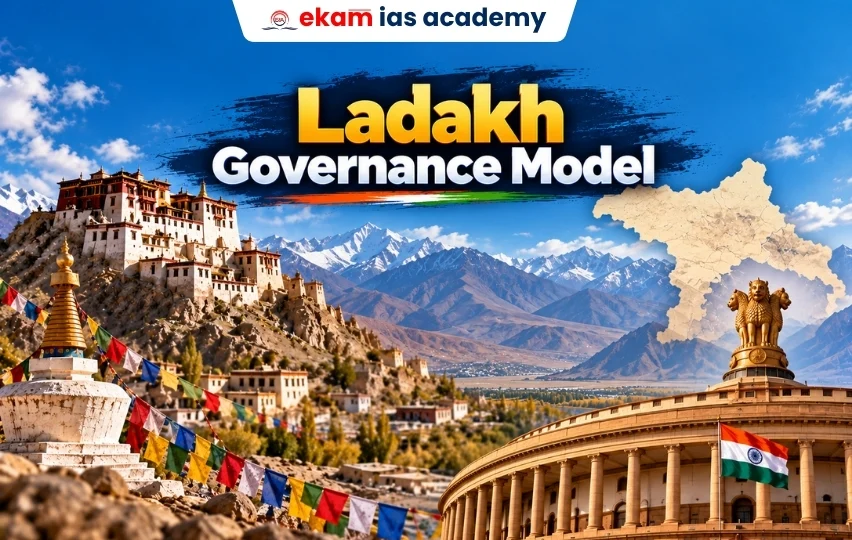
ToggleLadakh’s demand for greater constitutional safeguards has gained attention under the proposed Ladakh Governance Model, which includes a proposal for a directly elected legislative body through a new constitutional provision, Article 371-K. The debate focuses on protecting Ladakh’s cultural identity, land rights and local interests while retaining its status as a Union Territory without a Legislative Assembly.
Ladakh’s Governance Context
Ladakh became a Union Territory under the Jammu and Kashmir Reorganisation Act, 2019. Since then, local groups have sought stronger mechanisms for protecting language, culture, traditions, customary practices and land rights, along with greater political representation.
The Sixth Schedule has been a major demand because it provides constitutional mechanisms for autonomous governance in specified tribal areas.
About the Sixth Schedule
The Sixth Schedule operates through Articles 244(2) and 275(1) and currently applies to specified tribal areas in Assam, Meghalaya, Tripura and Mizoram.
It provides for Autonomous District Councils with powers relating to local governance. A District Council can have up to 30 members.
The broader objective is to enable tribal communities to participate more directly in decisions concerning their social, cultural and economic interests.
Why Does Ladakh Seek Greater Constitutional Protection?
The demand for stronger safeguards is linked to Ladakh’s distinctive geographical and cultural character. Key concerns include:
- Protection of local languages and traditions.
- Safeguarding customary practices.
- Protection of local land rights.
- Greater political representation.
- Greater participation in development and administrative decisions.
Proposed Article 371-K
Instead of directly extending the Sixth Schedule to Ladakh, the proposed framework involves inserting Article 371-K in Part XXI of the Constitution, which contains provisions relating to special arrangements for certain regions.
The proposal seeks to establish a directly elected legislative authority while retaining Ladakh’s Union Territory status.
The proposed institution could function alongside existing Ladakh Autonomous Hill Development Councils (LAHDCs), panchayats and other local institutions.
Key Issues Under the Proposed Model
Role of the Lieutenant Governor
The distribution of executive and administrative authority between the proposed legislature and the Lieutenant Governor would need clear definition.
Financial Powers
The extent of financial autonomy, including taxation, expenditure and control over resources, would be an important aspect of the proposed arrangement.
Existing Institutions
Clear division of responsibilities between the proposed legislative body, LAHDCs and panchayats would be necessary to prevent overlapping jurisdictions.
National Security
Ladakh’s strategic location makes national security and territorial administration important considerations while designing any new governance structure.
Can a Union Territory Have Special Constitutional Arrangements?
India’s constitutional system permits differentiated governance arrangements. For example, the National Capital Territory of Delhi has a special constitutional framework under Articles 239AA and 239AB.
Therefore, a separate constitutional provision for Ladakh could represent another example of differentiated governance within India’s constitutional framework.
Conclusion
The Ladakh governance debate reflects the challenge of balancing local democratic participation, cultural protection and national administrative responsibilities. Whether through the Sixth Schedule or a special provision such as proposed Article 371-K, the effectiveness of any model would ultimately depend on the clarity of its legislative, administrative and financial powers.


FAQs: Ladakh Governance Model
Why is Ladakh seeking greater constitutional safeguards?
The demand focuses on protecting Ladakh’s cultural identity, land rights, languages, traditions, customary practices and local interests, while also seeking greater political representation.
What is the Sixth Schedule of the Constitution?
The Sixth Schedule, under Articles 244(2) and 275(1), provides for autonomous governance in specified tribal areas of Assam, Meghalaya, Tripura and Mizoram through Autonomous District Councils.
What is the proposed Article 371-K for Ladakh?
The proposed Article 371-K would provide a special constitutional framework for Ladakh, including a directly elected legislative authority, while retaining Ladakh’s status as a Union Territory.
Would the proposed governance model replace the Ladakh Autonomous Hill Development Councils?
According to the article, the proposed legislative authority could function alongside the LAHDCs, panchayats and other local institutions. Clear division of responsibilities would be necessary to avoid overlapping jurisdictions.
What are the major issues in designing Ladakh’s proposed governance model?
Key issues include the powers of the Lieutenant Governor, financial autonomy, division of powers between institutions, local representation and national security considerations arising from Ladakh’s strategic location.