
Table of Contents
ToggleRIGHT TO INFORMATION AND TRANSPARENCY
TOPIC: (GS2) GOVERNANCE: THE HINDU
Tamil Nadu recently issued an order seeking to bring its Public (Law and Order) Department within the exemption framework of the RTI Act, before subsequently withdrawing the move.
RTI Act and Transparency
- The Right to Information Act, 2005 seeks to promote transparency and accountability by giving citizens access to information held by public authorities.
- It strengthens participatory democracy by enabling citizens to examine government decisions, expenditure and administrative functioning.
- However, the Act balances transparency with legitimate concerns such as national security, privacy and public order through specific exemptions.
Section 24: Special Exemption
- Section 24 permits specified intelligence and security organisations to remain outside the RTI framework.
- Even these organisations are not completely exempt: information relating to allegations of corruption and human-rights violations is subject to special disclosure provisions.
- The Second Schedule lists central intelligence and security organisations such as the IB, RAW, NIA and CBI.
- For State-level organisations, the relevant State Government can notify an organisation under the statutory procedure, with the notification required to be laid before the State Legislature.
challenges
- Broad exemptions: Public-order and security considerations must not automatically become grounds for withholding unrelated administrative information.
- Accountability: Excessive secrecy can reduce citizens’ ability to scrutinise public expenditure and administrative decisions.
- Balance: Sensitive operational information may legitimately require protection, while routine administrative information can remain accessible.
- Rule-based disclosure: Section 8 already provides several grounds for denying particular categories of information, making precise application important.
Strengthening Information Commissions
- Information Commissions are crucial for resolving second appeals and complaints when information is denied.
- Tamil Nadu increased the sanctioned strength of its State Information Commissioners from six to eight in December 2025, citing rising pendency and greater public awareness of RTI.
- The Commission’s official records also show substantial disposal of appeals in earlier years, demonstrating the importance of institutional capacity.
Way Forward
- Clearly distinguish genuine security-sensitive information from ordinary administrative matters.
- Strengthen Information Commissions through adequate staff, commissioners and digital case management.
- Improve proactive disclosure under Section 4 to reduce dependence on individual RTI applications.
- Maintain transparency while protecting legitimate interests such as security, privacy and confidential investigations.
Conclusion:
A mature RTI framework protects necessary secrecy while ensuring that public power remains answerable to citizens.
TACKLING FOOD LOSS AND WASTE IN INDIA
TOPIC: (GS3) ECONOMY: THE HINDU
September 29 is observed as the International Day of Awareness of Food Loss and Waste, with the 2026 focus on its transformative potential.
Food Loss and Waste in India
- Food loss: Reduction in food quantity or quality during production, harvesting, storage, processing and distribution before retail.
- Food waste: Food discarded mainly at retail, food-service and household levels.
- Globally, about 13% of food is lost between harvest and retail, while another 19% of food available to consumers is wasted.
- It is linked with SDG 12.3, which seeks to halve per-capita food waste and reduce food losses by 2030.
India’s Evidence Base
- The Ministry of Food Processing Industries (MoFPI) has conducted multiple national studies on post-harvest losses, covering different commodities and stages of the supply chain.
- However, systematic information on waste generated by households, hotels, restaurants and retail markets remains comparatively limited.
- Better data can help identify loss hotspots and direct public and private investment towards them.
Why Reducing Losses is important
- Food security: More of the food already produced reaches consumers.
- Nutrition: Reducing spoilage of fruits, vegetables and other perishables improves availability of nutritious food.
- Climate: Wasted food means wasted land, water, energy and labour; decomposing organic waste also generates methane.
- Farmer income: Better storage, processing and market access can reduce quantity and quality losses.
- Resource efficiency: Supports sustainable agriculture and circular-economy objectives.
Major Intervention Areas
- Farm-to-market infrastructure: Expand scientific storage, cold chains, drying and moisture-control systems.
- Processing: Promote food processing near production centres to increase shelf life and value addition.
- Digital solutions: Use traceability and data tools to identify supply-chain bottlenecks.
- Wholesale markets: Improve segregation, collection and treatment of organic waste.
- Circular economy: Convert unavoidable residues into compost, biogas, bio-CNG and biofertilisers.
Way Forward
- Surat: A wholesale-market facility processes about 50 tonnes of organic waste daily into compressed biogas and bio-fertiliser, demonstrating the potential of waste-to-resource models.
- Provide affordable finance for MSMEs, FPOs and farmers adopting loss-reduction technologies.
- Integrate food-loss reduction into agricultural, food-processing, urban and climate policies.
- Strengthen measurement across the entire chain, including consumer-level food waste.
Conclusion:
Reducing food loss and waste can simultaneously advance food security, farmer incomes, climate action and circular economic growth.
POOMPUHAR PORT AND ANCIENT INDIA’S MARITIME LINKS
TOPIC: (GS1) INDIAN ART AND CULTURE: THE HINDU
Recent underwater exploration off Poompuhar in Tamil Nadu has yielded a West Asian ceramic fragment and other remains.
Poompuhar: The Ancient Port City
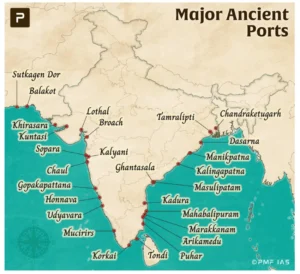
- Also known as Kaveripoompattinam, Poompuhar is located in Mayiladuthurai district, near the mouth of the Cauvery.
- It was an important early Chola port and is prominently mentioned in Sangam literature.
- The ancient settlement had three broad zones:
- Maruvurppakkam – coastal and commercial area.
- Pattinappakkam – inland residential area.
- Nalangadi – marketplace between the two.
Recent Underwater Discoveries
- An 18-day underwater exploration by the Tamil Nadu State Department of Archaeology and Indian Maritime University found:
- Fragment of a West Asian torpedo jar.
- Four terracotta ring wells.
- Over 250 ceramic fragments.
- Torpedo jars were used in ancient maritime trade to transport liquids such as wine and olive oil.
- The discovery provides material evidence of Poompuhar’s connections with West Asian maritime networks.
Evidence of a Global Trading Network
- Poompuhar functioned as a link between Indian, Southeast Asian, West Asian and Mediterranean trade routes.
- Historical evidence indicates movement of ships from Indian ports such as Tamralipti and Palur towards Southeast Asia and western markets.
- Sangam literature also describes Yavana traders and overseas commerce, indicating interaction between Tamilakam and the wider Indian Ocean world.
- Possible trade goods included textiles, spices, food products, precious items and horses.
Why Underwater Archaeology Matters
- Several archaeological remains suggest that parts of the ancient settlement are now submerged beneath the sea.
- Ring wells found underwater may indicate an ancient palaeochannel or freshwater system.
- Submergence could have resulted from a combination of coastal erosion, sea-level changes, storms and tsunami-related events.
- Literary traditions attribute the city’s destruction to divine intervention, but archaeology seeks evidence-based explanations.
Conclusion:
Poompuhar demonstrates how ancient Tamilakam was deeply integrated into the wider Indian Ocean trading world, while its submerged remains preserve an important maritime heritage.
IRDAI INSURANCE DISTRIBUTION REFORMS
TOPIC: (GS3) ECONOMY: THE HINDU
IRDAI has proposed changes to insurance commissions, distribution costs and expense limits through its consultation paper on insurance distribution.
Key Proposed Changes
- Commission caps: First-year commission in life insurance may be limited to 20% for distributors and 25% for agents.
- Expense of Management (EoM): IRDAI proposes reducing distribution and administrative expenses over five years to 12.5% of gross direct premium for life insurers and 20% for general insurers.
- The proposals aim to make insurers compete more on product quality, pricing and customer service, rather than incentives.
Why Reform Insurance Distribution?
- IRDAI has observed that distribution remuneration has increased faster than premiums in some channels.
- This can create incentives for agents or intermediaries to focus on selling new policies rather than suitability and long-term customer value.
- High upfront incentives may also contribute to mis-selling, policy switching and early policy lapses.
- Thus, regulation seeks to align the interests of insurers, intermediaries and policyholders.
Persistency: An Important Missing Link
- Persistency refers to the proportion of policyholders who continue their policies and pay premiums over time.
- A stronger framework could link part of distributor remuneration to long-term policy continuation.
- Possible approaches include:
- Deferring part of first-year commission.
- Linking payments to 13th- and 25th-month persistency.
- Recovering incentives when policies lapse prematurely.
Possible Impact
- Digital aggregators: Lower upfront commissions could affect customer-acquisition economics.
- Banks: Insurance distribution is an important cross-selling activity, so incentive-based models may need adjustment.
- Smaller insurers: Lower distribution margins could affect their ability to reach low-income and non-metro customers.
- Consumers: Greater transparency and reduced incentive-driven selling could improve product suitability.
Wider Insurance Sector
- India has substantial scope for insurance expansion despite growth in premiums.
- IRDAI’s Handbook on Indian Insurance Statistics 2024-25 provides detailed data on premiums, claims, distribution channels and market trends.
- The challenge is therefore to improve consumer protection without weakening accessibility, particularly in underserved regions.
Conclusion:
Insurance reforms should align distributor incentives with long-term consumer welfare while preserving affordable and inclusive insurance distribution.
ARTIFICIAL INTELLIGENCE AND THE QUESTION OF MACHINE CONSCIOUSNESS
TOPIC: (GS3) SCIENCE AND TECHNOLOGY: THE HINDU
Rapid advances in AI have intensified debate over whether increasingly capable machines could ever possess genuine subjective experience.
What is Machine Consciousness?
- Consciousness refers to subjective experience — the capacity to experience sensations, thoughts or feelings from a first-person perspective.
- AI systems can process information, recognise patterns, generate language and perform complex tasks, but human-like behaviour does not by itself establish consciousness.
- At present, there is no established scientific evidence that existing AI systems possess subjective experience.
Two Major Perspectives
- Functionalism: Consciousness may arise from the way information is organised and processed; therefore, a sufficiently complex artificial system could theoretically become conscious.
- Biological Naturalism: Consciousness may depend on specific biological processes of the brain and therefore may not be reproducible simply through computation.
- Recent research notes that biological approaches raise important questions but cannot currently establish that artificial consciousness is impossible.
Why Does It Matter?
- AI alignment: Highly autonomous systems must remain consistent with human-defined objectives and safety constraints.
- Accountability: Harm caused by autonomous AI raises questions about responsibility among developers, deployers and users.
- Moral status: If a machine were shown to experience suffering or pleasure, its ethical treatment could become a new issue.
- Human autonomy: Excessive dependence on AI-generated decisions could weaken independent reasoning and judgement.
- Existential risks: Advanced AI could create serious harms through poorly designed objectives even without being conscious.
Ethical Challenges
- Creating systems capable of suffering could raise questions about the morality of artificial suffering.
- Human-like voices, emotions and personalities may lead people to mistake convincing simulation for genuine experience.
- AI decisions in areas such as healthcare, policing or finance require clear attribution of responsibility.
Way Forward
- Human oversight: Keep ultimate responsibility with identifiable human actors.
- Interpretability and safety: Strengthen research on understanding, testing and controlling advanced AI.
- Ethical assessment: Evaluate potential social and human-rights impacts throughout the AI lifecycle.
- Clear accountability: India’s Responsible AI framework emphasises transparency, explainability and human supervisory control.
- Human-centred governance: UNESCO stresses human dignity, accountability, transparency and human oversight in AI governance.
Conclusion:
As AI becomes more human-like, governance must distinguish intelligent behaviour from consciousness while keeping human dignity and responsibility at the centre.
WEST BENGAL ANTI-GOONDA BILL, 2026
TOPIC: (GS2) GOVERNANCE: THE HINDU
The President has returned West Bengal’s Anti-Goonda Bill to the State Legislature for reconsideration under the constitutional procedure for reserved State Bills.
Key Provisions of the Bill
- The proposed law seeks to prevent activities considered harmful to public order, life, property and public safety.
- It provides for:
- Preventive detention for up to 12 months.
- Externment of persons from specified areas for a similar period.
- Search and seizure powers.
- Action against persons harbouring detainees or externed individuals.
- Cognizable and non-bailable offences.
- Its definitions of a “goonda” and “anti-social activity” cover habitual offenders and activities considered threatening to public order or public resources.
Constitutional Framework
- Public order is a State subject under the Seventh Schedule, giving States legislative competence in this area.
- Article 22 permits preventive detention but provides constitutional safeguards, including communication of grounds and review mechanisms.
- Preventive detention is an exception to ordinary criminal procedure, where punishment follows conviction after trial.
Governor–President Route
- Under Article 200, a Governor may reserve a State Bill for the President’s consideration; reservation is mandatory where a Bill would substantially undermine the constitutional position of the High Court.
- Under Article 201, the President may assent, withhold assent, or return a non-Money Bill through the Governor for reconsideration.
- If reconsidered and passed again, it is sent back to the President for further consideration.
Constitutional challenges
- Liberty vs public order: Broad preventive powers must be balanced against Articles 14 and 21.
- Overlapping laws: Provisions dealing with subjects already covered by central legislation can raise questions of repugnancy under Article 254.
- Judicial safeguards: Clear definitions and review mechanisms are important to prevent arbitrary detention.
- Federalism: The case illustrates the constitutional interaction between State legislative power and Presidential consideration of reserved Bills.
Broader Significance
- Similar preventive-detention laws exist in several States, including laws targeting goondas and other habitual offenders. Andhra Pradesh, for example, has the 1986 law dealing with dangerous activities of bootleggers, dacoits, goondas and others.
- The debate highlights the need to ensure that strong measures against organised or habitual crime operate within constitutional limits.
Conclusion:
Effective public-order legislation must combine preventive action with precise definitions, procedural safeguards, judicial review and respect for constitutional liberty.
INDIA’S FIRST LNG-POWERED TRAIN
TOPIC: (GS3) SCIENCE AND TECHNOLOGY: THE HINDU
Indian Railways has introduced its first LNG-powered train, using a diesel-LNG dual-fuel system.
Key Features
- The train was flagged off from Sabarmati, Gujarat.
- Two 1,400 HP Driving Power Cars (DPCs) at Sabarmati Integrated Coaching Depot have been converted for dual-fuel operation.
- LNG can substitute up to about 40% of diesel consumption under the system.
- This can help reduce fuel expenditure and emissions, including CO₂, nitrogen oxides and particulate matter.
What is LNG?
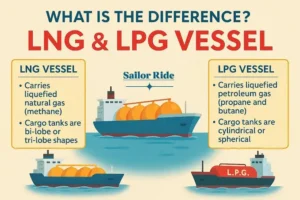
- Liquefied Natural Gas (LNG) is natural gas, mainly methane, cooled to around −162°C.
- At this temperature, gas becomes liquid and occupies nearly 600 times less volume, facilitating storage and transportation.
- India imports around half of its natural-gas requirement as LNG, making import diversification important for energy security.
Significance for Indian Railways
- Lower diesel dependence: Supports the gradual reduction of fossil-fuel consumption.
- Emission reduction: LNG generally produces lower local air pollutants than conventional diesel combustion.
- Cost efficiency: Partial substitution can reduce fuel costs where LNG is competitively available.
- Energy transition: Provides an intermediate option while railway electrification expands.
Challenges
- Import dependence: A substantial share of India’s LNG requirement is imported, exposing the sector to global prices.
- Infrastructure: LNG storage, refuelling and transportation facilities need wider development.
- Methane emissions: Methane leakage across production and supply chains can reduce the climate advantage of natural gas.
- Long-term transition: LNG remains a fossil fuel and cannot replace the need for renewable energy and railway electrification.
Way Forward
- Expand railway electrification and renewable-powered traction alongside cleaner transitional fuels.
- Develop reliable LNG infrastructure while improving energy-source diversification.
Conclusion:
LNG-powered trains can serve as a transitional measure, while electrification and renewable energy remain central to long-term railway decarbonisation.