
Table of Contents
ToggleLadakh Hill Councils
Why in News?
The Ladakh administration has announced the creation of Autonomous Hill Development Councils (AHDCs) in all seven districts of the Union Territory. This expands the hill council model beyond the existing councils of Leh and Kargil.
However, civil society groups in Ladakh have opposed the move, arguing that it may create fragmented authority while discussions on an Article 371-based constitutional framework are still ongoing.
What Has Been Announced?
The administration has proposed seven Autonomous Hill Development Councils for Ladakh.
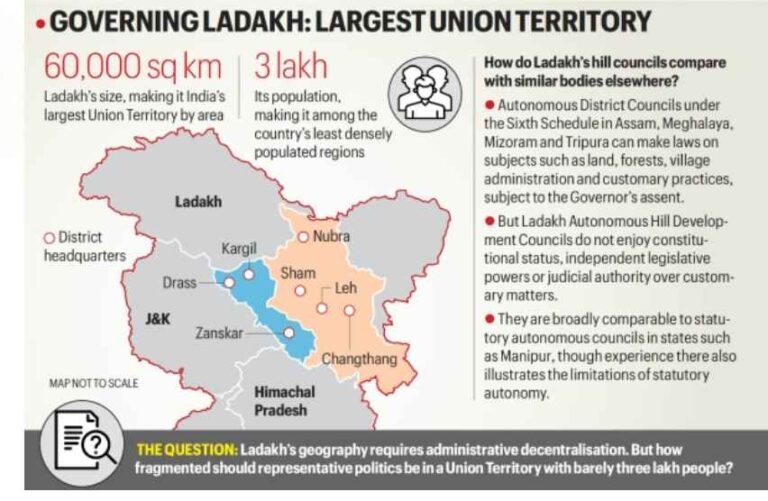
These include councils for:
- Leh
- Kargil
- Drass
- Sham
- Nubra
- Changthang
- Zanskar
The government has described this as a step towards democratic decentralisation and improved grassroots governance.
The move is considered legally possible under Section 3 of the Ladakh Autonomous Hill Development Council Act, 1997.
Why Decentralisation Matters in Ladakh
Ladakh is India’s largest Union Territory by area, covering around 60,000 sq km, but it has a very sparse population of nearly 3 lakh people.
Its villages are separated by difficult terrain, high mountain passes and harsh climatic conditions. This makes centralised administration difficult.
Decentralised governance is therefore seen as important for:
- Better service delivery
- Local planning
- Faster administrative response
- Representation of remote areas
- Development of border and mountain communities
Local groups in Ladakh have historically demanded stronger grassroots institutions and greater participation in decision-making.
Opposition from Civil Society
The proposal has been opposed by major civil society platforms such as:
- Apex Body Leh (ABL)
- Kargil Democratic Alliance (KDA)
Their main concern is that multiple councils may weaken the demand for a stronger and unified constitutional safeguard under Article 371.
They argue that the creation of seven councils may lead to institutional confusion rather than genuine empowerment.
Major Concerns Raised
Civil society groups have raised several concerns:
1. Weakening of Article 371 Demand
They fear that separate district councils may dilute the larger demand for a UT-level representative body with legislative and financial powers.
2. Institutional Overlap
There may be confusion between:
- Hill Councils
- Panchayats
- UT administration
- Lieutenant Governor’s office
- Proposed Article 371 authority
This could create governance overlap.
3. Weak Existing Councils
Existing councils in Leh and Kargil already face limited powers, reduced budgets and dependence on the UT administration.
Critics argue that creating more councils without strengthening existing ones may not solve the problem.
4. Trust Deficit
The opposition is also linked to a wider trust deficit after Ladakh became a Union Territory in 2019. Slow progress on constitutional safeguards, protests in Leh and concerns over district boundaries have added to public dissatisfaction.
Powers of Hill Councils: Paper vs Reality
| Aspect | On Paper | Ground Reality |
|---|---|---|
| Planning | District-level planning powers | Major decisions influenced by UT administration |
| Budget | Power to prepare and manage budgets | Financial dependence remains high |
| Land | Role in land management | Limited control after UT status |
| Taxation | Certain local taxation powers | Weak practical autonomy |
| Administration | Local governance role | Staff and authority remain limited |
The major criticism is that Ladakh is being offered more councils while the existing councils themselves remain weak.
Comparison with Sixth Schedule Councils
The Ladakh hill councils are different from the Sixth Schedule councils found in some North-eastern States.
Sixth Schedule councils enjoy constitutional protection and have powers related to legislation, administration, customary laws and local justice.
In contrast, the Ladakh Autonomous Hill Development Councils are statutory bodies created under an Act. They do not have the same level of constitutional protection.
This makes them closer to autonomous councils in States such as Manipur, where financial dependence and limited autonomy remain major concerns.
Article 371 Debate
The Centre and the Ladakh administration are also exploring a possible Article 371-based framework for Ladakh.
Such a framework may provide:
- A UT-level representative body
- Legislative powers
- Financial authority
- Protection of land and culture
- Greater local participation
Civil society groups argue that the focus should be on this broader constitutional framework rather than creating multiple district-level councils.
Conclusion
The announcement of seven Autonomous Hill Development Councils in Ladakh raises an important governance question: should Ladakh’s future be based on multiple district-level councils or a unified constitutional framework under Article 371?
While decentralisation is necessary for a geographically difficult region like Ladakh, it must be backed by real administrative, financial and legislative powers. Without clarity on constitutional safeguards, the seven-council plan may remain trapped in mistrust between the Centre, the UT administration and Ladakh’s civil society groups.



Ladakh Hill Councils-FAQs Answered
Why are Ladakh Hill Councils in news?
Ladakh Hill Councils are in news because the Ladakh administration has announced Autonomous Hill Development Councils in all seven districts, expanding beyond Leh and Kargil.
Which new districts will get Autonomous Hill Development Councils?
New AHDCs are proposed for Drass, Sham, Nubra, Changthang and Zanskar, in addition to the existing councils in Leh and Kargil.
Under which law can AHDCs be created in Ladakh?
AHDCs can be created under Section 3 of the Ladakh Autonomous Hill Development Council Act, 1997.
Why are civil society groups opposing the move?
Groups like Apex Body Leh and Kargil Democratic Alliance fear that seven councils may weaken the demand for a stronger Article 371-based framework and create institutional overlap.
How are Ladakh Hill Councils different from Sixth Schedule councils?
Sixth Schedule councils have constitutional protection and wider powers, while Ladakh Hill Councils are statutory bodies with limited autonomy and no constitutional protection.