
Table of Contents
ToggleAFSPA UPSC: Provisions, Powers and Current Status in Northeast India
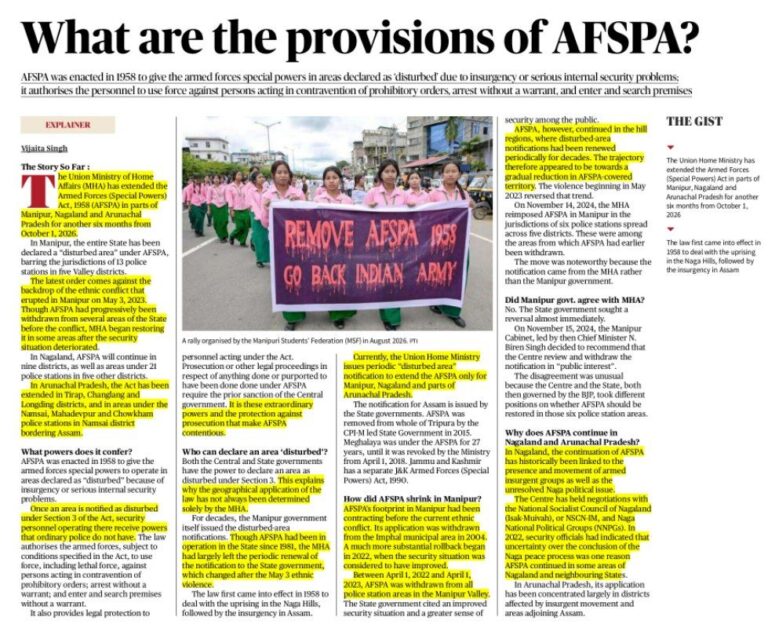
The Armed Forces (Special Powers) Act, 1958 (AFSPA) remains in focus as the Union Government has extended its application in designated areas of Manipur, Nagaland and Arunachal Pradesh for another six months from October 1, 2026. The latest notifications follow a review of the security and law-and-order situation.
What is AFSPA?
The Armed Forces (Special Powers) Act, 1958 was enacted to confer specified powers on members of the armed forces operating in areas declared as “disturbed areas.” The Act is particularly associated with counter-insurgency and internal-security operations in parts of Northeast India.
What is a “Disturbed Area”?
Under Section 3, the Governor of a State, Administrator of a Union Territory or the Central Government can declare the whole or part of a State or Union Territory as a disturbed area if it is considered to be in such a disturbed or dangerous condition that the use of armed forces in aid of civil power is necessary.
Key Powers under AFSPA
Section 4 provides specified powers to armed forces personnel in disturbed areas. These include:
- Using force, including potentially lethal force, in circumstances specified by the Act after giving due warning.
- Arresting without warrant under specified conditions.
- Searching without warrant in specified circumstances.
- Taking action against violations of certain prohibitory orders.
- Destroying arms dumps, fortified positions or structures used for armed attacks in circumstances covered by the Act.
The Act also contains procedural provisions. Section 5 requires a person arrested under the Act to be handed over to the officer-in-charge of the nearest police station with the least possible delay.
AFSPA in Northeast India
According to the latest notifications, most of Manipur remains a disturbed area, with 13 police-station jurisdictions excluded. In Nagaland, nine districts and specified areas under 21 police stations in five other districts remain covered. In Arunachal Pradesh, Tirap, Changlang and Longding districts, along with specified areas in Namsai district, remain covered. The notifications take effect from October 1, 2026 and remain valid for six months unless withdrawn earlier.
Why is AFSPA Important for UPSC?
AFSPA connects with several important UPSC Polity and Internal Security themes, including federalism, civil-military relations, human rights, insurgency, governance and Centre-State relations. Aspirants should understand the distinction between a disturbed-area declaration under Section 3 and the special powers under Section 4.
Conclusion
AFSPA represents a legal framework designed to enable armed forces to operate in areas facing serious security challenges. Its periodic extension and withdrawal also demonstrate how security assessments influence the geographical scope of the law. For UPSC preparation, the topic should be studied through the combined lens of internal security, constitutional governance, federalism and legal safeguards, while understanding the specific provisions of the Act.
Vocabulary
1. Disturbed Area – Area officially notified for application of AFSPA.
2. Insurgency – Organised armed challenge to state authority.
3. Prior Sanction – Government approval required before certain prosecutions.
Prelims MCQs
MCQ 1
Consider the following statements about AFSPA:
1. It operates in areas declared “disturbed”.
2. Only the Union Government can declare a disturbed area.
3. It permits arrest without warrant under specified conditions.
Which are correct?
A) 1 and 2 only
B) 1 and 3 only
C) 2 and 3 only
D) 1, 2 and 3
Answer: B
UPSC Mains Question
“AFSPA reflects the challenge of balancing national security with accountability and individual rights.” Discuss.
(10 Marks)
Frequently Asked Questions (FAQs)
What is AFSPA?
AFSPA is a 1958 law that provides specified special powers to members of the armed forces operating in areas declared as disturbed areas.
What is Section 3 of AFSPA?
Section 3 empowers the Central Government, Governor or Administrator, as applicable, to declare an area as a disturbed area when the statutory conditions are met.
What powers are provided under Section 4?
Section 4 provides specified powers including use of force, arrest without warrant and search without warrant in disturbed areas, subject to the conditions laid down in the Act.
Where is AFSPA applicable according to the latest update?
From October 1, 2026, designated areas of Manipur, Nagaland and Arunachal Pradesh continue under the disturbed-area framework for six months unless withdrawn earlier.
Why is AFSPA important for UPSC?
AFSPA is important for Polity, Internal Security, Federalism, Governance, Human Rights and civil-military relations, making it relevant for both Prelims and Mains.
Source From : The Hindu
J&K’s Evolving Status: From Article 370 to Union Territory
The constitutional and administrative status of Jammu & Kashmir (J&K) has evolved significantly, particularly after the constitutional changes of August 2019. The issue remains important for understanding Article 370, Article 35A, Union Territories, federalism and constitutional governance.
What was Article 370?
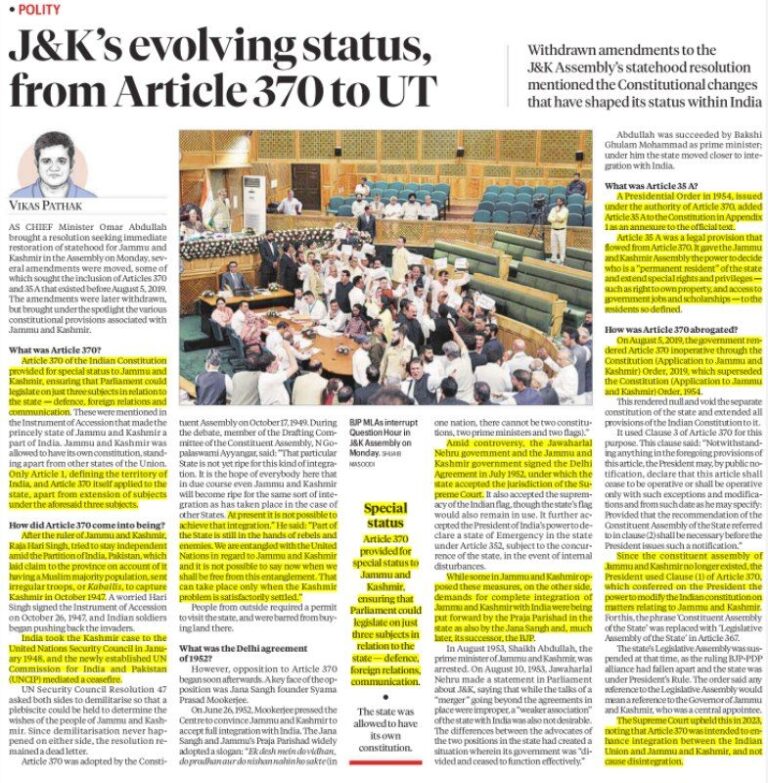
Article 370 provided special constitutional arrangements for Jammu & Kashmir. It governed the application of constitutional provisions to the region and gave the former State a distinct constitutional position.
The 1954 Presidential Order extended several provisions of the Indian Constitution to Jammu & Kashmir and was also associated with the introduction of Article 35A, which provided a framework concerning permanent residents and certain associated rights and privileges.
How did Article 370 change?
On August 5, 2019, constitutional measures were adopted that altered the earlier operation of Article 370. Parliament subsequently enacted the Jammu and Kashmir Reorganisation Act, 2019, providing for the reorganisation of the former State.
The reorganisation created two Union Territories:
- Union Territory of Jammu & Kashmir — with a Legislative Assembly
- Union Territory of Ladakh — without a Legislative Assembly
The Reorganisation Act provides the institutional framework for the administration of both Union Territories.
Supreme Court and Article 370
The constitutional changes were challenged before the Supreme Court of India. In its December 2023 judgment in In Re: Article 370 of the Constitution, the Court upheld the constitutional changes concerning Article 370 and upheld the creation of the Union Territory of Ladakh.
The judgment is significant for UPSC preparation because it connects constitutional interpretation, federalism, Article 3, Article 370 and the relationship between the Union and States/Union Territories.
Why is J&K Important for UPSC?
The evolution of J&K’s constitutional status provides an important case study in Indian Polity and Governance. Aspirants should understand the historical background of Article 370, the 1954 Presidential Order, the 2019 constitutional changes, the Jammu and Kashmir Reorganisation Act, 2019, and the Supreme Court’s 2023 judgment.
Conclusion
Jammu & Kashmir’s constitutional journey from the special arrangements associated with Article 370 to its present Union Territory framework represents a major development in India’s constitutional and federal structure. For UPSC aspirants, the topic should be studied not merely as a historical change but through the broader themes of federalism, constitutional governance, State reorganisation, Union–State relations and judicial review. Understanding this evolution helps connect constitutional provisions with their practical application in India’s changing political and administrative framework.
Vocabulary
1. Special Status – Distinct constitutional arrangements for a territory.
2. Presidential Order – Order issued by the President under constitutional authority.
3. Reorganisation – Alteration of a State’s territorial or administrative status.
Prelims MCQs
MCQ 1
Consider the following statements:
1. Article 370 concerned the constitutional relationship between J&K and the Union.
2. Article 35A originated through a Constitutional Amendment Act of Parliament.
3. The J&K Reorganisation of 2019 resulted in two Union Territories.
Which are correct?
A) 1 and 2 only
B) 1 and 3 only
C) 2 and 3 only
D) 1, 2 and 3
Answer: B
UPSC Mains Question
Trace the evolution of Jammu & Kashmir’s constitutional status from Article 370 to its reorganisation as a Union Territory.
(10 Marks)
Frequently Asked Questions (FAQs)
What was Article 370?
Article 370 provided special constitutional arrangements for Jammu & Kashmir and governed the application of constitutional provisions to the region.
What was Article 35A?
Article 35A, introduced through the 1954 Presidential Order, enabled the J&K legislature to define permanent residents and provide them with specified special rights and privileges.
What happened to Jammu & Kashmir in 2019?
The constitutional changes of August 2019 ended the earlier special constitutional arrangement and reorganised the former State into the Union Territories of Jammu & Kashmir and Ladakh.
What is the difference between J&K and Ladakh as Union Territories?
The Union Territory of Jammu & Kashmir has a legislature, while Ladakh does not have a legislature.
Why is Article 370 important for UPSC?
It is important for Indian Polity, Federalism, Constitutional Law, Union Territories, Presidential Orders, State Reorganisation and Supreme Court judgments.