
Table of Contents
TogglePopular Revolts in Mughal Empire UPSC
The surge of Popular Revolts under Mughal Empire rule during the late 17th century represented a profound agrarian and socio-political crisis. Under Emperor Aurangzeb, imperial administrative centralization, rising revenue demands, and ideological shifts triggered widespread regional uprisings. Mastering topics like the Jat Revolt UPSC, Satnami Revolt UPSC, and Sikh Revolt UPSC is essential for civil services aspirants covering Medieval Indian History UPSC.
Background of Popular Resistance under the Mughals
- Escalating state revenue assessments under the Zabt system placed extreme economic strain on rural peasants and regional landholders (Zamindars).
- Local agrarian communities began organizing along caste, tribal, and religious lines to resist aggressive imperial taxation and administrative overreach.
- Frequent military transfers and the growing Jagirdari crisis weakened local administrative control, creating opportunities for armed popular resistance.
Jat Revolt
- Sparked in 1669 around the Mathura-Agra region under the leadership of local Zamindar Gokula against harsh revenue extractions.
- Evolved under Rajaram and Churaman Jat into a sophisticated guerrilla insurgency targeting imperial trade routes and imperial communications.
- Established an independent political footprint in Bharatpur, posing a persistent threat to central imperial authority near Delhi.
Satnami Revolt
- Originated in 1672 in Narnaul as an armed uprising by the Satnamis, a egalitarian socio-religious sect comprising peasants, artisans, and low-caste groups.
- Triggered by a local conflict between a Satnami peasant and a Mughal foot soldier, quickly escalating into an open rebellion.
- Required Aurangzeb to deploy core imperial artillery and personal royal troops to suppress the fierce resistance.
Afghan Revolts
- Erupted along the strategic North-West frontier, led by tribal leaders such as Bhagu Khan (Yusufzai) and Khushal Khan Khattak.
- Motivated by a desire for tribal autonomy and resistance against imperial political interference and revenue collection.
- Tied down vast Mughal military resources in long, costly mountain campaigns, weakening imperial control in other provinces.
Sikh Resistance
- Transformed into an armed socio-political movement following the execution of Guru Tegh Bahadur in 1675 by Aurangzeb.
- Formalized under Guru Gobind Singh in 1699 with the creation of the Khalsa, a martial fraternity dedicated to opposing tyranny.
- Fought numerous battles against Mughal forces and local hill chieftains, laying the groundwork for a sovereign Sikh state in Punjab.
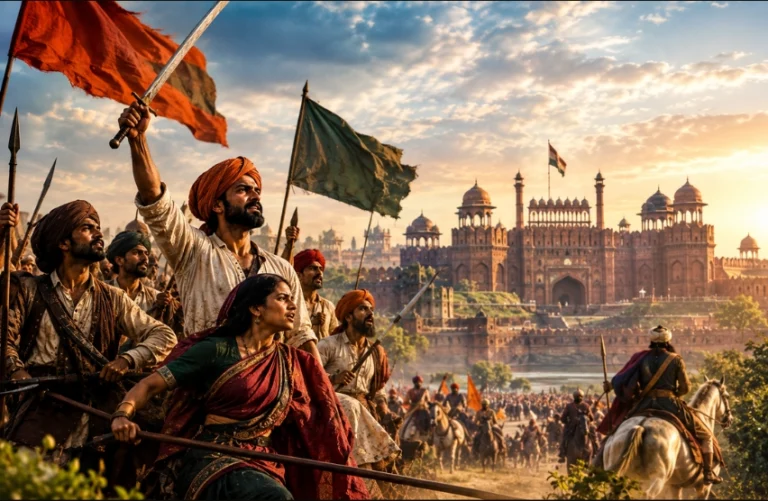
Causes of Popular Revolts
- Agrarian Oppression: Unreasonable revenue demands by local Jagirdars forced peasant communities into open rebellion.
- Ideological Friction: Imperial religious policies alienated local religious groups and tribal communities.
- Weakened Local Control: Administrative overextension created power vacuums across peripheral imperial provinces.
Impact on the Mughal Empire
- Severely drained imperial financial reserves through continuous, multi-front military containment campaigns.
- Disrupted crucial trade routes, revenue collection networks, and communication links between Northern India and the provinces.
- Fractured the imperial political structure, directly contributing to the eventual fragmentation studied in Mughal Empire Revolts UPSC.
Timeline of Popular Revolts
- 1669: Outbreak of the Jat Revolt under Gokula in the Mathura region.
- 1672: Occurrence of the Satnami Revolt in Narnaul and suppression by imperial forces.
- 1667–1675: Major tribal uprisings along the North-West frontier during the Afghan Revolt.
- 1675–1699: Execution of Guru Tegh Bahadur (1675) followed by the establishment of the Khalsa (1699) in the Sikh Revolt.
Conclusion
The wave of Popular Revolts under Aurangzeb exposed structural vulnerabilities within the imperial apparatus. From agrarian uprisings like the Jat Rebellion Mughal Empire and Satnami Rebellion Aurangzeb to tribal and religious resistance in the Afghan Rebellion Mughal Empire and Sikh Rebellion Mughal Empire, these movements altered the political landscape of South Asia. A clear understanding of these regional rebellions remains vital for scoring high in competitive examinations.
UPSC Prelims: PYQs & Practice Questions
Previous Year Questions (Prelims)
Q: With reference to the religious and agrarian uprisings during the reign of Aurangzeb, consider the following statements:
1. The Satnamis were a socio-religious sect comprising
mainly peasants, artisans, and lower-caste groups concentrated around
Narnaul.
2. The Jat revolt in the Mathura-Agra region was initially
led by Gokula, a local peasant leader and Zamindar.
Which of the statements given above is/are correct? (UPSC CSE Prelims 2019)
(a) 1 only
(b) 2 only
(c) Both 1 and 2
(d) Neither 1 nor 2
Answer: (c) Both 1 and 2
Explanation:
Statement 1 is correct: The Satnamis were a distinct
socio-religious community composed of low-caste artisans, peasants, and
landless laborers centered in Narnaul (present-day Haryana). Their
movement combined egalitarian socio-religious ideals with resistance
against local imperial officials.
Statement 2 is correct: The initial phase of the Jat uprising (1669) in the Mathura district was organized under the leadership of Gokula, a Jat Zamindar of Tilpat, who rallied local peasantry against the oppressive revenue extractions of the local Mughal faujdar, Abdun Nabi.
Q2: The creation of the Khalsa by
Guru Gobind Singh in 1699 was primarily aimed at:
(a) Establishing an independent commercial guild network across Punjab
and Sindh.
(b) Transforming the Sikh community into a martial fraternity to resist
socio-political tyranny and imperial overreach.
(c) Reorganizing the administrative revenue collection offices under
Mughal supervision.
(d) Negotiating peace treaties between local Rajput hill chiefs and
Mughal provincial governors.
Answer: (b) Transforming the Sikh community into a martial fraternity to resist socio-political tyranny and imperial overreach.
Explanation:
On Baisakhi in 1699 at Anandpur Sahib, Guru Gobind Singh instituted the
Khalsa (the order of the Pure). This formalized the Sikh
community into a disciplined, martial brotherhood dedicated to defending
righteousness, fighting religious intolerance, and resisting political
oppression under the late Mughal state.
Practice Questions
Q: Regarding the Afghan uprisings along the North-West frontier during Aurangzeb's reign, consider the following statements:
1. Khushal Khan Khattak, a prominent Pashtun poet and
warrior chief, united various Afghan tribes against imperial control.
2. The Afghan revolts forced the Mughal administration to divert large
contingents of veterans and elite artillery away from Northern India
and the Deccan.
Which of the statements given above is/are correct?
(a) 1 only
(b) 2 only
(c) Both 1 and 2
(d) Neither 1 nor 2
Answer: (c) Both 1 and 2
Explanation:
Statement 1 is correct: Khushal Khan Khattak utilized
his nationalist poetry and tribal influence to unite the Khattak,
Afridi, and Yusufzai tribes in a multi-year guerrilla campaign against
Mughal authority.
Statement 2 is correct: The frontier wars (1667–1675) severely strained imperial finances and tied down prime military units and top commanders, including Maharaja Jaswant Singh and Prince Akbar, at a critical juncture before the Deccan campaigns.
Q2: Which of the following best describes the underlying common factor across the Jat, Satnami, and Sikh resistance movements during the late 17th century?
(a) Direct military backing from European trading companies in coastal
ports.
(b) Fusion of rural agrarian discontent with local socio-religious or
caste identity against imperial centralisation.
(c) Formal alliances with the Ottoman Empire to overthrow Mughal rule.
(d) Rejection of the traditional Zamindari landholding
structure across all provinces.
Answer: (b) Fusion of rural agrarian discontent with local socio-religious or caste identity against imperial centralisation.
Explanation:
While each movement had distinct local triggers, historians like
Irfan Habib emphasize that these uprisings represented
a general crisis of the Mughal agrarian system. Exorbitant revenue
burdens imposed by Jagirdars led agrarian working
classes to consolidate along religious, sectarian, or caste lines
(Jat, Satnami, Sikh) to mount armed resistance.
UPSC Mains – Previous Year & Practice Questions
Mains Previous Year Questions
Question: "The popular uprisings of the Jats, Satnamis, and Sikhs during Aurangzeb's reign were fundamentally agrarian in character, wrapped in religious or caste identities." Examine. (UPSC CSE Mains 2022)
Question: Analyze the causes and nature of the Afghan tribal rebellions on the North-West frontier and their impact on the stability of the Mughal Empire. (UPSC CSE Mains 2016)
Question: Trace the transformation of the Sikh movement from a devotional, socio-religious order into a formidable martial power during the 17th century. (UPSC CSE Mains 2011)
Question: Discuss how regional revolts during the late 17th century disrupted the fiscal and administrative machinery of the Mughal Empire. (UPSC CSE Mains 2004)
Question: "The rise of regional resistance movements under Aurangzeb revealed the structural flaws of the Jagirdari system." Comment. (UPSC CSE Mains 1998)
Mains Practice Questions
[15 Marks | 250 Words]
Question: The Satnami Revolt of 1672 demonstrated the capacity of egalitarian peasant sects to challenge imperial military power. Critically analyze its origins, spread, and ultimate suppression.
[15 Marks | 250 Words]
Question: How did the leadership of Rajaram and Churaman Jat transform the agrarian Jat rebellion into an organized state-building process in the early 18th century?
[10 Marks | 150 Words]
Question: "Multi-front internal rebellions during 1665–1700 shattered the illusion of imperial invincibility and laid the groundwork for the 18th-century regional states." Elucidate.
Popular Revolts in Mughal Empire-FAQs
What was the Jat Revolt under Aurangzeb?
The Jat Revolt began around 1669 in the Mathura-Agra region, associated with the leadership of Gokula. Later leaders such as Rajaram and Churaman helped strengthen Jat resistance.
What caused the Satnami Revolt of 1672?
The Satnami Revolt began at Narnaul in 1672 and involved peasants, artisans and members of a socio-religious community. A local conflict with a Mughal soldier escalated into a wider armed rebellion.
Why did the Afghan tribes revolt against the Mughals?
Afghan resistance in the North-West was driven by tribal autonomy, opposition to Mughal interference and revenue demands. The prolonged campaigns consumed considerable Mughal military resources.
How did Sikh resistance develop during Aurangzeb’s reign?
The execution of Guru Tegh Bahadur in 1675 intensified Sikh resistance. In 1699, Guru Gobind Singh established the Khalsa, giving the movement a stronger martial and socio-political character.
How did popular revolts affect the Mughal Empire?
The revolts disrupted revenue collection, trade routes and imperial communications while requiring prolonged military campaigns. Together with other political and economic pressures, they exposed weaknesses in Mughal administrative control.