Table of Contents
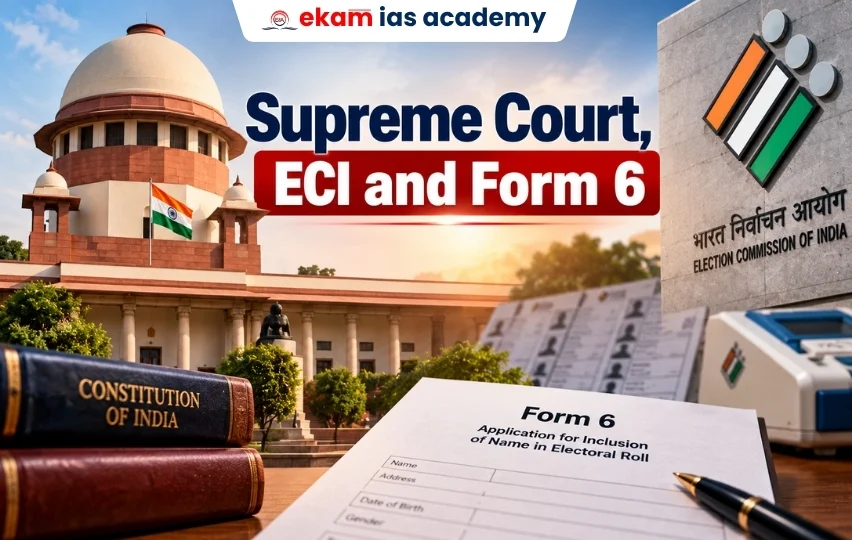
ToggleThe Supreme Court, Election Commission of India (ECI) and Form 6 have come under scrutiny following the Court’s clarification that it had not approved any modified version of Form 6 used during the Special Intensive Revision (SIR) of electoral rolls.
Why in News?
On 5 October 2026, a three-judge Bench headed by Chief Justice of India Surya Kant, along with Justices Joymalya Bagchi and V. Mohana, clarified that the Supreme Court had not approved a modified Form 6.
The Court indicated that it would examine the ECI’s records to establish how and by whom changes to the form were introduced. The clarification arose during proceedings concerning allegations of unilateral decisions in connection with the SIR exercise.
What is Form 6?
Form 6 is the prescribed application used by an eligible citizen to request inclusion of their name in the electoral roll.
According to the ECI, an eligible person seeking registration as a general elector can submit Form 6 before the Electoral Registration Officer (ERO) or Assistant Electoral Registration Officer (AERO).
The application can also be submitted through the ECI’s online platforms or the website of the concerned Chief Electoral Officer.
Thus, Form 6 plays an important role in enabling eligible citizens to register as voters and participate in the electoral process.
Role of the Election Commission of India
The Election Commission of India is a constitutional authority entrusted with the superintendence, direction and control of elections.
Under Article 324, its responsibilities include:
- Conducting elections to the Lok Sabha and State Legislative Assemblies.
- Conducting elections for the offices of the President and Vice-President.
- Supervising the preparation and revision of electoral rolls.
- Directing and supervising the election process.
- Recognising political parties and regulating election symbols under applicable laws and rules.
Constitutional Provisions Related to Electoral Rolls
India’s Constitution establishes the framework governing electoral rolls, voter registration and elections through several provisions:
- Article 324: Provides for the Election Commission’s superintendence, direction and control over elections.
- Article 325: Provides for a common electoral roll for each territorial constituency and prohibits exclusion solely on grounds of religion, race, caste or sex.
- Article 326: Establishes adult suffrage for Lok Sabha and State Assembly elections, subject to constitutional and statutory requirements.
- Article 327: Gives Parliament power to make laws concerning elections and electoral rolls.
- Article 328: Allows State Legislatures to make provisions relating to elections to State Legislatures, subject to laws made by Parliament.
Conclusion
The Form 6 issue highlights the importance of procedural transparency and institutional accountability in electoral-roll revision. The Supreme Court’s examination of the ECI records is expected to clarify how the disputed changes were introduced and the legal basis for their use during the SIR exercise.


FAQs – Supreme Court, ECI and Form 6
What is Form 6?
Form 6 is the prescribed application used by an eligible citizen to request inclusion of their name in the electoral roll.
What did the Supreme Court clarify about Form 6?
The Supreme Court clarified that it had not approved any modified version of Form 6 used during the Special Intensive Revision (SIR) of electoral rolls.
Who can submit Form 6?
An eligible citizen seeking registration as a general elector can submit Form 6 to the Electoral Registration Officer (ERO) or Assistant Electoral Registration Officer (AERO).
Which Constitutional Article governs the Election Commission of India?
Article 324 gives the Election Commission of India superintendence, direction and control over elections and electoral-roll-related processes.
Which Constitutional Articles are important for electoral rolls?
Articles 324, 325, 326, 327 and 328 collectively provide the constitutional framework for the Election Commission, electoral rolls, adult suffrage and legislative powers relating to elections.