Table of Contents
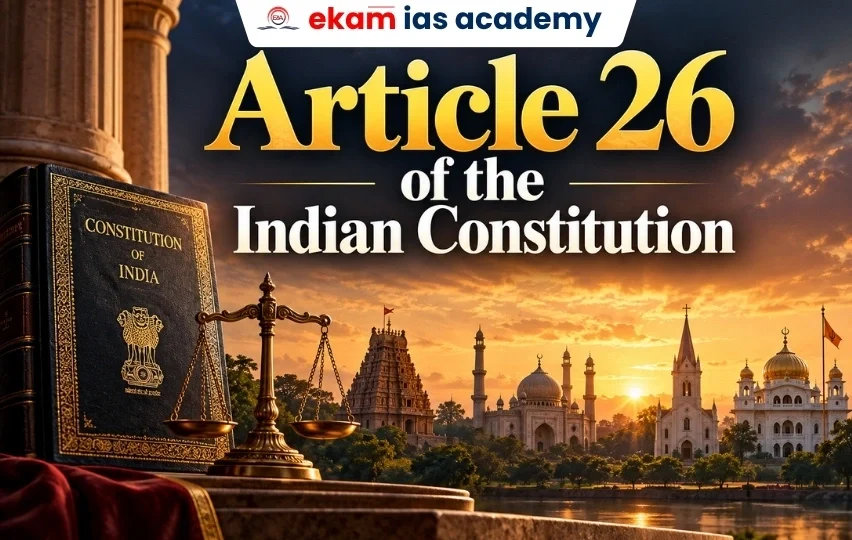
ToggleArticle 26 of the Indian Constitution
- Mastering Article 26 is vital for candidates covering Article 26 UPSC, Freedom of Religion UPSC, and Indian Polity UPSC syllabus modules.
- Placed in Part III under the Freedom of Religion in India, it guarantees collective autonomy to religious groups to govern their internal affairs.
- Article 26 Indian Constitution balances group denominational liberties with state regulation and public welfare.
- Studying Article 26 Fundamental Rights enables civil services aspirants to evaluate key institutional dynamics surrounding secularism and constitutional morality.
- A tundra biome is a vast, treeless geographic region characterized by extremely low temperatures, little precipitation, poor nutrients, and short growing seasons. The most defining feature of this biome is the permafrost—a layer of soil that remains permanently frozen throughout the year.
Constitutional Text of Article 26
- Textual Mandate: Guarantees every religious denomination or section thereof the right to manage its religious affairs, subject to public order, morality, and health.
- Institutional Creation: Protects the Right to Establish Religious Institutions and maintain them for religious and charitable purposes under Article 26(a).
- Internal Autonomy: Grants complete authority to manage internal matters of religion under Article 26(b).
- Property Ownership: Enshrines the right to own, acquire, and administer movable and immovable property in accordance with law under Article 26(c) and (d).
Meaning and Scope of Article 26
- Collective Liberty: Focuses exclusively on group rights, empowering institutional bodies alongside individual liberties under Article 26 Religious Freedom.
- Four-Fold Protections: Covers institution building, religious self-management, property acquisition, and statutory property administration.
- Internal vs External: Distinguishes core religious self-governance from external secular administration regulated by statutory law.
- Institutional Shield: Prevents state authorities from encroaching upon legitimate, age-old practices of Religious Denominations in India.
Who is a “Religious Denomination”
- SP Mittal Benchmark: Defined by the Supreme Court in SP Mittal v. Union of India (1983) using a three-pronged legal test.
- System of Beliefs: Must consist of an aggregate of individuals with a common system of beliefs conductive to spiritual well-being.
- Common Organization: Must possess a distinct organizational hierarchy, administrative structure, and designated leadership.
- Distinctive Name: Must be designated and recognized by a distinct, specialized name (e.g., Ramakrishna Mission, Ananda Marga).
Religious Denomination vs Religion
- Sub-Group Identity: A religious denomination constitutes a specialized sub-sect or branch within a broader overarching religion.
- Shared Foundations: Shares baseline spiritual texts with the parent faith while maintaining distinct rituals, lineages, or practices.
- Legal Test: Not every religious group qualifies as a denomination unless it strictly satisfies the SP Mittal judicial criteria under Religious Denominations Article 26.
- Doctrinal Variance: Enables recognized denominational sub-sects to preserve unique traditions without breaking away from the parent faith.
Article 26 and Individual vs Collective Religious Freedom
- Institutional Priority: Prioritizes group rights of organized sects, enabling collective self-governance without undue external interference.
- Institutional Synergy: Complements individual faith by providing a organized framework to build temples, monasteries, and seminaries.
- Conflict Resolution: Requires balancing denominational autonomy when group practices infringe upon individual fundamental rights.
- Harmonious Reading: Establishes a structural equilibrium between collective identity and personal constitutional protections under Fundamental Rights UPSC.
Article 25 vs Article 26
- Individual vs Group: Article 25 protects individual Freedom of Religion in India, while Article 26 grants collective rights to religious denominations.
- Scope of Rights: Article 25 covers conscience, practice, and propagation; Article 26 grants the Right to Manage Religious Affairs and property.
- Limitation Differences: Article 25 is subject to “public order, morality, health, and other fundamental rights,” whereas Article 26 omits the explicit overarching fundamental rights clause.
- Beneficiary Focus: Article 25 applies to all “persons” (including non-citizens), whereas Article 26 applies specifically to “religious denominations or sections thereof.”
Article 26 and Secularism
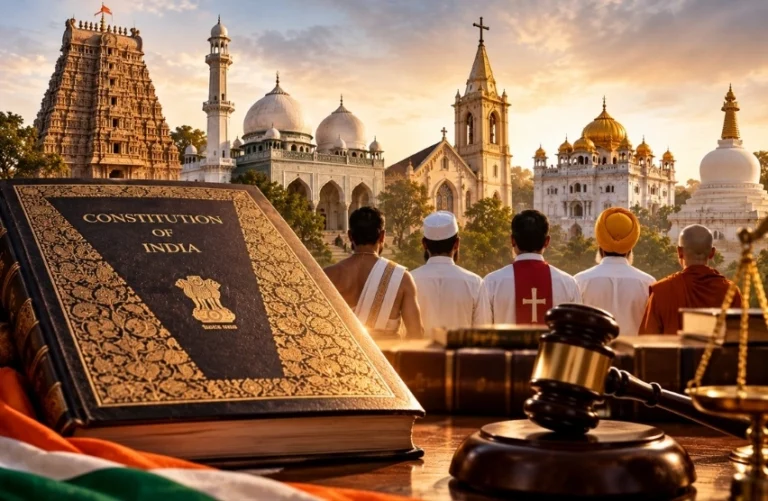
- Positive Secularism: Reflects Indian positive secularism, assuring state non-interference in purely religious functions of denominations.
- Principled Distance: Upholds a principled distance while allowing state regulation over secular, financial, and property matters.
- Equal Protection: Ensures no single denomination receives state preference, enforcing neutral Article 26 and Religious Institutions oversight.
- Basic Structure: Reinforces secularism as an unamendable feature of the Constitution by preserving pluralistic institutional autonomy.
Article 26 and State Regulation
- Secular Administration: Article 26(d) specifies that property administration must be conducted “in accordance with law” passed by legislatures.
- Financial Auditing: Empowers state authorities to audit financial accounts, check corruption, and regulate secular endowments.
- Limits of Regulation: The state can regulate property administration, but it cannot strip a denomination’s primary Freedom to Manage Religious Affairs.
- Statutory Machinery: Enacted through state-level Religious Endowments Acts to prevent administrative mismanagement in religious trusts.
Essential Religious Practices Doctrine and Article 26
- Judicial Filter: Uses the Essential Religious Practices (ERP) doctrine to identify whether a denominational practice forms an integral part of religion.
- Core vs Peripheral: Only core, indispensable religious practices receive absolute protection under Article 26(b).
- Judicial Determination: Vests power in higher courts to evaluate textual, historical, and doctrinal evidence behind denominational claims.
- Reform Catalyst: Prevents superstitious, harmful, or exclusionary practices from claiming constitutional immunity under Article 26 Indian Polity.
Landmark Supreme Court Judgments on Article 26
| Case | Year | Key Principle |
|---|---|---|
| Commissioner, Hindu Religious Endowments, Madras v. Sri Lakshmindra Thirtha Swamiar of Sri Shirur Mutt | 1954 | Religious denomination and autonomy in matters of religion |
| Ratilal Panachand Gandhi v. State of Bombay | 1954 | Religious freedom and administration of religious institutions |
| S.P. Mittal v. Union of India | 1983 | Interpretation of religious denomination |
| Durgah Committee, Ajmer v. Syed Hussain Ali | 1961 | Distinction between essential religious practices and secular/superstitious practices |
| Seshammal v. State of Tamil Nadu | 1972 | Religious institutions and secular aspects of administration |
| Sri Adi Visheshwara of Kashi Vishwanath Temple v. State of U.P. | 1997 | Religious institution management and State regulation |
| A.S. Narayana Deekshitulu v. State of Andhra Pradesh | 1996 | Temple administration and distinction between religious and secular functions |
| Indian Young Lawyers Association v. State of Kerala | 2018 | Equality, religious practice and denominational rights |
| Shayara Bano v. Union of India | 2017 | Personal law, constitutional rights and religious practice |
Article 26 and Women's Rights
- Gender Equality Clash: Denominational customs excluding women often conflict with Article 14 (Equality) and Article 15 (Non-discrimination).
- Sabarimala Milestone: In Young Lawyers Association (2018), the Supreme Court ruled that exclusionary denominational practices yield to constitutional morality.
- Individual Precedence: Affirmed that individual rights to dignity and gender equality outweigh traditional denominational claims.
- Evolving Jurisprudence: Re-evaluates patriarchal temple traditions against transformative constitutional values and fundamental freedoms.
Article 26 and Article 27
- Taxation Immunity: Article 27 complements Article 26 by ensuring state revenue is not used to favor or maintain any specific religious denomination.
- Fee vs Tax: Allows the state to levy a regulatory “fee” on religious trusts to cover administrative and safety expenses.
- Financial Neutrality: Maintains state neutrality by barring compulsory state taxation earmarked for religious promotion.
- Fiscal Autonomy: Ensures religious institutions fund their spiritual activities independently without state fiscal patronage.
Article 26 and Article 28
- Educational Autonomy: Works alongside Article 28 to permit religious denominations to establish and administer educational institutions.
- Instructional Freedom: Denominational institutions can impart religious instruction, subject to student consent rules under Article 28(3).
- Trust-Established Schools: Institutions established under religious trusts receive special constitutional protection regarding religious education.
- Cultural Preservation: Protects denominational traditions through educational, spiritual, and cultural transmission.
Restrictions on Article 26
- Public Order: Denominational activities cannot disrupt public peace, provoke communal violence, or cause law and order breakdown.
- Morality Clause: Practices violating basic human dignity, moral standards, or human rights lose constitutional protection.
- Public Health: State can restrict denominational gatherings, rituals, or animal sacrifices during epidemics or public health emergencies.
- Legislative Boundary: Enforces public health and order limits without destroying the core institutional identity of the denomination.
Contemporary Issues Related to Article 26
- Sabarimala Review Bench: 9-judge bench reference analyzing the balance between Article 25, Article 26, and constitutional morality.
- State Control of Temples: Ongoing debates surrounding state government control and administration of Hindu temple boards and endowments.
- Place of Worship Act: Discussions regarding historical religious sites and property administration under Article 26(c).
- Minority vs Denomination: Clarifying legal distinctions between Article 26 denominational rights and Article 30 minority educational rights.
Conclusion
- Balanced Architecture: Article 26 serves as a vital constitutional shield protecting institutional religious autonomy in India.
- Constitutional Harmony: Upholds group rights while ensuring alignment with public order, morality, and human dignity.
- UPSC Core Essential: Mastery over Article 26 Fundamental Rights is essential for answering high-scoring questions in Civil Services Polity papers.
UPSC Prelims: PYQs & Practice Questions
Previous Year Questions (Prelims)
Q: Right to vote and to be elected in India is a:
(a) Fundamental Right
(b) Natural Right
(c) Constitutional Right
(d) Legal Right
Answer: (c)
Explanation:
While this question examines constitutional classifications, it highlights how Part III fundamental rights, such as Article 26, differ from other constitutional rights.
In contrast to voting rights under Article 326, Article 26 is a core Fundamental Right under Part III, specifically providing collective Freedom to Manage Religious Affairs to Religious Denominations in India.
Q: Which one of the following categories of Fundamental Rights incorporates protection against untouchability as a form of discrimination?
(a) Right against Exploitation
(b) Right to Freedom
(c) Right to Constitutional Remedies
(d) Right to Equality
Answer: (d)
Explanation:
Protection against untouchability falls under Article 17 within the Right to Equality (Articles 14–18).
In constitutional jurisprudence, such as the Sabarimala case, conflict often arises between Articles 17, 14 and 15 (Right to Equality) and Article 26 (Freedom to Manage Religious Affairs for religious denominations), requiring the judiciary to balance individual rights with collective religious autonomy.
Practice Questions
Q: With reference to Article 26 of the Indian Constitution, consider the following statements:
1. The term "Religious Denomination" is explicitly defined under Article 26 of the Constitution.
2. The rights guaranteed under Article 26 are subject to public order, morality, and health, but not explicitly to other fundamental rights.
3. Under Article 26(d), a religious denomination's right to administer property is absolute and immune from statutory state regulation.
Which of the statements given above is/are correct?
(a) 1 and 2 only
(b) 2 only
(c) 2 and 3 only
(d) 1, 2, and 3
Answer: (b)
Explanation:
Statement 1 is incorrect: The Constitution does not define "Religious Denomination". The Supreme Court laid down the three-part test in S.P. Mittal v. Union of India (1983).
Statement 2 is correct: Unlike Article 25, Article 26 is explicitly subject to public order, morality, and health.
Statement 3 is incorrect: Article 26(d) provides the right to administer property "in accordance with law", permitting statutory regulation by the State.
Q: According to the Supreme Court of India (S.P. Mittal Case, 1983), which of the following criteria must be satisfied for a group to qualify as a Religious Denomination under Article 26?
1. Collection of individuals with a system of beliefs conducive to spiritual well-being.
2. Common organization.
3. Designation by a distinctive name.
4. Registration as a public charitable trust under state law.
Select the correct answer using the code given below:
(a) 1 and 2 only
(b) 1, 2, and 3 only
(c) 2, 3, and 4 only
(d) 1, 2, 3, and 4
Answer: (b)
Explanation:
Under the landmark S.P. Mittal v. Union of India (1983) judgment, the Supreme Court prescribed three cumulative conditions:
1. A collection of individuals sharing common spiritual beliefs or doctrines.
2. A common organization.
3. Designation by a distinctive name.
Registration as a public charitable trust is not a constitutional requirement to qualify as a religious denomination under Article 26.
UPSC Mains – Previous Year & Practice Questions
Mains Previous Year Questions
Question: How far do you agree with the view that the
Essential Religious Practices (ERP) doctrine has allowed
the judiciary to intervene in matters of religious freedom under
Articles 25 and 26? Illustrate with recent judicial precedents.
(UPSC CSE Mains 2019)
[15 Marks | 250 Words]
Question: Analyze the tension between individual
fundamental rights (Articles 14, 15, and 21) and collective
religious autonomy under Article 26 in light of the
Sabarimala temple entry judgment.
(UPSC CSE Mains 2018)
[15 Marks | 250 Words]
Question: Discuss the concept of
'Constitutional Morality' and how higher courts apply it
to resolve conflicts between religious denominational rights under
Article 26 and gender equality.
(UPSC CSE Mains 2017)
[10 Marks | 150 Words]
Question: What constitutes a
'Religious Denomination' under the Indian Constitution?
Examine how the State regulates secular property administration of
religious institutions under Article 26(d).
(UPSC CSE Mains 2015)
[15 Marks | 250 Words]
Question: Indian secularism does not mean complete
separation of church and state, but principled distance.
Examine this statement in the context of state regulatory powers over
religious trusts and denominations under Article 26.
(UPSC CSE Mains 2013)
[10 Marks | 150 Words]
Mains Practice Questions
[15 Marks | 250 Words]
Question: Examine the legal distinction between Article 25 and Article 26 of the Indian Constitution. How does the judicial interpretation of 'matters of religion' versus 'secular activities' dictate the scope of state intervention in religious institutions?
[15 Marks | 250 Words]
Question: The state regulation of temple endowments under state Hindu Religious and Charitable Endowments (HR&CE) Acts has sparked debates regarding denominational autonomy under Article 26. Critically evaluate this issue from a constitutional perspective.
[10 Marks | 150 Words]
Question: Evaluate the mandate of the 9-judge Constitution Bench regarding the harmonization of individual rights under Article 25, denominational rights under Article 26, and non-arbitrariness under Article 14.
Article 26 of the Indian Constitution-FAQs
What is Article 26 of the Indian Constitution?
Article 26 guarantees religious denominations the right to establish and maintain religious and charitable institutions, manage religious affairs, and own and administer property, subject to public order, morality and health.
Who can claim rights under Article 26?
Article 26 protects a religious denomination or any section thereof, rather than individuals generally. The Supreme Court has developed criteria to determine whether a particular group qualifies as a religious denomination.
What are the four rights guaranteed under Article 26?
Article 26 provides four major rights: establishing and maintaining religious institutions, managing matters of religion, owning and acquiring property, and administering such property in accordance with law.
What is the difference between Article 25 and Article 26?
Article 25 protects the individual freedom of conscience and religion, while Article 26 protects the collective rights of religious denominations to manage their religious affairs and institutions.
Can the State regulate religious institutions under Article 26?
Yes. The State may regulate the secular, financial and administrative aspects of religious institutions. However, such regulation cannot arbitrarily destroy the denomination’s constitutionally protected religious autonomy.