

Table of Contents
ToggleCoal Stocks Critically Low as Power Demand Rises in India
India’s electricity demand has been rising amid high temperatures, changing monsoon conditions and strong El Niño events, putting additional pressure on coal-fired thermal power plants. The article highlights concerns over declining coal inventories at thermal power stations even as coal continues to remain the dominant source of India’s power generation.
Coal Stocks Under Pressure
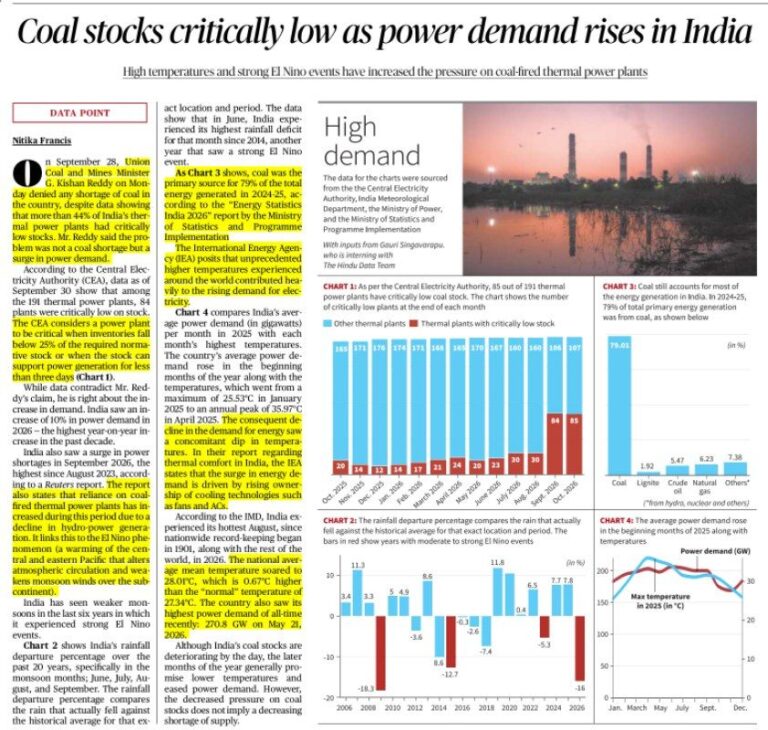
According to data from the Central Electricity Authority (CEA), 85 out of 191 thermal power plants had critically low coal stocks as of September 30. The CEA considers a power plant to have critically low stock when its inventory falls below 25% of the required norm or when the available coal can support power generation for less than three days.
The situation is significant because coal accounted for around 79% of India’s total primary energy generation in 2024-25, highlighting the country’s continuing dependence on coal for electricity supply.
Rising Power Demand and Temperatures
The article links the pressure on coal stocks with increasing electricity demand. India’s average power demand increased during months when temperatures were higher. The maximum temperature rose from around 25.53°C in January 2025 to 35.97°C in April 2025, while the country recorded an all-time high power demand of 270.8 GW on May 21, 2026.
Higher temperatures increase the use of air conditioners, coolers and fans, thereby raising electricity consumption. The International Energy Agency (IEA) has also highlighted the contribution of unusually high temperatures to increasing electricity demand globally.
Climate and Energy Security
The article connects changing weather conditions with India’s power-sector challenges. Strong El Niño events can influence monsoon circulation and rainfall patterns, affecting both hydropower generation and overall electricity demand.
India’s dependence on coal-fired thermal power becomes particularly important when hydroelectric generation declines. Therefore, maintaining adequate coal inventories is essential for ensuring energy security and grid reliability.
Way Forward
India needs to strengthen fuel supply chains, diversify its energy mix, improve renewable-energy integration and expand energy-storage capacity. Greater efficiency in thermal power generation and better forecasting of electricity demand can also reduce pressure during periods of extreme temperatures.
Conclusion
India’s rising electricity demand highlights the continuing importance of reliable fuel supplies and a resilient power system. While coal remains central to India’s energy security, reducing excessive dependence through renewables, storage, hydropower and energy efficiency will be crucial for building a more sustainable and climate-resilient energy sector.
Vocabulary
1. Critical Stock – Coal inventory below the prescribed threshold.
2. Peak Demand – Highest electricity demand in a period.
3. El Niño – Pacific warming that can influence India’s monsoon.
Prelims MCQs
MCQ 1
Higher temperatures can increase power demand mainly through:
A) Irrigation
B) Cooling appliances
C) Coal exports
D) Hydropower
Answer: B
UPSC Mains Question
“India’s rising electricity demand highlights the challenge of balancing energy security with energy transition.” Discuss.
(10 Marks)
Frequently Asked Questions (FAQs)
Why are coal stocks at thermal power plants declining?
Rising electricity demand, particularly during periods of high temperatures, has increased pressure on coal-fired thermal power plants.
When is a thermal power plant considered to have critically low coal stock?
According to the article, the CEA considers stocks critically low when inventories fall below 25% of the required norm or can support generation for less than three days.
How does El Niño affect India's power sector?
Strong El Niño events can influence monsoon patterns and rainfall, potentially affecting hydropower generation while higher temperatures can increase electricity demand.
Why is coal important for India's electricity generation?
Coal remains the dominant source of India’s power generation, accounting for about 79% of total primary energy generation in 2024-25 according to the article.
What can India do to improve energy security?
India can diversify its energy mix, expand renewable energy and storage, strengthen fuel supply chains and improve energy efficiency and demand forecasting.
From India to Global South: A Gujarat Water-Governance Model
India’s experience in water governance is increasingly gaining attention across the Global South. The article “From India to Global South, a Gujarat water-governance model” examines how Gujarat’s experience in water management can offer lessons for countries facing growing challenges of water scarcity, climate change, urbanisation and rising demand.
The central argument is that water security is not merely an engineering challenge. It requires strong governance, institutional capacity, community participation and long-term planning.
Gujarat’s Water-Governance Experience
The article traces India’s evolving approach to water governance and highlights Gujarat’s experience with reforms undertaken between 2001 and 2014. These reforms are presented as an example of how political leadership and institutional strengthening can improve water management at scale.
The approach moved beyond simply building infrastructure. It focused on improving water access, conservation, groundwater management, rainwater harvesting and community participation.
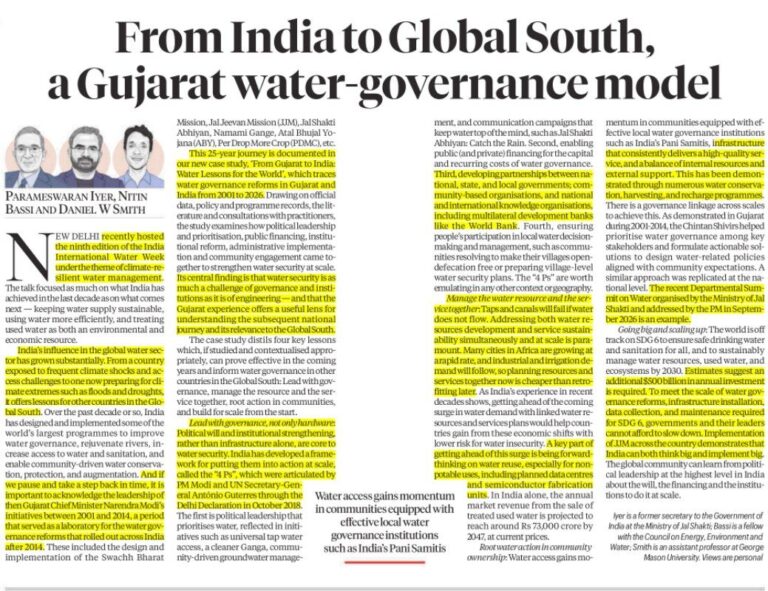
The case study identifies four key lessons that could be adapted by countries in the Global South: lead with governance, manage water resources and services together, involve communities and build systems for scale from the beginning.
Governance Over Infrastructure
One of the major lessons is that water security depends on governance as much as infrastructure. Political commitment, institutional strengthening and effective implementation are essential for translating water policies into outcomes.
India has developed a broader framework for putting these principles into practice, including the “4 Ps” framework, articulated through the Delhi Declaration in October 2018.
Several initiatives, including Jal Jeevan Mission, Jal Shakti Abhiyan, Namami Gange and Atal Bhujal Yojana, reflect India’s expanding focus on water conservation, access and sustainable management.
Community Participation and Local Governance
The article highlights the importance of empowering communities through institutions such as Pani Samitis. Local participation can improve the management of water infrastructure, encourage conservation and make water services more responsive to community needs.
The Gujarat experience also demonstrates the importance of stakeholder participation, water harvesting and groundwater recharge programmes.
Water Security and the Global South
Developing countries face increasing pressure from climate change, urbanisation, industrialisation and rising water demand. The article argues that planning water resources and wastewater services together can help countries prepare for future demand.
It also highlights opportunities in water reuse, desalination, semiconductor fabrication and industrial water management, while emphasising the need for sustainable resource use.
Conclusion
India’s water-governance experience demonstrates that achieving water security requires more than constructing infrastructure. Political will, strong institutions, community participation, conservation and long-term planning must work together. Gujarat’s experience can therefore provide useful lessons for other countries in the Global South seeking scalable and sustainable solutions to growing water challenges.
Vocabulary
1. Water Governance – Management of water resources and services.
2. Water Security – Reliable access to adequate and safe water.
3. Pani Samiti – Village-level committee for water management.
Prelims MCQs
MCQ 1
Community-based water governance promotes:
1. Local participation
2. Water conservation
3. Decentralised management
A) 1 and 2 only
B) 2 and 3 only
C) 1, 2 and 3
D) 1 only
Answer: C
UPSC Mains Question
“Water security is as much a governance challenge as an infrastructure challenge.” Discuss. (10 Marks)
Frequently Asked Questions (FAQs)
Why is Gujarat’s water-governance model significant?
It demonstrates how political leadership, institutional strengthening, community participation and water-management programmes can work together at scale.
What is the importance of the 4 Ps framework?
The framework provides an approach for strengthening water governance through coordinated action involving governance and institutional mechanisms.
What is the role of Pani Samitis?
Pani Samitis are community-level institutions that can support local participation and effective management of rural water infrastructure and services.
Which major Indian initiatives focus on water management?
Important initiatives include the Jal Jeevan Mission, Jal Shakti Abhiyan, Namami Gange and Atal Bhujal Yojana.
Why is water governance important for the Global South?
Climate change, urbanisation, industrialisation and increasing water demand are intensifying water stress, making sustainable and effective water governance increasingly important.