Table of Contents
TogglePFAS Contamination
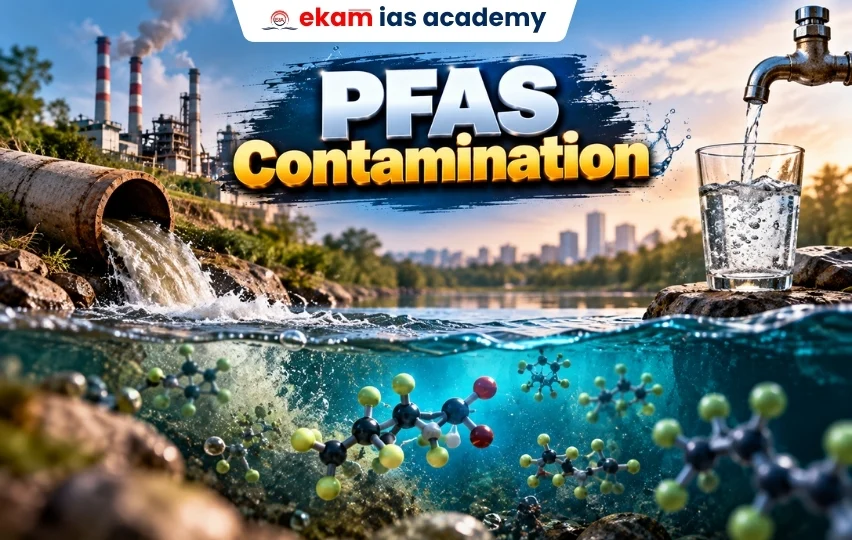
PFAS Contamination is emerging as a serious environmental concern in India. Per- and polyfluoroalkyl substances (PFAS), popularly known as “forever chemicals”, have been detected in water sources across several States, while India is still developing dedicated standards for their monitoring and removal.
What Are PFAS?
PFAS are a large group of synthetic chemicals containing strong carbon-fluorine bonds, making them highly resistant to natural degradation. They have been widely used in products such as coatings, textiles and industrial materials.
Their persistence allows them to remain in the environment for long periods, enabling accumulation in water, soil and living organisms.
Health Concerns: What We Know
Concerns have increased following the 2025 classification by the International Agency for Research on Cancer (IARC), which identified PFOA as carcinogenic to humans and PFOS as possibly carcinogenic to humans.
However, simply finding PFAS in water does not automatically establish a health risk. Potential impacts depend on the specific chemical, concentration, duration and pathway of exposure.
A 2026 study involving 24 PFAS compounds also reported adverse effects in zebrafish, including delayed hatching, reduced growth and changes in heart rate, highlighting possible ecological concerns.
Evidence of Contamination Across India
PFAS contamination has been reported in studies covering Gujarat, Maharashtra, Tamil Nadu and West Bengal. A 2025 review described the issue as a genuine concern but noted that India lacks a comprehensive picture because testing methods differ between studies.
An IIT Madras study analysing water samples collected during 2022–23 found particularly high concentrations near groundwater sources close to waste dumps. Interestingly, PFAS levels in some treated samples were higher than in untreated water, indicating that treatment could potentially transform unidentified precursor compounds into more persistent PFAS.
Why Treatment Systems Are Failing
Conventional biological wastewater treatment is generally ineffective against PFAS. Adsorption technologies offer greater potential, but affordable and efficient treatment materials remain under development.
Another challenge is testing only a fixed list of PFAS, which can overlook other compounds and precursor chemicals. Advanced techniques such as high-resolution mass spectrometry can provide broader detection capabilities.
India’s Regulatory Response: Work in Progress
India currently has no PFAS-specific drinking-water limit under IS 10500:2012. The standard is being revised, while the Bureau of Indian Standards has established a working group to examine emerging contaminants and “forever chemicals”.
Meanwhile, CSIR-IITR, Lucknow, is contributing to a UNEP-supported initiative to develop baseline PFAS information and has developed capabilities to detect multiple PFAS compounds.
Conclusion
PFAS contamination highlights the need for stronger environmental monitoring and regulation. India’s priorities should include standardised testing, baseline mapping, appropriate interim limits and improved treatment technologies to address these persistent contaminants before their environmental footprint becomes more difficult to control.


FAQs: PFAS Contamination in India
What are PFAS and why are they called forever chemicals?
Per- and polyfluoroalkyl substances (PFAS) are synthetic chemicals containing strong carbon-fluorine bonds. They are called “forever chemicals” because they resist natural degradation and can persist in water, soil and living organisms for long periods.
What are the major health risks associated with PFAS exposure?
Long-term exposure to certain PFAS compounds has been associated with cancer, immune system effects, liver damage and developmental problems. The IARC classifies PFOA as carcinogenic to humans and PFOS as possibly carcinogenic to humans.
Which Indian states have reported PFAS contamination?
Studies have reported PFAS contamination in water sources across Gujarat, Maharashtra, Tamil Nadu and West Bengal. However, differences in testing methods and limited monitoring make it difficult to assess the full extent of contamination across India.
Why are conventional water treatment systems ineffective against PFAS?
PFAS are highly resistant to degradation because of their strong chemical bonds. Conventional biological wastewater treatment generally cannot remove them effectively. Advanced technologies such as activated carbon adsorption, ion exchange and reverse osmosis can help reduce PFAS concentrations.
Does India have specific regulations for PFAS in drinking water?
India currently has no PFAS-specific drinking-water limits under IS 10500:2012. The Bureau of Indian Standards (BIS) is examining emerging contaminants, while research institutions are working on improved PFAS monitoring and detection methods.