Table of Contents
ToggleWarming Himalayas: Rethinking Development and Disaster Risk
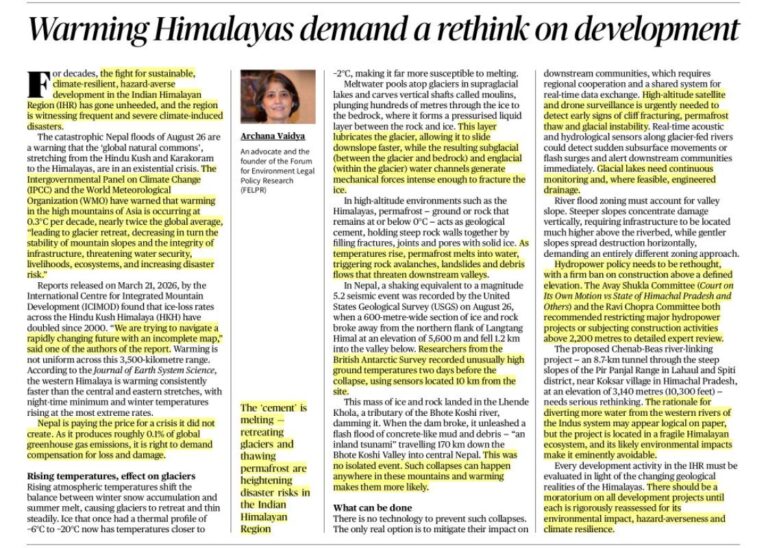
The Indian Himalayan Region (IHR) is facing growing climate and geological risks as rising temperatures accelerate glacier retreat, permafrost thawing and mountain instability. The article highlights the urgent need to rethink development practices in the Himalayas, particularly as climate-induced disasters become more frequent and severe.
Rising Temperatures and Himalayan Vulnerability
The Himalayan region is warming at a significantly higher rate than the global average. The IPCC and World Meteorological Organization (WMO) have warned that warming across the high mountains of Asia is increasing glacier retreat, reducing water security and weakening mountain slopes.
The article notes that glacier ice-loss rates across the Hindu Kush Himalaya have doubled since 2000. Rising temperatures are altering the balance between winter snow accumulation and summer melting, causing glaciers to retreat and thin.
Another major concern is permafrost thawing. Permafrost and rock at temperatures around or below 0°C act like geological cement, stabilising mountain slopes. As temperatures rise, this frozen layer weakens, increasing the possibility of rock avalanches, landslides and debris flows.
Glacial and Mountain Hazards
The article highlights how the combination of ice and unstable rock can produce sudden disasters. A major collapse in Nepal released a massive flow of ice, rock and debris into a downstream valley. Such events demonstrate how warming can amplify existing geological vulnerabilities.
The risk is particularly serious for communities living downstream of glaciers and unstable mountain slopes. Glacial lakes, glacier-fed rivers and steep valleys require continuous monitoring and early-warning systems.
Rethinking Himalayan Development
The article calls for a fundamental reassessment of infrastructure projects in the IHR. Hydropower projects, roads, river-linking projects and other construction activities must account for changing geological and climatic conditions.
River flood zoning should consider differences in valley geometry and slope characteristics. Similarly, hydropower projects in fragile high-altitude ecosystems require detailed environmental and hazard assessments.
The article also stresses the importance of real-time data sharing, satellite monitoring, acoustic and hydrological sensors, and regional cooperation to detect early signs of instability.
Conclusion
The warming Himalayas require a development model based on climate resilience, ecological sensitivity and disaster preparedness. Development cannot be assessed only through economic benefits; its long-term environmental and geological risks must also be considered. A precautionary approach, stronger monitoring systems and rigorous environmental assessments are essential to protect Himalayan ecosystems and downstream communities.
Vocabulary
1. Permafrost – Ground remaining frozen for at least two years.
2. GLOF – Sudden release of water from a glacial lake.
3. Climate Resilience – Capacity to withstand climate-related shocks.
Prelims MCQs
MCQ 1
Consider the following statements:
1. Permafrost thaw can destabilise mountain slopes.
2. Glacial retreat may increase GLOF risks.
3. Himalayan warming eliminates avalanche risks.
Which are correct?
A) 1 and 2 only
B) 2 and 3 only
C) 1 and 3 only
D) 1, 2 and 3
Answer: A
UPSC Mains Question
“Climate change is transforming the Himalayan region into a zone of increasing ecological and disaster vulnerability.” Discuss. (10 Marks)
Frequently Asked Questions (FAQs)
Why are the Himalayas warming rapidly?
The article notes that the Hindu Kush Himalaya is experiencing warming at a rate significantly higher than the global average, increasing risks to glaciers, slopes and water security.
How does permafrost thawing increase disaster risks?
Permafrost acts as a natural stabilising layer. Its thawing can weaken rock and slopes, increasing the risk of rock avalanches, landslides and debris flows.
Why are Himalayan glaciers important?
Himalayan glaciers contribute to river systems and provide an important source of water for downstream communities. Their retreat can affect long-term water security.
Why does Himalayan development need to be reconsidered?
Climate change is altering the geological conditions of the region. Infrastructure projects must therefore account for glacier instability, permafrost thawing, landslides and flood risks.
What measures can reduce Himalayan disaster risks?
The article highlights real-time data sharing, satellite monitoring, hydrological sensors, early-warning systems, scientific assessments and stronger regional cooperation.
Source From : The Hindu
The Internet in a Sachet: Making Connectivity Affordable for Every Indian
India has achieved remarkable progress in digital payments and mobile data, making internet access cheaper and more widespread. However, the country still faces a major challenge in providing affordable, reliable and universal last-mile internet connectivity. The idea of putting the internet “in a sachet” focuses on making connectivity available in small, affordable packages, particularly for people who cannot afford conventional broadband or mobile data plans.
What Is the Internet-in-a-Sachet Idea?
The concept draws inspiration from India’s successful sachet economy, where products are sold in small quantities at affordable prices. Applied to internet connectivity, it means enabling users to purchase small amounts of internet access, rather than committing to expensive monthly plans.
The idea was proposed in 2016 through a TRAI consultation paper, followed by recommendations in March 2017. The approach envisaged open and interoperable public Wi-Fi networks that could allow users to connect through nearby hotspots.
PM-WANI and Public Wi-Fi
The PM-WANI (Prime Minister’s Wi-Fi Access Network Interface) framework was approved by the Union Cabinet in December 2020. It aimed to create a network of public Wi-Fi hotspots through local entrepreneurs and small establishments.
The model can potentially transform neighbourhood shops, tea stalls and other small businesses into Public Data Offices (PDOs) providing internet connectivity.
However, the article highlights that the promise of PM-WANI has not yet been fully realised. One major concern is the continuing dominance of large telecom operators and the difficulty faced by small establishments in accessing affordable connectivity infrastructure.
BharatNet and Last-Mile Connectivity
Another important component is BharatNet, which seeks to extend optical-fibre connectivity to rural areas. The article points out that substantial investments have already been made in rural broadband infrastructure, but the challenge remains converting this infrastructure into affordable and accessible consumer-level connectivity.
Technologies such as satellite broadband could potentially complement fibre networks in remote and difficult-to-reach areas.

Why Affordable Connectivity Matters
Affordable internet access is increasingly important for education, healthcare, digital payments, government services and employment. Leaving connectivity entirely to a small number of telecom companies could create excessive dependence on a duopoly.
A more competitive ecosystem involving public Wi-Fi, fibre networks, local entrepreneurs and satellite connectivity could improve consumer choice and access.
Conclusion
India has already demonstrated that digital services can become affordable and universal when supported by the right infrastructure and policy framework. The next challenge is to ensure that internet connectivity itself becomes accessible in small, affordable and flexible packages. Strengthening PM-WANI, improving BharatNet utilisation and encouraging competition could help turn the idea of an “internet in a sachet” into a practical tool for digital inclusion.
Vocabulary
1. PM-WANI – Prime Minister Wi-Fi Access Network Interface.
2. Backhaul – Network connecting local hotspots to the internet.
3. Digital Divide – Gap in access to digital services.
Prelims MCQs
MCQ 1
Consider the following statements:
1. PM-WANI promotes public Wi-Fi access.
2. BharatNet aims to expand rural broadband connectivity.
3. PM-WANI requires every user to purchase a separate mobile data plan. Which are correct?
A) 1 and 2 only
B) 2 and 3 only
C) 1 and 3 only
D) 1, 2 and 3
Answer: A
UPSC Mains Question
“Affordable last-mile internet connectivity is essential for bridging India’s digital divide.” Discuss the role of PM-WANI and BharatNet. (10 Marks)
Frequently Asked Questions (FAQs)
What does “Internet in a Sachet” mean?
It refers to providing internet connectivity in small, affordable and flexible packages, similar to India’s successful sachet-based consumer model.
What is PM-WANI?
PM-WANI is the Prime Minister’s Wi-Fi Access Network Interface, a framework approved in December 2020 to expand public Wi-Fi connectivity.
What is the role of Public Data Offices?
Public Data Offices (PDOs) can provide public Wi-Fi connectivity through local establishments, helping extend internet access closer to consumers.
What is BharatNet?
BharatNet is an initiative aimed at expanding optical-fibre broadband connectivity to rural India, particularly through village-level connectivity infrastructure.
Why is affordable internet important for India?
Affordable connectivity supports education, healthcare, digital payments, government services, employment and broader digital inclusion.