
Daily Current affairs 27 October 2026

Daily Current Affairs 27 October 2026

Share this Post

KUDANKULAM DATA BREACH AND STRENGTHENING CYBERSECURITY OF INDIA'S CRITICAL INFRASTRUCTURE

TOPIC: (GS3) SCIENCE AND TECHNOLOGY: THE HINDU

A reported ransomware-related data breach involving documents linked to the Kudankulam Nuclear Power Project in Tamil Nadu has raised national security concerns.

Kudankulam Cybersecurity Incident

  • In July 2026, a ransomware group reportedly claimed possession of nearly 19,000 files (14.3 GB) linked to the nuclear project.
  • The documents allegedly included engineering drawings, supplier details, inspection reports and project records.
  • The reported exposure involved a third-party data centre used by a project contractor.
  • NPCIL clarified that the affected documents concerned non-nuclear infrastructure and that nuclear safety systems were not compromised.
  • Earlier example: In 2019, malware was detected on an administrative computer associated with Kudankulam, while critical operational systems remained isolated.

Why Critical Infrastructure Faces Cyber Threats

  • Critical infrastructure includes nuclear plants, electricity grids, telecommunications networks and defence facilities.
  • Modern projects depend on multiple contractors, software providers and cloud services.
  • Attackers may target less-protected suppliers instead of directly attacking secure government facilities.
  • Stolen technical documents can support espionage, phishing, sabotage planning or future cyberattacks.

India’s Existing Cybersecurity Framework

  • Information Technology Act, 2000: Provides the legal foundation for cybersecurity regulation.
  • Section 70: Enables the government to designate certain computer resources as protected systems.
  • Section 70A: Provides for the National Critical Information Infrastructure Protection Centre (NCIIPC).
  • CERT-In: National agency responsible for responding to cybersecurity incidents under Section 70B.
  • CERT-In Directions, 2022: Require specified entities to report certain cyber incidents within six hours of noticing them.
  • Digital Personal Data Protection Act, 2023: Addresses personal data protection but does not generally protect technical documents without personal information.

Challenges

  • Supply-chain vulnerability: Security weaknesses in contractors can expose sensitive project information.
  • Unclear accountability: Operators, vendors and hosting companies may have overlapping responsibilities.
  • Limited data classification: Excessive sharing increases the risk of information leakage.
  • Weak oversight: Periodic compliance checks may fail to identify emerging threats.
  • Expanding digitalisation: Smart grids, cloud services and private-sector participation increase possible attack points.

National Security and Economic Implications

  • Leaked information may reveal infrastructure design, suppliers and maintenance arrangements.
  • Cyber incidents can damage investor confidence and increase project costs.
  • Dependence on foreign technology providers introduces additional security and geopolitical concerns.

Way Forward

  • Security follows data: Extend mandatory safeguards to contractors and subcontractors.
  • Zero-trust architecture: Verify every user and device before granting access.
  • Data minimisation: Share only necessary information for limited periods.
  • Continuous audits: Conduct independent security assessments and simulated cyberattacks.
  • Institutional coordination: Establish common standards involving CERT-In, NCIIPC and sectoral regulators.
  • Accountability: Include breach-reporting duties and penalties in procurement contracts.

Conclusion

India’s critical infrastructure will remain secure only when cybersecurity protection extends beyond physical facilities to every organisation handling sensitive national assets.

NATIONAL MEDICAL COMMISSION'S REGULATORY CHANGES

TOPIC: (GS2) POLITY: THE HINDU

The National Medical Commission (NMC) has withdrawn the Maintenance of Standards of Medical Education Regulations (MSMER), 2023, raising concerns about weaker accountability in medical colleges.

National Medical Commission

  • The NMC is India’s statutory regulator for medical education and professional standards.
  • Established under the National Medical Commission Act, 2019, it replaced the Medical Council of India in 2020.
  • Its objectives include maintaining educational quality, ensuring adequate medical professionals and improving institutional accountability.
  • It operates through four autonomous boards responsible for undergraduate education, postgraduate education, medical assessment and professional ethics.

What Were the MSMER, 2023?

  • The regulations prescribed standards for infrastructure, teaching staff, clinical facilities and academic quality.
  • They aimed to prevent misleading information during medical college inspections.
  • Individual accountability: Faculty members and administrators could face penalties of up to ₹5 lakh for submitting false information.
  • They also provided procedures for monitoring compliance and appealing penalties.

Why Were the Regulations Withdrawn?

  • According to the NMC, the regulations created overlapping inspection powers.
  • Undergraduate and postgraduate education boards could evaluate institutions, potentially duplicating the responsibilities of the Medical Assessment and Rating Board (MARB).
  • However, complete withdrawal has raised questions about whether important safeguards were unnecessarily removed.

Challenges

  • Ghost faculty: Some institutions allegedly present temporary or fictitious teaching staff to satisfy inspection requirements.
  • Ghost patients: Artificially inflated patient numbers may misrepresent clinical training facilities.
  • Reduced personal liability: Weakening individual penalties could reduce deterrence against malpractice.
  • Transparency gaps: Limited public access to college assessment reports makes independent scrutiny difficult.
  • Legal uncertainty: Differences between regulatory appeal deadlines and statutory provisions may delay enforcement.

Existing Regulatory Safeguards

  • MARB Regulations, 2023: Permit penalties of up to ₹1 crore against non-compliant medical institutions.
  • Postgraduate Medical Education Regulations, 2023: Retain certain penalties against individual faculty members.
  • NMC Act, 2019: Provides statutory powers for assessment, regulation and appeals.
  • Right to Information Act, 2005: Supports public access to regulatory information, subject to lawful exemptions.

Way Forward

  • Restore clear individual accountability for deliberate misrepresentation.
  • Define inspection responsibilities to prevent institutional overlap.
  • Publish annual college assessments and compliance reports.
  • Use verified digital faculty attendance and hospital records to detect fraud.
  • Ensure transparent appeals, independent inspections and proportionate penalties.

Conclusion

India’s expanding medical education system needs simpler regulations, but never at the cost of strong enforcement, transparent inspections and patient safety.

DOUBLE FORTIFIED SALT TO COMBAT ANAEMIA IN INDIA

TOPIC: (GS2) SOCIAL JUSTICE AND HEALTH: THE HINDU

Despite government nutrition programmes, anaemia remains widespread among Indian women and children, affecting health, education and productivity. Experts have recommended expanding Double Fortified Salt (DFS) through public welfare schemes to strengthen India’s Anaemia Mukt Bharat mission.

Anaemia: Meaning and Causes

  • Anaemia occurs when haemoglobin levels are insufficient to carry adequate oxygen throughout the body.
  • Iron deficiency is a major cause, but deficiencies of vitamin B12 and folate also contribute.
  • Other causes include malaria, worm infections, chronic diseases and inherited blood disorders.
  • NFHS-5 (2019–21): Anaemia affected 57% of women aged 15–49 and 67.1% of children aged 6–59 months.
  • Consequences include maternal health risks, fatigue, poor learning ability and reduced economic productivity.

What is Double Fortified Salt?

  • DFS is common edible salt enriched with iodine and iron.
  • Iodine supports thyroid function and brain development, while iron helps produce haemoglobin.
  • Salt is widely consumed, making it an effective vehicle for delivering essential nutrients.
  • DFS builds upon India’s successful Universal Salt Iodisation programme.
  • The Food Safety and Standards Authority of India (FSSAI) has prescribed standards for its production and quality.

Benefits of Double Fortified Salt

  • Improved nutrition: Regular consumption can help prevent iron deficiency.
  • Wide coverage: Reaches households across different income groups.
  • Affordable intervention: Estimated annual cost is ₹14–₹20 per person.
  • Economic benefits: Better health can improve learning outcomes and workforce productivity.
  • Scientific evidence: Studies cited in the article indicate that DFS can reduce anaemia by up to 21%.

Government Initiatives

  • Anaemia Mukt Bharat: Uses a 6×6×6 strategy covering target groups, interventions and institutional mechanisms.
  • PM POSHAN: Provides nutritional support through school meals.
  • Anganwadi Services: Support nutrition among young children, pregnant women and lactating mothers.
  • Public Distribution System (PDS): Offers an existing network for wider DFS distribution.
  • POSHAN Abhiyaan: Promotes improved nutrition through coordinated action and behavioural change.

Challenges in Nationwide Adoption

  • Uneven implementation: DFS availability differs across States.
  • Financial constraints: Procurement and distribution require sustained funding.
  • Consumer awareness: Some households may be unfamiliar with fortified salt.
  • Quality control: Iron and iodine levels must meet prescribed standards.
  • Medical limitations: DFS cannot treat every cause of anaemia, including genetic blood disorders.

Way Forward

  • Expand DFS distribution through PDS, schools and Anganwadi centres.
  • Strengthen FSSAI monitoring and independent laboratory testing.
  • Promote awareness without encouraging excessive salt consumption.
  • Combine fortification with dietary diversity, iron supplementation and regular screening.
  • Ensure special medical guidance for people with conditions affecting iron metabolism.

Conclusion

Scaling up safe, affordable Double Fortified Salt alongside comprehensive healthcare can help India break the cycle of anaemia and build a healthier, more productive population.

INDIA'S RECORD PERFORMANCE AT THE 2026 ASIAN PARA GAMES

TOPIC: (GS2) POLITY: THE HINDU

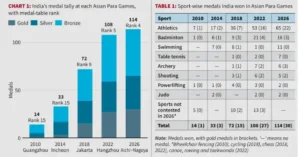
India achieved its best-ever performance at the 2026 Aichi-Nagoya Asian Para Games, winning 114 medals and securing fourth position.

Key Highlights of India’s Performance

  • Total medals: 114, including 30 gold, 35 silver and 49 bronze.
  • Overall ranking: Fourth, India’s highest position in the Asian Para Games.
  • Athlete participation: 168 athletes across 11 sports, compared with 309 athletes across 17 sports at Hangzhou.
  • Previous record: India’s revised Hangzhou tally was 108 medals after three medals were withdrawn for doping violations.
  • Despite fewer sporting opportunities, India achieved a new record.

India’s Progress Over the Years

Asian Para Games

Total Medals

Gold Medals

Guangzhou 2010

14

1

Incheon 2014

33

3

Jakarta 2018

72

15

Hangzhou 2022

108 (revised)

27

Aichi-Nagoya 2026

114

30

  • India’s medal tally has increased substantially since 2010, reflecting sustained progress in para sports.

Improved Medal Efficiency

  • Medals per 100 athletes: Increased from approximately 35 at Hangzhou to 68 at Aichi-Nagoya.
  • Gold-medal efficiency: Increased from 8.7 to approximately 18 gold medals per 100 athletes.
  • Better results suggest stronger athlete preparation, coaching and competitive performance.
  • However, changing event categories and athlete quotas also influence comparisons.

Performance Across Sports

  • Para athletics: India’s strongest discipline, contributing 65 medals, including 22 gold.
  • Swimming: Improved to 11 medals.
  • Table tennis: Increased its contribution to seven medals.
  • Badminton: Recorded 16 medals, compared with 21 at Hangzhou.
  • Archery and shooting: Emerged as important sources of gold medals.
2026 Aichi-Nagoya Asian Para Games

Women’s Participation and Gender Inclusion

  • Women athletes won 36 medals, including 10 gold.
  • Their medal efficiency reached approximately 64 medals per 100 athletes, close to men’s performance.
  • However, women’s share of the contingent declined from 37% at Hangzhou to roughly one-third.
  • This highlights the need to expand opportunities for women with disabilities.

Government Initiatives and Constitutional Linkages

  • Khelo India: Supports grassroots sports development and talent identification.
  • Target Olympic Podium Scheme (TOPS): Provides specialised assistance to selected elite athletes, including para-athletes.
  • Rights of Persons with Disabilities Act, 2016: Promotes equal opportunities and participation in recreational and sporting activities.
  • Article 21: Supports the broader constitutional principle of living with dignity.
  • SDG 10: Emphasises reducing inequalities and promoting inclusion.

Challenges

  • Improve accessible stadiums, transport and specialised training facilities.
  • Expand grassroots talent identification in rural and underserved areas.
  • Strengthen sports science, rehabilitation, nutrition and anti-doping education.
  • Increase women’s participation and international competition exposure.
  • Prepare systematically for the Los Angeles Paralympics 2028.

Conclusion

India’s record Para Games performance demonstrates that sustained investment in accessibility, talent and equal opportunity can transform sporting excellence into genuine social inclusion.

REMOVAL OF THE CHIEF ELECTION COMMISSIONER

TOPIC: (GS2) POLITY: THE HINDU

The Election Commission of India (ECI) informed the Supreme Court that the Chief Election Commissioner (CEC) can be removed only through a procedure similar to that applicable to a Supreme Court judge.

Constitutional Position of the ECI

  • Article 324: Entrusts the ECI with the supervision, direction and control of elections to Parliament, State Legislatures, and the offices of President and Vice-President.
  • The Commission consists of the CEC and other Election Commissioners appointed according to law.
  • Its independence is essential for free and fair elections, a basic feature of India’s constitutional democracy.
 

Removal of the chief Election Commissioner

Removal of the Chief Election Commissioner

  • Article 324(5): The CEC cannot be removed except in the same manner and on the same grounds as a Supreme Court judge.
  • Grounds: Proven misbehaviour or incapacity.
  • Procedure: Requires a parliamentary address supported by a special majority in both Houses, followed by a removal order from the President.
  • Other Election Commissioners: They can be removed only on the recommendation of the CEC, providing a different level of protection.

ECI’s Defence Before the Supreme Court

  • The ECI argued that unverified media reports cannot independently establish allegations of misconduct.
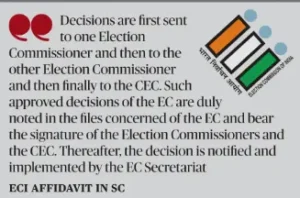
  • It maintained that major decisions are examined and approved by all three Commissioners.
  • Section 18 of the 2023 Act: Differences of opinion are resolved through majority voting.
  • The Commission acknowledged internal correspondence concerning a disputed administrative order but stated that the order was never implemented.

Controversy Over Electoral Roll Revision

  • Special Intensive Revision (SIR): A process intended to verify and update electoral rolls.
  • Form 6: Statutory application used by eligible citizens seeking inclusion in electoral rolls.
  • The ECI denied changing Form 6 and described the additional declaration concerning voter mapping as a separate document.
  • It argued that mapping could simplify verification by reducing the need for further supporting documents.
  • Critics have raised concerns about documentation requirements and possible exclusion of eligible voters.

Democratic and Legal Significance

  • Institutional independence: Removal safeguards protect the CEC against arbitrary political pressure.
  • Collective decision-making: Majority voting discourages concentration of authority.
  • Electoral integrity: Accurate voter lists prevent wrongful inclusion and exclusion.
  • Transparency: Clear procedures and accessible records strengthen public confidence.
  • Judicial review: Courts can examine the legality of ECI actions without automatically interfering with constitutional tenure protections.

Challenges

  • Ensure transparent recording of important Commission decisions.
  • Clearly explain voter verification requirements in regional languages.
  • Provide accessible correction, objection and appeal mechanisms.
  • Strengthen safeguards against arbitrary deletion of eligible voters.
  • Maintain a balance between the ECI’s functional independence and accountability under law.

Conclusion

The Election Commission’s independence must be protected through strong constitutional safeguards, while transparent decisions and fair electoral procedures remain essential to public trust.


FROM CLIMATE TARGETS TO ENERGY JUSTICE AND EQUITABLE ENERGY TRANSITION

TOPIC: (GS3) ENVIRONMENT: THE HINDU

A recent debate has called for shifting global climate policy from emission-reduction targets towards fair energy consumption and national development needs.

Understanding Energy Justice

  • Energy justice means ensuring affordable, reliable and clean energy access for everyone.
  • It recognises differences in historical emissions, economic development and energy consumption among countries.
  • Developed nations have historically consumed more fossil fuels, while developing countries still face energy poverty.
  • Climate action must therefore balance environmental protection with poverty reduction and economic growth.

Limitations of Existing Climate Governance

  • Emission-focused approach: Global negotiations largely emphasise greenhouse gas reduction targets.
  • Unequal responsibilities: Uniform expectations can overlook historical emissions and development differences.
  • Climate finance gap: Developing countries face difficulties obtaining affordable finance and clean technologies.
  • Consumption inequality: Goods manufactured in developing countries are often consumed in wealthier economies.
  • National differences: Countries have different energy resources, infrastructure and development priorities.

3. Changing Global Energy Trends

  • Electrification: Electric vehicles, electric cooking and industrial technologies can reduce fossil-fuel dependence.
  • Renewable expansion: Solar, wind and hydropower increasingly support electricity generation.
  • China’s example: Large-scale renewable installations and electric vehicle adoption demonstrate the importance of government-led infrastructure planning.
  • Emerging economies: India and other developing countries can improve living standards through more energy-efficient development pathways.
  • However, renewable energy requires storage, reliable grids and flexible electricity systems.

India’s Climate Justice Framework

  • CBDR-RC: Common But Differentiated Responsibilities and Respective Capabilities recognises unequal national circumstances.
  • Paris Agreement, 2015: Encourages nationally determined climate commitments.
  • India’s updated NDC: Targets a 45% reduction in emissions intensity of GDP by 2030 from 2005 levels.
  • Non-fossil electricity capacity: India aims for about 50% of cumulative installed electric power capacity from non-fossil sources by 2030.
  • Net-zero target: India has announced a long-term goal for 2070.
  • LiFE initiative: Promotes environmentally responsible lifestyles and consumption.

Challenges

  • Rising electricity demand from urbanisation, industries and digital infrastructure.
  • Continued dependence on coal for reliable electricity.
  • High costs of storage, grid modernisation and clean technologies.
  • Unequal access to energy between regions and income groups.
  • Growing climate disasters affecting agriculture, health and livelihoods.

Way Forward

  • Expand renewable electricity alongside storage and modern transmission networks.
  • Promote energy-efficient buildings, public transport and cleaner industries.
  • Ensure affordable electricity access for vulnerable households.
  • Strengthen domestic manufacturing of clean-energy technologies.
  • Demand predictable climate finance, technology transfer and adaptation support.
  • Improve early-warning systems and regional disaster cooperation.

Conclusion

A fair energy transition must reduce environmental damage while guaranteeing every nation the energy needed for dignity, development and sustainable prosperity.

Write a Review

Your email address will not be published. Required fields are marked *