
Table of Contents
ToggleWARMING HIMALAYAS AND NEED FOR SUSTAINABLE DEVELOPMENT
TOPIC: (GS3) ENVIRONMENT: THE HINDU
Recent floods and glacier-related disasters in Nepal have highlighted the growing vulnerability of the Hindu Kush Himalayan (HKH) region to climate change.
What are the Himalayas?
- The Himalayas are the world’s highest mountain system, formed around 50 million years ago due to the collision of the Indian Plate with the Eurasian Plate.
- They extend approximately 2,400 km from the Indus River in the west to the Brahmaputra River in the east.
- The Himalayan mountain system stretches across India, Nepal, Bhutan, China (Tibet) and Pakistan.
- The Himalayas are broadly divided into three parallel ranges:
- Himadri (Greater Himalayas): Highest range, containing permanently snow-covered peaks.
- Himachal (Lesser Himalayas): Known for valleys, forests and hill stations.
- Shiwaliks (Outer Himalayas): Youngest and southernmost range, consisting largely of unconsolidated sediments.
- Water Tower of Asia: Himalayan glaciers feed major river systems such as the Indus, Ganga and Brahmaputra, supporting millions of people.
- Biodiversity Hotspot: The region supports rich biodiversity, including endangered species such as the snow leopard and red panda.
Why Are the Himalayas Becoming More Vulnerable?
- Rapid warming: High-altitude regions are experiencing accelerated warming, increasing the frequency of climate-related hazards.
- Glacier retreat: Rising temperatures reduce snowfall accumulation and accelerate ice melting, affecting river flows.
- Permafrost thaw: Melting of permanently frozen ground weakens mountain slopes, causing landslides and rockfalls.
- Glacial Lake Outburst Floods (GLOFs): Sudden failure of natural dams releases enormous quantities of water and debris.
- Geological fragility: Young fold mountains, steep slopes and active tectonic processes increase disaster vulnerability.
Major Implications
- Environmental: Loss of biodiversity, changing river ecosystems and declining glacier reserves.
- Economic: Damage to hydropower projects, roads, tourism infrastructure and agricultural livelihoods.
- Social: Displacement, loss of traditional livelihoods and greater vulnerability of remote mountain communities.
- Water security: Changing glacier melt patterns threaten the long-term reliability of Himalayan rivers, including the Ganga and Indus systems.
- Strategic: Damage to border infrastructure and transboundary river systems creates national security and diplomatic challenges.
Challenges in Himalayan Development
- Unplanned construction: Road widening, tunnelling and hill cutting destabilise fragile slopes.
- Hydropower expansion: Projects in hazard-prone valleys face risks from floods, landslides and sediment flows.
- Weak regulation: Project-wise environmental assessments often overlook cumulative ecological impacts.
- Monitoring gaps: Limited high-altitude weather stations and inadequate cross-border data sharing weaken early warning systems.
- Climate injustice: Himalayan communities face severe consequences despite contributing relatively little to global emissions.
Way Forward
- Risk-sensitive planning: Introduce hazard-based land-use zoning and restrict construction in highly vulnerable locations.
- Scientific monitoring: Deploy satellite imagery, drones, automated sensors and community-based early warning systems.
- Sustainable infrastructure: Mandate climate-resilient designs and cumulative environmental impact assessments.
- Regional cooperation: Strengthen glacier monitoring and river-data exchange through institutions such as ICIMOD.
GOVERNMENT INITIATIVES
- National Mission for Sustaining the Himalayan Ecosystem (NMSHE): Supports scientific research and climate adaptation under the National Action Plan on Climate Change.
- National Disaster Management Authority (NDMA): Provides guidelines for managing GLOFs and landslide risks.
- National Mission on Himalayan Studies (NMHS): Promotes conservation, research and sustainable livelihoods.
- Disaster Management Act, 2005: Provides the institutional framework for disaster preparedness and response.
Conclusion
The Himalayas need a development model that places ecological security, disaster resilience and community welfare above short-term economic gains.
DROUGHT MANAGEMENT IN INDIA AND CLIMATE-RESILIENT AGRICULTURE
TOPIC: (GS3) DISASTER MANAGEMENT: THE HINDU
Severe monsoon rainfall shortages have triggered drought conditions in Karnataka and Andhra Pradesh, affecting agriculture, water availability and rural livelihoods.
What is Drought?
- Drought is a prolonged period of below-normal rainfall that causes water shortages, crop losses and ecological stress.
- Meteorological drought: Significant rainfall deficiency compared to the long-term average.
- Agricultural drought: Inadequate soil moisture affecting crop growth and productivity.
- Hydrological drought: Declining water levels in rivers, reservoirs and groundwater.
- Socio-economic drought: Water scarcity disrupts livelihoods, food supply and economic activities.
Major Causes of Drought in India
- Monsoon dependence: Uneven distribution, delayed arrival or early withdrawal of southwest monsoon rainfall.
- El Niño: Warming of the central and eastern equatorial Pacific can weaken India’s summer monsoon, although its effects vary.
- Climate change: Higher temperatures increase evaporation and worsen soil moisture loss.
- Groundwater depletion: Excessive extraction reduces water availability during dry periods.
- Unsustainable agriculture: Cultivation of water-intensive crops in low-rainfall regions increases drought vulnerability.
Impacts of Drought
- Agriculture: Crop failures, reduced yields and declining farmer incomes.
- Economy: Higher food prices, rural unemployment and increased agricultural indebtedness.
- Social: Distress migration, drinking water shortages and greater vulnerability of small farmers.
- Energy: Reduced reservoir storage affects hydropower generation and thermal power plant cooling.
- Example: The 2015–16 drought in Maharashtra’s Marathwada region highlighted the consequences of water-intensive sugarcane cultivation in drought-prone areas.
Challenges
- Delayed assistance: Lengthy assessment and approval procedures can slow financial relief to affected States.
- Exclusion of vulnerable groups: Tenant farmers, sharecroppers and agricultural labourers often struggle to access compensation.
- Poor water governance: Inefficient irrigation, weak groundwater regulation and inadequate rainwater storage worsen scarcity.
- Policy distortions: Subsidised electricity and crop procurement policies may encourage excessive groundwater use.
- Federal concerns: Disagreements over drought assessments and relief allocations can strain Centre-State relations.
Way Forward
- Timely financial support: Expedite IMCT assessments and release justified NDRF assistance through transparent procedures.
- Climate-smart agriculture: Promote millets, pulses, drought-resistant seeds and locally suitable cropping patterns.
- Water conservation: Expand drip irrigation, rainwater harvesting, watershed development and aquifer recharge.
- Inclusive protection: Extend insurance and income support to tenant farmers and other vulnerable agricultural households.
- Better forecasting: Use IMD forecasts, satellite monitoring and soil-moisture data for early drought warnings.
GOVERNMENT INITIATIVES
- Manual for Drought Management, 2016: Provides scientific indicators such as rainfall, vegetation, soil moisture and hydrological conditions for drought assessment.
- SDRF and NDRF: State Disaster Response Fund provides immediate relief, while the National Disaster Response Fund supplements State resources during severe disasters.
- Inter-Ministerial Central Team (IMCT): Assesses drought damage and relief requirements following State requests.
- PM Fasal Bima Yojana (PMFBY): Offers crop insurance protection against notified natural risks.
- Atal Bhujal Yojana: Promotes community-led groundwater management in selected water-stressed areas.
Conclusion
India must shift from drought relief to drought resilience through timely financial support, sustainable water management and climate-adaptive agriculture.
WWF LIVING PLANET REPORT 2026 AND GLOBAL WILDLIFE POPULATION DECLINE
TOPIC: (GS3) ENVIRONMENT: THE HINDU
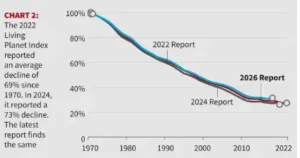
The World Wide Fund for Nature (WWF) Living Planet Index 2026 highlights an average 73% decline in monitored wildlife populations between 1970 and 2022.
What is the Living Planet Index (LPI)?
- Published by: WWF, using scientific data compiled by the Zoological Society of London (ZSL) and its partners.
- Objective: Measures changes in the relative abundance of monitored vertebrate wildlife populations over time.
- Coverage: Includes mammals, birds, reptiles, amphibians and freshwater and marine fish.
- Methodology: Uses population trends and a weighted geometric mean to calculate the overall index.
- Significance: Helps assess biodiversity trends and guide conservation priorities.
Key Findings of the 2026 Report
- Average decline: Monitored wildlife populations recorded an average 73% reduction in the index compared with the 1970 baseline.
- Population trends: Among the studied populations:
- 50% showed declining trends.
- 43% recorded increasing trends.
- 7% remained relatively stable.
- Regional differences: Latin America and the Caribbean experienced the steepest decline (95%), followed by Africa (80%), Asia (49%) and Europe (23%).
- Important clarification: A 73% index decline does not mean 73% of animals have disappeared or 73% of species have become extinct.
Major Causes of Wildlife Decline
- Habitat destruction: Deforestation, agricultural expansion, mining and urbanisation reduce natural habitats.
- Overexploitation: Illegal hunting, overfishing and wildlife trafficking threaten species survival.
- Climate change: Rising temperatures and extreme weather disrupt ecosystems and breeding patterns.
- Pollution: Pesticides, plastics and industrial waste damage terrestrial and aquatic biodiversity.
- Invasive species: Non-native organisms compete with indigenous species for food and habitat.
Limitations of the Living Planet Index
- Limited coverage: Excludes plants and invertebrates from the global index.
- Data gaps: Remote regions and poorly studied species may be underrepresented.
- Changing datasets: New populations and species are added, making direct comparisons between different report editions misleading.
- Statistical variation: Severe losses in some populations can strongly influence the global average.
India’s Biodiversity Conservation Efforts
- Wildlife (Protection) Act, 1972: Provides legal protection to wild animals and regulates hunting and wildlife trade.
- Project Tiger and Project Elephant: Support habitat conservation and protection of flagship species.
Way Forward
- Habitat restoration: Restore degraded forests, wetlands, grasslands and wildlife corridors.
- Scientific monitoring: Expand biodiversity surveys using camera traps, satellite technology and environmental DNA.
- Community participation: Strengthen local conservation initiatives and provide sustainable livelihood opportunities.
- Sustainable development: Integrate biodiversity safeguards into agriculture, infrastructure and urban planning.
- Targeted conservation: Prioritise species and ecosystems facing the most severe population declines.
Conclusion
Biodiversity conservation must move beyond alarming global statistics towards science-based, community-driven action that protects threatened wildlife and restores ecological balance.

ELDERLY CARE IN INDIA AND CAREGIVING WORKFORCE
TOPIC: (GS2) POLITY: THE HINDU
The Union Budget 2026–27 announced plans to train 1.5 lakh caregivers, while NITI Aayog’s 2026 report highlighted the economic importance of caregiving.
Ageing Population in India
- Demographic transition: India’s elderly population (60+) is projected to increase from 149 million in 2022 to 347 million by 2050, accounting for 20.8% of the population.
- Changing family structures: Nuclear families, migration and urbanisation have weakened traditional family-based support.
- Growing healthcare needs: Older people increasingly require assistance with chronic diseases, mobility and mental health.
Why is a Trained Caregiving Workforce Needed?
- Quality healthcare: Skilled caregivers can monitor medicines, recognise emergencies and prevent avoidable hospitalisation.
- Gender equality: Women perform a disproportionate share of unpaid care work, limiting their education and employment opportunities.
- Economic opportunities: Professional caregiving can generate employment, particularly for women and rural youth.
- Dignity of elderly: Trained support promotes independence, emotional well-being and healthy ageing.
- Care economy: Recognising unpaid caregiving as productive work can strengthen India’s economic development.
Challenges in Elderly Care
- Skill shortage: Most family caregivers lack professional training.
- Financial burden: Long-term healthcare and caregiving costs strain household incomes.
- Limited infrastructure: Rural areas face shortages of geriatric specialists and home-based care services.
- Social barriers: Caregiving is often viewed as women’s responsibility rather than a shared duty.
Government Initiatives
- Union Budget 2026–27: Proposed training 1.5 lakh caregivers under the National Skills Qualifications Framework.
- Kudumbashree’s K4 Care (Kerala): Trains women in elderly, patient and disability care.
- ASHA training: Supports community-based elderly care through primary healthcare services.
- Atal Vayo Abhyuday Yojana: Promotes senior citizens’ welfare and support services.
- Ayushman Arogya Mandirs: Support comprehensive primary healthcare, including elderly care.
Way Forward
- Standardised training: Develop certified courses covering physical care, dementia, emergency response and emotional support.
- Institutional framework: Establish a National Caregiver Council to regulate training and professional standards.
- Inclusive caregiving: Encourage men and women to share family caregiving responsibilities.
- Employment protection: Ensure fair wages, social security and safe working conditions.
- Community participation: Use self-help groups, ASHA workers and digital platforms to expand affordable home-based care.
Conclusion
India must transform elderly caregiving from an invisible family responsibility into a skilled, inclusive and dignified profession to achieve healthy ageing and Viksit Bharat@2047.
GLOBAL INITIATIVE ON AI FOR AGRI-FOOD SYSTEMS (GI-AI4FS)
TOPIC: (GS2) POLITY: THE HINDU
India’s Telecommunication Engineering Centre (TEC), under the Department of Telecommunications, hosted the second meeting of the UN Global Initiative on AI for Agri-Food Systems.
About Global Initiative on AI for Agri-Food Systems
- Nature: A United Nations initiative promoting responsible AI adoption in agriculture and food systems.
- Coordinating agency: International Telecommunication Union (ITU).
- Partner organisations: Food and Agriculture Organization (FAO), International Fund for Agricultural Development (IFAD) and World Food Programme (WFP).
- Objective: Develop trustworthy, interoperable and farmer-centric AI technologies.
- Focus: International cooperation, common technical standards and practical agricultural applications.
Significance for Agriculture
- Precision farming: AI supports efficient irrigation, fertiliser application and crop monitoring.
- Climate resilience: Predictive tools help farmers prepare for droughts, floods and pest attacks.
- Food security: Better forecasting reduces crop losses and improves supply chains.
- Farmer empowerment: Digital advisory services provide timely information to small farmers.
- Example: India’s Kisan e-Mitra AI chatbot helps farmers access information on government agricultural schemes.
Challenges
- Limited rural internet connectivity and digital literacy.
- High technology costs and unequal access among small farmers.
- Concerns regarding farmers’ data privacy and algorithmic bias.
About International Telecommunication Union (ITU)
- Established: 1865 as the International Telegraph Union; became a UN specialised agency in 1947.
- Headquarters: Geneva, Switzerland.
- Role: Develops global telecommunications standards and promotes digital connectivity.
- India: Member since 1869 and a regular ITU Council member since 1952.
Conclusion
Responsible and inclusive AI adoption can transform agriculture by improving productivity, strengthening climate resilience and ensuring food security.
NATIONAL HOUSEHOLD TRAVEL SURVEY (NHTS)
TOPIC: (GS2) POLITY: THE HINDU
The National Statistics Office (NSO) released findings from India’s first National Household Travel Survey (NHTS).
About National Household Travel Survey
- Conducted by: National Statistics Office (NSO), under the Ministry of Statistics and Programme Implementation (MoSPI).
- Objective: Generate reliable data for transport planning, infrastructure development and public policy.
- Coverage: Examines travel purposes, transport modes, journey distances, travel time and expenditure.
- Travel purposes: Employment, education, healthcare, caregiving, tourism and social activities.
Key Findings
- Student mobility: Among students aged 15–29, regular educational travel participation was 79.1% in rural areas and 73.3% in urban areas.
- Gender gap: 61.9% of male workers undertook daily work trips exceeding 1 km, compared with 41.9% of female workers.
- Commuting expenditure: Average monthly workplace travel cost was ₹785, with ₹1,044 in urban areas and ₹612 in rural areas.
Significance
- Urban planning: Supports better public transport networks and reduces traffic congestion.
- Gender equality: Highlights the need for safe, affordable transport for women.
- Rural connectivity: Helps identify transport gaps affecting education and employment.
- Economic development: Improved mobility enhances labour participation and productivity.
Way Forward
- Expand affordable public transport and last-mile connectivity.
- Improve pedestrian infrastructure and women’s safety.
- Integrate NHTS findings with PM Gati Shakti and urban mobility planning.
Conclusion
Evidence-based, affordable and inclusive transport planning is essential for equitable mobility and sustainable economic development in India.
GLOBAL INNOVATION INDEX 2026
TOPIC: (GS3) SCIENCE AND TECHNOLOGY: THE HINDU
India has secured the 38th position among 139 economies in the Global Innovation Index (GII) 2026, according to the figures provided.
About Global Innovation Index
- Published by: World Intellectual Property Organization (WIPO), a UN specialised agency headquartered in Geneva.
- Launched: 2007; published annually.
- Objective: Measures countries’ innovation capabilities and performance.
- Indicators: Covers institutions, human capital, research, infrastructure, market development, business sophistication, knowledge outputs and creativity.
Key Highlights of GII 2026
- Coverage: 19th edition, assessing 139 economies.
- Global rankings: Switzerland (1st), Sweden (2nd) and United States (3rd).
- India’s position: 38th globally.
- Regional leadership: India ranks first among lower-middle-income economies and in Central and Southern Asia.
- Innovation clusters: Identifies leading centres of research, patents and technological development.
Significance for India
- Economic growth: Innovation improves productivity, competitiveness and high-value employment.
- Digital leadership: India ranks first globally in ICT services exports.
- Innovation efficiency: India ranks 25th in innovation outputs against 49th in inputs.
- Innovation hubs: Bengaluru, Delhi, Mumbai and Chennai feature among the world’s top 100 innovation clusters.
Conclusion
India must convert its innovation potential into scientific breakthroughs, quality employment and globally competitive technologies to achieve Viksit Bharat@2047.