
Table of Contents
ToggleAngioplasty
Recent remarks by the Kerala Chief Minister questioning the need for some “unnecessary” angioplasty procedures have sparked discussion among medical organisations. The debate has highlighted the importance of ensuring that patients receive evidence-based treatment while maintaining public confidence in qualified medical professionals.
About Angioplasty
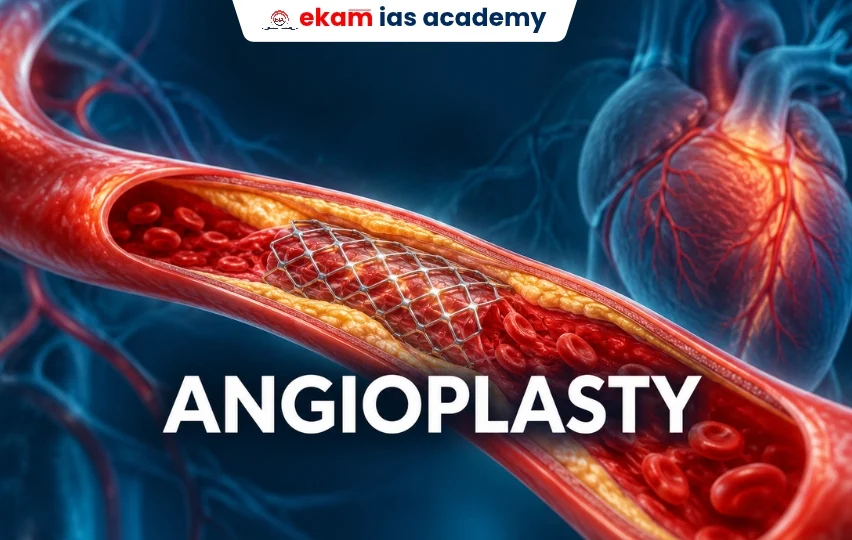
Angioplasty is a minimally invasive medical procedure used to widen a narrowed or blocked artery and improve blood flow. The term combines “angio”, referring to a blood vessel, and “plasty”, meaning to reshape or open.
The procedure is commonly used to treat atherosclerosis, a condition in which fatty deposits containing cholesterol and other substances accumulate inside arteries. Depending on the location and severity of the blockage, restoring blood flow may help reduce the risk of serious complications such as heart attack or stroke.
Compared with major surgical procedures such as bypass surgery, angioplasty is generally less invasive and involves a shorter recovery process.
Types of Angioplasty
The two major categories are:
- Coronary Angioplasty: Also known as Percutaneous Coronary Intervention (PCI), it is performed on the coronary arteries that supply blood to the heart.
- Peripheral Angioplasty: This procedure is used to improve blood flow through peripheral arteries, including vessels supplying the arms and legs.
Different Angioplasty Techniques
Several techniques may be used depending on the patient’s condition and the location of the blockage.
- Balloon Angioplasty: A small balloon is guided into the narrowed section of an artery and inflated to push plaque against the arterial wall, improving the passage for blood.
- Angioplasty with or without Stenting: A small mesh tube called a stent may be placed to help keep the artery open after it has been widened. The decision depends on clinical circumstances.
- Excimer Laser Coronary Angioplasty (ELCA): In selected cases, a laser is used to remove or modify plaque instead of relying primarily on a balloon. This technique is less commonly used.
The choice of procedure depends on factors such as the severity and location of arterial narrowing and the patient’s overall clinical condition.


FAQs - Angioplasty
What is angioplasty?
Angioplasty is a minimally invasive procedure used to widen narrowed or blocked arteries and improve blood flow.
What are the main types of angioplasty?
Coronary angioplasty treats arteries supplying the heart, while peripheral angioplasty treats arteries outside the heart, including those supplying the arms and legs.
How does balloon angioplasty work?
A catheter carries a small balloon to the narrowed part of an artery. The balloon is inflated to widen the passage and improve blood flow.
Is a stent always required during angioplasty?
No. A stent may be inserted to help keep the artery open, depending on the blockage and the patient’s clinical condition.
How is angioplasty different from bypass surgery?
Angioplasty widens an existing artery using a catheter. Bypass surgery creates an alternative route for blood flow around a blockage. Angioplasty is generally less invasive.