Table of Contents
ToggleArticle 40 of the Indian Constitution
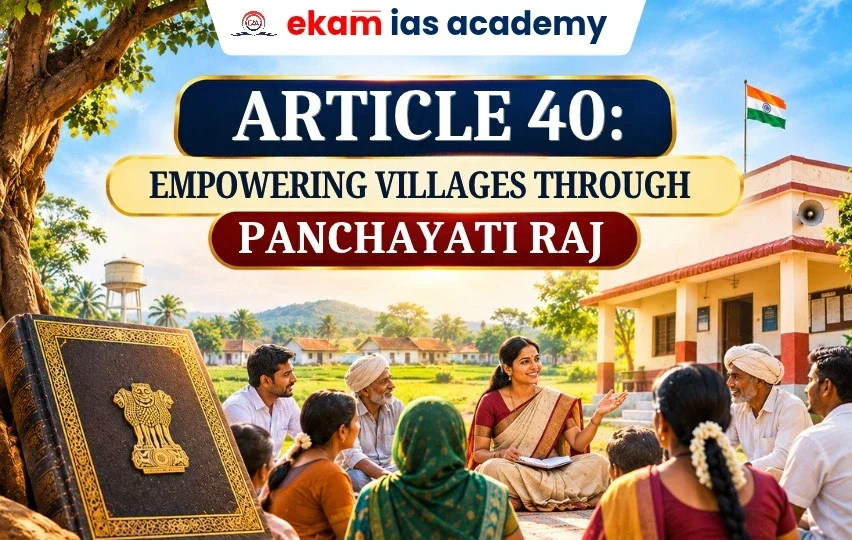
- Article 40 of the Indian Constitution stands as the foundational constitutional mandate for establishing Local Self-Government in India and empowering rural communities.
- Mastering Article 40 UPSC concepts is vital for civil services aspirants studying Directive Principles of State Policy UPSC, Part IV of Indian Constitution, and Indian Polity UPSC modules.
- This provision envisions decentralized grassroots governance by directing the State to organize village panchayats and endow them with self-governing powers.
- A comprehensive analysis of Article 40 Explained provides candidates with deep insights into Rural Local Governance and the journey toward the Constitutional Status of Panchayats.
Constitutional Provision – Article 40
- Textual Mandate: Directs that the State shall take steps to organize village panchayats and endow them with such powers and authority as may be necessary to enable them to function as units of self-government.
- Non-Justiciable Directive: Located in Part IV, Article 40 Constitution of India is non-enforceable by courts under Article 37, yet fundamental in state governance.
- Decentralized Governance Goal: Moves beyond mere administrative delegation to establish genuine participatory self-rule at the village level.
- Legislative Guidance: Serves as the primary constitutional benchmark guiding Union and State enactments on Organisation of Village Panchayats.
Municipal Council: Meaning and Composition
- Definition: A urban local governing body constituted for a smaller urban area based on demographic size, density, non-agricultural employment, and local revenue.
- Elected Representatives: Composed of Ward Councillors directly elected by voters residing within designated territorial ward constituencies.
- Nominated Members: Includes individuals with special knowledge or experience in municipal administration, appointed as per state laws (without voting rights in council elections).
- Ex-Officio Representation: Grants representation to Members of Parliament (MPs) and Members of Legislative Assemblies (MLAs) representing the municipal constituency.
Historical Background
- Ancient Indian Roots: Draws inspiration from traditional self-governing village communities (Sabhas and Samitis) in ancient and medieval India.
- Constituent Assembly Debates: Initially omitted from the Draft Constitution by Dr. B.R. Ambedkar, sparking intense debate among rural governance advocates.
- K. Santhanam Amendment: Incorporated into the final Constitution following an amendment moved by K. Santhanam to reflect rural democratic aspirations.
- Post-Independence Trajectory: Transitioned from a non-binding moral directive in 1950 to a mandatory constitutional structure over four decades.
Article 40 and Gandhian Principles
- Gram Swaraj Vision: Embodies Mahatma Gandhi’s philosophy of Gram Swaraj (village self-rule), viewing villages as self-sufficient democratic republics.
- Bottom-Up Democracy: Rejects top-down bureaucratic centralization in favor of participatory decision-making starting from the grassroots.
- Social and Economic Regeneration: Aligns with Gandhian ideals of rural upliftment, cottage industry promotion, and community self-reliance.
- Ideological Pillar: Forms the cornerstone of the Gandhian classification within Article 39 & Article 40 Directive Principles of State Policy.
Article 40 and Other Constitutional Provisions
- Seventh Schedule Linkage: Connects with Entry 5 of the State List (List II), which assigns local government powers to State Legislatures.
- Part IX Integration: Found concrete institutional expression through Part IX (Articles 243 to 243O), added in 1992.
- Article 243I & 243K Synergy: Supported by the State Finance Commission and State Election Commission to ensure fiscal and electoral autonomy for panchayats.
- Article 37 Context: Operates under the overarching rule of Article 37, obligating the State to apply these decentralization principles in law-making.
Evolution of Panchayati Raj in India
- Balwant Rai Mehta Committee (1957): Recommended the establishment of a three-tier Panchayati Raj System, leading to its first inauguration in Nagaur, Rajasthan (1959).
- Ashok Mehta Committee (1977): Suggested a two-tier system, official participation of political parties, and constitutional recognition for panchayats.
- G.V.K. Rao Committee (1985): Emphasized regular elections and revitalizing district-level planning to prevent “grass without roots.”
- L.M. Singhvi Committee (1986): Strongly recommended granting constitutional status to Panchayati Raj Institutions and establishing Nyaya Panchayats.
Article 40 vs Article 243G
← Swipe left or right to view the full comparison →
| Comparison Feature | Article 40 (Part IV) | Article 243G (Part IX) |
|---|---|---|
| Constitutional Status | Original Directive Principle of State Policy, in force since 1950. | Inserted by the 73rd Constitutional Amendment Act, 1992. |
| Legal Enforceability | Non-justiciable under Article 37, but fundamental in governance. | A constitutional enabling provision. Actual devolution of powers depends on laws made by State Legislatures. |
| Nature of Mandate | Directs the State to organise village panchayats and endow them with powers and authority to function as units of self-government. | Enables State Legislatures, by law, to endow panchayats with powers, authority and responsibilities needed for self-government. |
| Functional Scope | Provides a broad vision of village self-government without listing specific subjects. | Covers preparation of plans for economic development and social justice, and implementation of entrusted schemes, including those concerning the Eleventh Schedule. |
73rd Constitutional Amendment Act, 1992
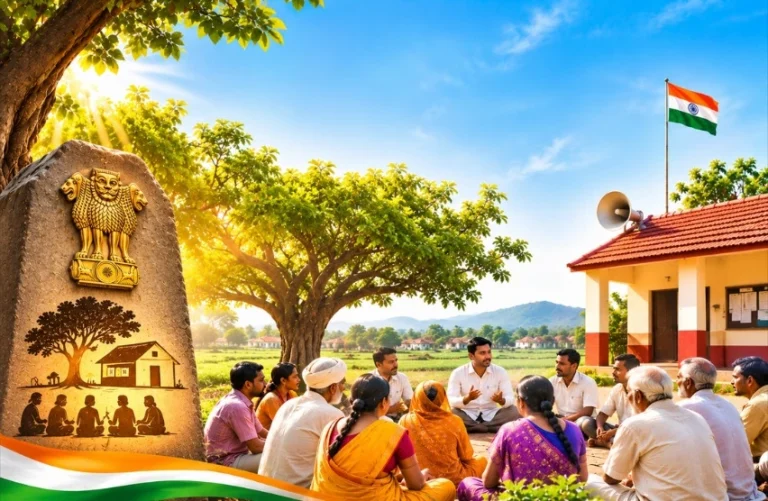
- Constitutional Recognition: Fulfilled the long-standing mandate of Article 40 by adding Part IX and the Eleventh Schedule to the Constitution.
- Mandatory Structural Framework: Made regular five-year elections, reservation of seats for SCs, STs, and women (one-third minimum), and Gram Sabhas compulsory across states.
- Justiciable Backing: Transformed the non-justiciable directive of Article 40 of the Indian Constitution into an enforceable constitutional obligation.
- Grassroots Democratization: Ushered in the third tier of Indian federalism through the 73rd Constitutional Amendment Act.
Three-Tier Panchayati Raj System
- Gram Panchayat (Village Level): The foundational executive body operating at the village or group-of-villages level (Gram Panchayat in India).
- Panchayat Samiti (Intermediate/Block Level): Acts as the coordinating block-level body linking village institutions with district administration.
- Zilla Parishad (District Level): Functions as the apex supervisory and planning body at the district level.
- Population Exemption: States having a population not exceeding 20 lakhs are exempted from constituting the intermediate tier.
Gram Sabha and Its Importance
- Constitutional Definition (Article 243A): Comprises all persons registered in the electoral rolls relating to a village within the Panchayat area.
- Direct Democracy Forum: Functions as the primary assembly of direct democracy where citizens directly deliberate on local governance.
- Social Audit Mechanism: Exercises powers to approve village development plans, identify beneficiaries, and conduct social audits of public funds.
- Executive Accountability: Holds the elected Gram Panchayat accountable for administrative transparency and budget utilization.
Eleventh Schedule – 29 Subjects
- Functional Devolution: Contains 29 functional items placed within the purview of Panchayats under Article 243G.
- Agrarian and Rural Economy: Covers agriculture, land improvement, minor irrigation, animal husbandry, fisheries, and social forestry.
- Infrastructure and Welfare: Encompasses rural housing, drinking water, rural roads, electrification, poverty alleviation programs, and primary education.
- Local Empowerment: Enables decentralized planning and execution of socio-economic development schemes tailored to local village needs.
Conclusion
- Article 40 of the Indian Constitution laid the ideological bedrock for transforming India into a vibrant participatory democracy.
- Through the 73rd Constitutional Amendment Act, its Gandhian vision of Gram Swaraj achieved permanent constitutional protection and institutional depth.
- Comprehensive mastery of Article 40 Directive Principles of State Policy and Part IX equips civil services aspirants to write high-scoring analytical answers in Indian Polity UPSC examinations.
UPSC Prelims: PYQs & Practice Questions
Previous Year Questions (Prelims)
Q: Consider the following statements:
1. The minimum age prescribed for any person to be a member of Panchayat is 25 years.
2. A Panchayat reconstituted after premature dissolution continues only for the remainder period.
Which of the statements given above is/are correct?
(a) 1 only
(b) 2 only
(c) Both 1 and 2
(d) Neither 1 nor 2
Answer: (b) 2 only
Explanation:
Statement 1 is incorrect: Under Article 243F, the minimum age required to contest Panchayat elections is 21 years, not 25 years. The 25-year minimum age applies to elections to the Lok Sabha and State Legislative Assemblies.
Statement 2 is correct: Under Article 243E, if a Panchayat is dissolved before the expiry of its normal five-year term, the reconstituted Panchayat continues only for the remainder of the period for which the dissolved Panchayat would have continued.
Q: Which of the following provisions of the Constitution of India have a bearing on Education?
1. Directive Principles of State Policy
2. Rural and Urban Local Bodies
3. Fifth Schedule
4. Sixth Schedule
5. Seventh Schedule
Select the correct answer using the code given below:
(a) 1 and 2 only
(b) 3, 4 and 5 only
(c) 1, 2 and 5 only
(d) 1, 2, 3, 4 and 5
Answer: (d) 1, 2, 3, 4 and 5
Explanation:
Directive Principles of State Policy: Articles 41, 45, and 46 directly address education, while Article 40 provides for the organization of village Panchayats as self-governing units.
Rural and Urban Local Bodies: The Eleventh Schedule includes education, including primary and secondary schools, among the subjects that may be devolved to Panchayats. The Twelfth Schedule also contains functions relating to education and cultural aspects of urban governance.
Fifth, Sixth and Seventh Schedules: The Fifth and Sixth Schedules provide for autonomous administration in Scheduled and tribal areas, while the Seventh Schedule places Education in the Concurrent List under Entry 25.
Practice Questions
Q: With reference to Article 40 of the Indian Constitution, consider the following statements:
1. It is classified under the Gandhian principles of the Directive Principles of State Policy in Part IV.
2. It originally contained a detailed three-tier structural framework and a list of 29 functional subjects for village panchayats.
3. Its constitutional objective was legally realized through the enactment of the 73rd Constitutional Amendment Act, 1992.
Which of the statements given above are correct?
(a) 1 and 2 only
(b) 1 and 3 only
(c) 2 and 3 only
(d) 1, 2, and 3
Answer: (b) 1 and 3 only
Explanation:
Statement 1 is correct: Article 40 embodies Mahatma Gandhi's vision of Gram Swaraj (village self-rule) and is categorized under the Gandhian principles of Part IV.
Statement 2 is incorrect: Originally, Article 40 was a concise, non-justiciable policy directive without any structural tier specification or subject list. The three-tier structure and the Eleventh Schedule (29 subjects) were added later by the 73rd Amendment Act, 1992.
Statement 3 is correct: The 73rd Constitutional Amendment Act gave practical, enforceable shape to Article 40 by adding Part IX (Articles 243 to 243O) to the Constitution.
Q: Consider the following committees associated with the evolution of Panchayati Raj Institutions pursuant to Article 40:
1. Balwant Rai Mehta Committee (1957): Recommended a three-tier Panchayati Raj system.
2. Ashok Mehta Committee (1977): Recommended a two-tier system and constitutional recognition for Panchayats.
3. L.M. Singhvi Committee (1986): Recommended establishing Nyaya Panchayats and granting constitutional status to local self-government.
Which of the pairs given above are correctly matched?
(a) 1 and 2 only
(b) 2 and 3 only
(c) 1 and 3 only
(d) 1, 2, and 3
Answer: (d) 1, 2, and 3
Explanation:
Pair 1 is correctly matched: The Balwant Rai Mehta Committee (1957) coined the term "democratic decentralization" and proposed the three-tier structure comprising Gram Panchayat, Panchayat Samiti, and Zilla Parishad.
Pair 2 is correctly matched: The Ashok Mehta Committee (1977) recommended replacing the three-tier system with a two-tier model consisting of Zilla Parishad and Mandal Panchayat and advocated constitutional status.
Pair 3 is correctly matched: The L.M. Singhvi Committee (1986) emphasized the revitalization of Panchayati Raj Institutions for democracy and development and recommended a new chapter in the Constitution to recognize and protect Panchayats.
UPSC Mains – Previous Year & Practice Questions
Mains Previous Year Questions
Question: The strength and sustenance of local institutions in India has shifted from their formative phase of “Functions, Functionaries and Funds” to the contemporary stage of “Functionality”. Highlight the critical challenges faced by local institutions in terms of their functionality in recent times. (Mains 2020 – GS Paper II)
Question: Examine the role of the Gram Sabha in strengthening grassroots democracy and ensuring accountability in the functioning of Panchayati Raj Institutions. (Mains 2017 – GS Paper II)
Question: In absence of a well-educated and organized local level government system, “Panchayats” and “Samitis” have remained mainly political institutions and not effective instruments of governance. Critically discuss. (Mains 2015 – GS Paper II)
Question: Discuss the constitutional and operational journey of village panchayats from a non-justiciable directive under Article 40 to a mandatory third tier of federalism. (Mains 2013 – GS Paper II)
Question: Evaluate the significance of the 73rd Constitutional Amendment Act in fulfilling the Gandhian vision of Gram Swaraj enshrined in Article 40. (Mains 2009 – GS Paper II / Public Administration)
Mains Practice Questions
[15 Marks | 250 Words]
Question: While Article 40 envisioned village panchayats as autonomous “units of self-government”, inadequate devolution of the 3Fs (Funds, Functions, and Functionaries) under Article 243G continues to restrict them to mere implementing agencies. Critically analyze.
[15 Marks | 250 Words]
Question: Trace the ideological debate in the Constituent Assembly surrounding the inclusion of Article 40. How did subsequent committee recommendations bridge the gap between Dr. B.R. Ambedkar’s skepticism and Mahatma Gandhi’s vision of Gram Swaraj?
[10 Marks | 150 Words]
Question: Examine how the Gram Sabha acts as the cornerstone of direct democracy at the village level, transforming the constitutional mandate of Article 40 into participatory governance.


Article 40 of the Indian Constitution-FAQs
What is Article 40 of the Indian Constitution?
Article 40 directs the State to organize village panchayats and provide them with the powers necessary to function as units of self-government.
Is Article 40 legally enforceable?
No. Article 40 is part of the Directive Principles of State Policy and is non-justiciable under Article 37, but it remains fundamental to governance.
How did the 73rd Constitutional Amendment strengthen Article 40?
The 73rd Constitutional Amendment Act, 1992 gave constitutional status to Panchayati Raj Institutions through Part IX and the Eleventh Schedule, providing an institutional framework for rural self-government.
What is the relationship between Article 40 and Article 243G?
Article 40 provides the broad vision of village self-government, while Article 243G enables State Legislatures to devolve powers and responsibilities to Panchayats for economic development and social justice.
What are the three tiers of Panchayati Raj?
The system generally consists of the Gram Panchayat, Panchayat Samiti and Zilla Parishad at the village, intermediate and district levels respectively. States with a population not exceeding 20 lakh may not constitute the intermediate tier.