Table of Contents
ToggleTurning Battery Waste into Strategic Mineral Wealth
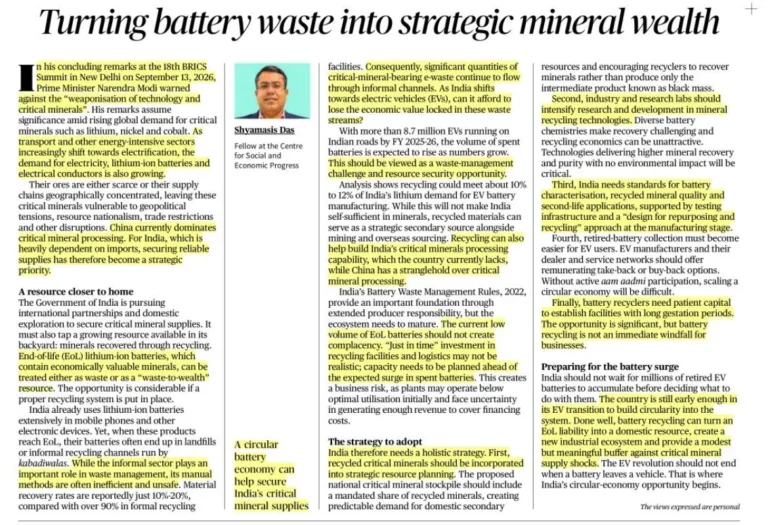
India’s rapid transition towards electric mobility is increasing demand for critical minerals such as lithium, nickel and cobalt. At the same time, growing volumes of end-of-life lithium-ion batteries present both a waste-management challenge and an opportunity to strengthen India’s critical-mineral security.
Why Critical Minerals Matter
Critical minerals are essential for:
- Electric vehicles and lithium-ion batteries
- Renewable-energy technologies
- Electrical conductors and advanced industries
- Strategic and high-technology sectors
Their supply chains are geographically concentrated, while China has a dominant position in critical-mineral processing. For an import-dependent country like India, securing reliable supplies has therefore become a strategic priority.
Battery Waste as a Resource
India has more than 8.7 million EVs on its roads, and the volume of spent batteries is expected to increase substantially.
End-of-life lithium-ion batteries contain valuable minerals that can be recovered through recycling. However, a significant proportion of used batteries currently enters informal recycling channels or landfills.
The editorial notes that informal recycling has relatively low recovery rates of around 10–20%, compared with over 90% in formal recycling.
Effective recycling can potentially meet around 10–12% of India’s lithium demand for EV-battery manufacturing.
While this cannot make India mineral self-sufficient, it can provide a strategic secondary source alongside mining and overseas supplies.
Battery Waste Management Rules, 2022
The Battery Waste Management Rules, 2022 provide an important regulatory foundation through the principle of Extended Producer Responsibility (EPR).
However, the recycling ecosystem needs to expand in anticipation of the future surge in retired EV batteries. Insufficient recycling capacity could result in under-utilised facilities initially and inadequate capacity later.
Way Forward
India needs a comprehensive circular-economy strategy:
Include recycled critical minerals in the proposed national critical-mineral stockpile.
Increase R&D in battery-mineral recovery and recycling technologies.
Establish standards for battery characterisation and recycled-mineral quality.
Strengthen collection and take-back systems for end-of-life batteries.
Promote battery design for repurposing and recycling.
Integrate informal recyclers into safer and formalised systems.
Provide patient capital because battery-recycling businesses require long gestation periods.
Conclusion
India’s EV transition should not end with the sale of vehicles. Battery recycling can transform end-of-life batteries into a domestic resource, reduce dependence on imported critical minerals and strengthen India’s circular economy. The emerging challenge is therefore not merely waste management but resource security and strategic resilience.
Vocabulary
1. Critical Minerals – Minerals essential for strategic industries.
2. Urban Mining – Recovering valuable materials from discarded products.
3. Extended Producer Responsibility (EPR) – Producers’ responsibility for end-of-life waste management.
Prelims MCQs
MCQ 1
Consider the following statements:
1. Lithium, nickel and cobalt are used in certain lithium-ion battery chemistries.
2. India’s Battery Waste Management Rules, 2022 incorporate Extended Producer Responsibility.
3. Recycling lithium-ion batteries eliminates India’s need for critical mineral imports.
Which are correct?
A) 1 and 2 only
B) 2 and 3 only
C) 1 and 3 only
D) 1, 2 and 3
Answer: A
UPSC Mains Question
“Battery recycling can strengthen India’s critical mineral security.” Discuss the opportunities and challenges. (10 Marks)
Frequently Asked Questions (FAQs)
Why are lithium, nickel and cobalt called critical minerals?
They are essential for important technologies while their supply chains face geographical concentration and potential disruptions.
How can battery recycling improve mineral security?
It can recover valuable minerals from spent batteries and create a secondary domestic source of critical minerals.
What is Extended Producer Responsibility (EPR)?
EPR makes producers responsible for managing products and their waste during the relevant stages of their lifecycle.
Can battery recycling make India self-sufficient in critical minerals?
No. It can supplement mining and overseas sourcing and reduce vulnerability to supply disruptions.
What is the UPSC relevance?
The issue links critical minerals, EVs, circular economy, waste management, resource security, clean energy transition and environmental governance.
Source From : The Hindu
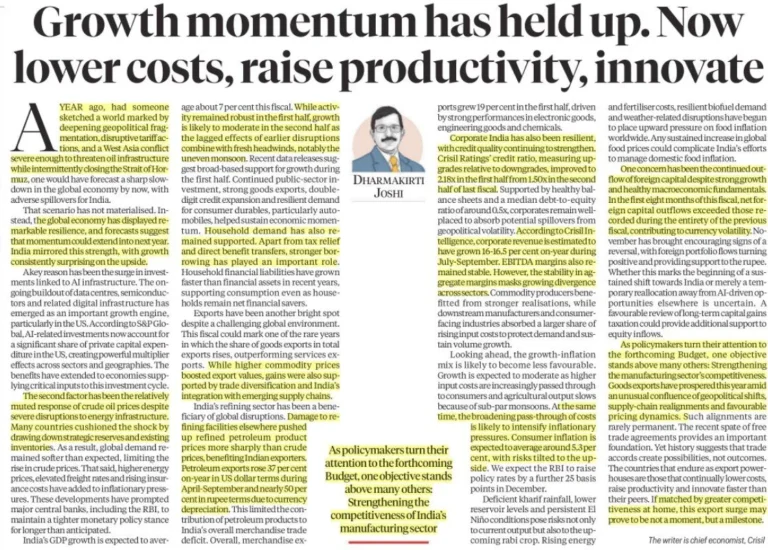
India’s Growth Momentum: Lower Costs, Higher Productivity and Innovation
India’s economic growth has remained resilient despite geopolitical fragmentation, tariff disruptions and the West Asia conflict. However, with growth expected to moderate, the policy challenge is to reduce costs, improve productivity and strengthen innovation to sustain long-term economic momentum.
Current Growth Drivers
India’s growth has received broad-based support from:
- Strong public-sector investment.
- Resilient domestic demand.
- Double-digit credit expansion.
- Growth in consumer durables and automobiles.
- Robust goods exports.
- Household consumption supported by tax relief and direct benefit transfers.
Goods exports grew strongly in the first half of the fiscal year, supported by electronics, engineering goods and chemicals. Supply-chain diversification has also created opportunities for Indian exporters.
Emerging Challenges
Despite resilience, several risks remain.
1. Global Uncertainty
Geopolitical tensions, tariff disruptions and changes in global supply chains could affect trade and investment.
2. Inflation Risks
An uneven monsoon, deficient rainfall, lower reservoir levels and persistent El Niño conditions could affect agricultural output and food prices.
3. Cost Pressures
Higher input costs and commodity-price volatility can affect consumers and businesses, potentially limiting the pace of domestic demand.
4. Capital Flows
Foreign portfolio investment remains sensitive to global interest rates, geopolitical developments and relative returns. A sustained reversal in capital flows could affect financial markets.
Policy Priorities
The editorial highlights the need for the forthcoming Budget and economic policy to focus on manufacturing competitiveness.
India needs to:
- Reduce logistics and input costs.
- Improve infrastructure and supply-chain efficiency.
- Strengthen manufacturing ecosystems.
- Promote technological innovation and R&D.
- Improve productivity across sectors.
- Encourage greater integration into global value chains.
- Build resilience against geopolitical supply disruptions.
- Create an environment conducive to long-term private investment.
India’s export performance shows that diversification can create new opportunities. However, sustained competitiveness requires productivity improvements rather than relying only on favourable external conditions.
Conclusion
India has demonstrated considerable economic resilience despite a challenging global environment. The next phase of growth must therefore move beyond demand-led expansion towards productivity-led, innovation-driven and export-oriented growth. Lower costs, stronger manufacturing capabilities and technological innovation can help India convert its current resilience into durable long-term competitiveness.
Vocabulary
1. Economic Resilience – Ability to withstand economic shocks.
2. Cost-Push Inflation – Price rise caused by higher production costs.
3. Manufacturing Competitiveness – Ability to produce efficiently and compete globally.
Prelims MCQs
MCQ 1
Consider the following statements:
1. Currency depreciation can improve export price competitiveness.
2. Cost-push inflation may arise from rising energy prices.
3. Higher labour productivity necessarily increases production costs.
Which are correct?
A) 1 and 2 only
B) 2 and 3 only
C) 1 and 3 only
D) 1, 2 and 3
Answer: A
UPSC Mains Question
“Sustained economic growth requires productivity and competitiveness beyond short-term resilience.” Discuss. (10 Marks)
Frequently Asked Questions (FAQs)
Why has India’s growth remained resilient?
Strong domestic demand, public investment, credit expansion, exports and resilient corporate activity have supported growth.
What are the major risks to India’s growth?
Geopolitical tensions, tariff disruptions, uneven monsoons, inflationary pressures, energy prices and volatile capital flows.
Why is manufacturing competitiveness important?
It can raise productivity, create employment, strengthen exports and integrate India more deeply into global value chains.
How can India sustain long-term growth?
By reducing costs, improving infrastructure and productivity, encouraging innovation and strengthening domestic manufacturing and supply chains.
What is the UPSC relevance?
The topic connects economic growth, inflation, manufacturing, exports, FDI/FPI, productivity, supply chains and Budget priorities, making it relevant to GS Paper III – Indian Economy.