Table of Contents
ToggleArticle 44 of the Indian Constitution
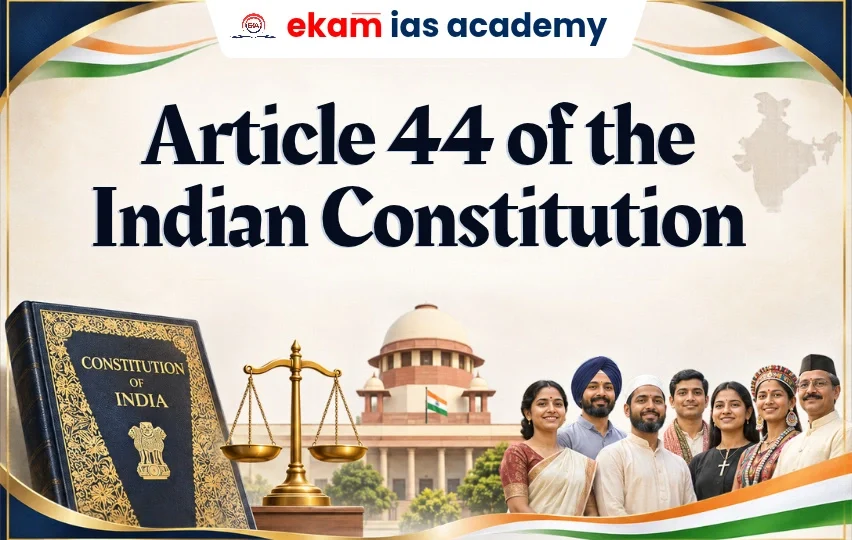
- Article 44 of the Indian Constitution serves as a pivotal directive in Part IV of Indian Constitution, advocating for a single legal code governing personal matters for all citizens.
- Mastering Article 44 UPSC nuances is indispensable for civil services candidates preparing for Directive Principles of State Policy UPSC and Indian Polity UPSC modules.
- The provision aims to replace diverse religious and customary laws with a Common Civil Code in India to advance national integration and gender justice.
- A detailed breakdown of Article 44 Explained provides aspirants with critical insights into the Uniform Civil Code Debate and Article 44 Constitution of India jurisprudence.
Constitutional Provision – Article 44
- Textual Mandate: Directs that the State shall endeavour to secure for the citizens a Uniform Civil Code (UCC) throughout the territory of India.
- Liberal-Intellectual Classification: Categorized under the liberal-intellectual principles of Article 44 Directive Principles of State Policy alongside Articles 45, 50, and 51.
- Non-Justiciable Nature: Governed by Article 37, making it unenforceable by courts while remaining fundamental to state law-making.
- Citizenship-Centric Framing: Framed specifically for “citizens” rather than religious communities, emphasizing equal individual rights across India.
Historical Background of Uniform Civil Code
- Lex Loci Report (1840): Recommended uniform codification of Indian criminal, contract, and evidence laws while leaving religious personal laws untouched.
- Queen’s Proclamation (1859): Formalized the British colonial policy of strict non-interference in religious customs and family laws.
- Pre-Independence Social Reforms: Enactments like the Special Marriage Act, 1872 and Hindu Women’s Right to Property Act, 1937 initiated gradual civil codification.
- Post-Independence Hindu Code Bills (1955–56): Codified and modernized laws governing Hindus, Buddhists, Jains, and Sikhs as a stepping stone toward a Uniform Civil Code in India.
Constituent Assembly Debates on UCC
- Draft Article 35 Debate (November 1948): Witnessed intense ideological clashes between progressive reformers and minority community representatives.
- Proponents’ Standpoint: Dr. B.R. Ambedkar, K.M. Munshi, and Alladi Krishnaswami Ayyar argued that a UCC was vital for national consolidation and women’s equality.
- Opponents’ Apprehensions: Members like Mohammad Ismail and Naziruddin Ahmad feared that a uniform code would infringe upon religious freedom and minority cultural identity.
- Constitutional Compromise: To maintain social harmony, the framers placed UCC in Part IV rather than Part III, with Ambedkar suggesting an initial voluntary phase.
Meaning and Scope of Uniform Civil Code
- Personal Law Domain: Encompasses civil matters currently governed by religious scriptures and customs—specifically marriage, divorce, maintenance, adoption, guardianship, and inheritance.
- Exclusion of Criminal & Commercial Laws: Does not affect criminal, tax, or contract laws, which are already uniform across India.
- Substantive Gender Parity: Seeks to eliminate patriarchal discrimination in property inheritance, polygamy, and unilateral divorce across all communities.
- Secular Legal Framework: Ensures every citizen is governed by identical civil rights irrespective of religion, caste, or sect.
Constitutional Provisions Related to UCC
- Article 14 & 15 (Equality): Guarantees equality before law and prohibits discrimination on grounds of religion or sex, reinforcing the case for gender-just civil laws.
- Article 25 (Freedom of Religion): Protects freedom of conscience and religious practice, subject to public order, morality, health, and other Fundamental Rights.
- Article 29 & 371: Safeguards cultural rights of minorities and special customary protections for tribal communities in Northeastern states (e.g., Nagaland, Mizoram).
- Seventh Schedule (Entry 5, Concurrent List): Empowers both Parliament and State Legislatures to legislate on marriage, divorce, adoption, and succession.
Uniform Civil Code and Personal Laws in India
- Fragmented Legal Landscape: Currently, Personal Laws in India vary significantly across Hindus, Muslims, Christians, Parsis, and Jews.
- Optional Secular Remedies: Statutes like the Special Marriage Act, 1954 and Juvenile Justice Act, 2015 already offer religion-neutral civil alternatives.
- Uniformity vs. Reform Debate: The 21st Law Commission (2018) observed that a UCC was neither necessary nor desirable at that stage, advocating instead for reforming discriminatory practices within existing personal laws.
- Harmonizing Secularism: Reinforces Uniform Civil Code and Secularism by separating religion from civil legal status.
Landmark Supreme Court Judgments on UCC
- Mohd. Ahmed Khan v. Shah Bano Begum (1985): Upheld a divorced Muslim woman’s right to maintenance under Section 125 CrPC and urged Parliament to frame a common civil code for national integration.
- Sarla Mudgal v. Union of India (1995): Ruled that converting to Islam solely to contract a second marriage without dissolving the first Hindu marriage constitutes bigamy, emphasizing the urgency of Article 44.
- John Vallamattom v. Union of India (2003): Struck down discriminatory provisions of the Indian Succession Act, 1925 affecting Christians, lamenting that Article 44 remained a dead letter.
- Shayara Bano v. Union of India (2017): Declared instant triple talaq (talaq-e-biddat) unconstitutional, affirming that personal laws cannot violate fundamental rights to equality and dignity.
Goa Civil Code – A Case Study
- Portuguese Civil Code of 1867: Retained after Goa’s liberation in 1961, making Goa the sole Indian state with a historical common family law.
- Communion of Assets: Mandates equal sharing of marital property between spouses upon marriage and equal inheritance rights for sons and daughters.
- Compulsory Civil Registration: Requires mandatory civil registration of all marriages and prohibits polygamy for most communities.
- Specific Exceptions: Contains certain statutory exceptions for Goan Hindus regarding bigamy under narrow conditions, showing that even Goa’s model contains community-specific nuances.
Uniform Civil Code and Federalism
- Concurrent List Competence: Since family law falls under Entry 5 of the Concurrent List, both the Union and States hold legislative authority.
- State-Level Legislative Momentum: Uttarakhand became the first post-independence state to enforce a state UCC (January 2025), followed by legislative enactments in Gujarat, Assam, and Madhya Pradesh in 2026.
- Risk of Fragmentation: Legal experts note that divergent state-specific codes could create inter-state conflicts of law, whereas Article 44 envisions uniformity “throughout the territory of India”.
- Presidential Assent Requirement: State UCC bills repugnant to existing central personal laws require Presidential assent under Article 254(2).
Challenges in Implementing UCC
- Religious & Cultural Pluralism: Deep-seated fears among minority communities that a uniform code may erode religious autonomy or impose majoritarian norms.
- Tribal Customary Protections: Constitutional safeguards under the Fifth and Sixth Schedules and Articles 371A and 371G protect indigenous tribal customs, necessitating exemptions in state UCC bills.
- Drafting Complexity: Reconciling diverse rules on coparcenary property, testamentary succession, and marriage ceremonies into one equitable statute.
- Lack of Consensus: Political polarization and insufficient grassroots consultation hinder smooth nationwide adoption.
Conclusion
- Article 44 of the Indian Constitution embodies the constitutional aspiration of uniting legal equality with secular democratic governance.
- Achieving a Uniform Civil Code in India requires broad stakeholder consensus, protection of tribal autonomy, and an unwavering focus on gender justice.
- Mastery of Constitutional Provisions for UCC and recent judicial-legislative developments equips civil services candidates to deliver balanced, analytical answers in Indian Polity UPSC examinations.
UPSC Prelims: PYQs & Practice Questions
Previous Year Questions (Prelims)
Q: Consider the following statements regarding the Directive Principles of State Policy:
1. The Principles spell out the socio-economic democracy in the country.
2. The provisions contained in these Principles are not enforceable by any court.
Which of the statements given above is/are correct?
(a) 1 only
(b) 2 only
(c) Both 1 and 2
(d) Neither 1 nor 2
Answer: (c) Both 1 and 2
Explanation:
Statement 1 is correct: Part IV of the Indian Constitution (Articles 36 to 51), which includes Article 44 (Uniform Civil Code), aims to establish social and economic democracy and transform India into a welfare state.
Statement 2 is correct: Under Article 37, the provisions contained in Part IV are non-justiciable—they cannot be enforced by any court of law, though they remain fundamental in the governance of the country.
Q: Which of the following is/are among the Directive Principles of State Policy?
1. Uniform Civil Code for the citizens throughout the territory of India
2. Separation of Judiciary from Executive in the public services of the State
3. Promotion of educational and economic interests of Scheduled Castes, Scheduled Tribes, and other weaker sections
Select the correct answer using the code given below:
(a) 1 only
(b) 2 and 3 only
(c) 1 and 3 only
(d) 1, 2 and 3
Answer: (d) 1, 2 and 3
Explanation:
Statement 1 is correct: Article 44 explicitly directs the State to endeavour to secure for the citizens a Uniform Civil Code throughout the territory of India.
Statement 2 is correct: Article 50 mandates the State to take steps to separate the judiciary from the executive in the public services of the State.
Statement 3 is correct: Article 46 directs the State to promote with special care the educational and economic interests of the weaker sections, particularly Scheduled Castes and Scheduled Tribes.
Practice Questions
Q: With reference to the Uniform Civil Code (UCC) and constitutional provisions in India, consider the following statements:
1. Article 44 falls under the Liberal-Intellectual classification of the Directive Principles of State Policy.
2. Matters relating to marriage, divorce, adoption, and succession fall under the Union List of the Seventh Schedule, empowering only Parliament to enact a Uniform Civil Code.
3. Constitutional provisions under Articles 371A and 371G provide special protection to the customary laws and social practices of Nagaland and Mizoram respectively.
Which of the statements given above are correct?
(a) 1 and 2 only
(b) 1 and 3 only
(c) 2 and 3 only
(d) 1, 2, and 3
Answer: (b) 1 and 3 only
Explanation:
Statement 1 is correct: Article 44 is classified under the Liberal-Intellectual principles of Part IV alongside Articles 45, 48, 48A, 49, 50, and 51.
Statement 2 is incorrect: Under Entry 5 of the Concurrent List (List III) of the Seventh Schedule, matters relating to marriage, divorce, infants and minors, adoption, wills, intestacy, and succession fall within the legislative competence of both Parliament and State Legislatures.
Statement 3 is correct: Article 371A (Nagaland) and Article 371G (Mizoram) stipulate that no Act of Parliament in respect of religious or social practices and customary law and procedure shall apply to these states unless their respective State Legislative Assemblies decide so by resolution.
Q: Consider the following pairs of landmark Supreme Court judgments and their legal observations regarding Article 44 (Uniform Civil Code):
1. Mohd. Ahmed Khan v. Shah Bano Begum (1985): Upheld a divorced Muslim woman's right to maintenance under Section 125 CrPC and lamented that Article 44 remained a dead letter.
2. Sarla Mudgal v. Union of India (1995): Ruled that religious conversion to Islam solely for contracting a second marriage without dissolving the first marriage amounts to bigamy.
3. Shayara Bano v. Union of India (2017): Declared instant triple talaq (talaq-e-biddat) unconstitutional as it violates Article 14 of the Constitution.
Which of the pairs given above are correctly matched?
(a) 1 and 2 only
(b) 2 and 3 only
(c) 1 and 3 only
(d) 1, 2, and 3
Answer: (d) 1, 2, and 3
Explanation:
Pair 1 is correctly matched: In the Shah Bano case (1985), the Supreme Court affirmed secular maintenance rights under CrPC and urged the government to frame a common civil code to promote national integration.
Pair 2 is correctly matched: In Sarla Mudgal (1995), the Court held that a second marriage solemnized after converting to Islam while the first Hindu marriage subsists is void under Section 494 IPC and reiterated the necessity of Article 44.
Pair 3 is correctly matched: In Shayara Bano (2017), a five-judge Constitution Bench declared instant triple talaq void and unconstitutional for being manifestly arbitrary and violative of Article 14.
UPSC Mains – Previous Year & Practice Questions
Mains Previous Year Questions
Question: Critically examine the constitutional mandate of a Uniform Civil Code (Article 44) in light of India's religious pluralism and gender justice imperatives. (Mains 2024 – GS Paper I / II)
Question: Discuss the relevance of the Uniform Civil Code in strengthening secularism and national integration in contemporary India. (Mains 2022 – GS Paper I)
Question: The 21st Law Commission observed that a Uniform Civil Code is “neither necessary nor desirable at this stage”. Critically analyze this view in the context of codifying and reforming personal laws. (Mains 2018 – GS Paper II)
Question: Discuss the possible factors that inhibit India from enacting for its citizens a Uniform Civil Code as provided for in the Directive Principles of State Policy. (Mains 2015 – GS Paper II)
Question: Analyze the relationship between the Freedom of Religion guaranteed under Article 25 and the State's constitutional obligation to enact a Uniform Civil Code under Article 44. (Mains 2011 – GS Paper II / Law Paper)
Mains Practice Questions
[15 Marks | 250 Words]
Question: With multiple Indian states enacting state-specific Uniform Civil Codes under the Concurrent List, evaluate the federal and legal implications of fragmented state codes versus a single national Uniform Civil Code envisioned under Article 44.
[15 Marks | 250 Words]
Question: How can India reconcile the constitutional protection of indigenous tribal customs under the Fifth and Sixth Schedules and Article 371 with the egalitarian mandate of Article 44?
[10 Marks | 150 Words]
Question: Examine the role of the Supreme Court of India in nudging the legislature toward a Uniform Civil Code from the Shah Bano judgment to contemporary family law jurisprudence.


Article 44 of the Indian Constitution-FAQs
What is Article 44 of the Indian Constitution?
Article 44 directs the State to endeavour to secure a Uniform Civil Code (UCC) for all citizens throughout India. It is a Directive Principle and is non-justiciable under Article 37.
What is the Uniform Civil Code?
The UCC refers to a common set of civil laws governing matters such as marriage, divorce, adoption, guardianship, maintenance and inheritance, irrespective of religion.
Why is Article 44 significant?
It seeks to promote legal uniformity, gender justice, equality and national integration, while raising important questions concerning religious freedom, cultural diversity and federalism.
What is the constitutional conflict surrounding the UCC?
Implementation must balance Articles 14 and 15 (equality), Article 25 (freedom of religion), cultural protections and tribal customary rights, along with the Directive under Article 44.
What is the significance of Goa in the UCC debate?
Goa is often cited as a case study because it retains a common civil/family-law framework derived from the Portuguese Civil Code, although it also contains certain community-specific exceptions.