Table of Contents
ToggleArticle 15 of the Indian Constitution
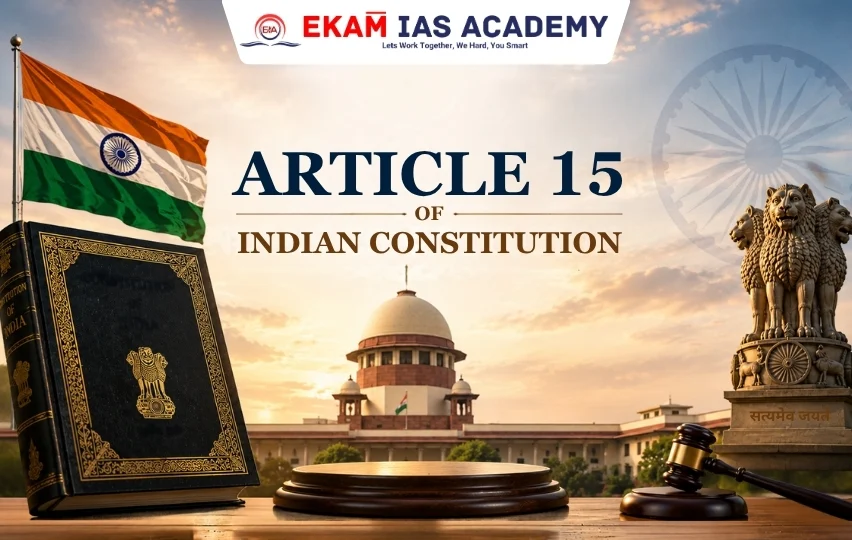
The provision under Article 15 Indian Constitution serves as a core pillar of the Right to Equality UPSC framework. Enshrined within Part III as a fundamental right, it prohibits the State from discriminating against citizens on specific protected grounds while empowering the legislature to enact protective discrimination policies.
What is Article 15
Article 15 guarantees prohibition of discrimination and secures social equality. While Article 14 establishes general equality before the law, Article 15 provides a specific guarantee against arbitrary state actions and social barriers.
Clauses of Article 15: Fundamental Guarantees & Exceptions
Grounds of Discrimination & Access to Public Places
- Article 15(1): Directs that the State shall not discriminate against any citizen on grounds only of religion, race, caste, sex, place of birth, or any of them.
- Article 15(2): Guarantees equal access to shops, public restaurants, hotels, places of public entertainment, wells, tanks, bathing ghats, roads, and places of public resort maintained out of State funds or dedicated to the use of the general public.
Protective Discrimination & Affirmative Action Provisions
- Article 15(3): Empowers the State to make special provisions for women and children, serving as an exception to the general prohibition on discrimination.
- Article 15(4): Enables special provisions for the advancement of Socially and Educationally Backward Classes (SEBCs), Scheduled Castes (SCs), and Scheduled Tribes (STs).
- Article 15(5): Allows reservations for SEBCs, SCs, and STs in educational institutions (including private aided and unaided institutions, except minority educational institutions).
- Article 15(6): Introduced to enable up to 10% reservation for Economically Weaker Sections (EWS) in educational institutions.
Article 15 and Reservation in India
The framework of Article 15 Reservation operates as positive discrimination to dismantle historical social stratification:
- Educational Access: Article 15(4) and Article 15(5) form the legal foundation for seat allocations across higher education institutions.
- Article 15 EWS Integration: Article 15(6) expanded affirmative action beyond historical social backwardness to include purely economic criteria.
Comparative & Constitutional Intersections
Article 15 vs. Article 16
- Scope of Protection: Article 15 applies broadly to social equality, access to public places, and educational institution admissions.
- Public Employment: Article 16 deals specifically with equality of opportunity in matters of public employment under the State.
Article 15 and Article 14
- Article 14 provides the generic rule of equality and equal protection of laws, whereas Article 15 is a specific application of that general principle
Key Constitutional Amendments & Landmark Judgments
Amendments
- 1st Constitutional Amendment (1951): Inserted Article 15(4) following the Champakam Dorairajan case.
- 93rd Constitutional Amendment (2005): Added Article 15(5) to cover admissions in private educational institutions.
- 103rd Constitutional Amendment (2019): Added Article 15(6) providing EWS reservations.
Landmark Supreme Court Judgments
- State of Madras v. Champakam Dorairajan (1951): Prompted the first constitutional amendment to allow educational reservations.
- Ashoka Kumar Thakur v. Union of India (2008): Upheld the constitutional validity of Article 15(5) and OBC reservation in central educational institutions while excluding the “creamy layer.”
- Janhit Abhiyan v. Union of India (2022): Upheld the constitutional validity of the 103rd Amendment and Article 15(6) EWS quota.
Issues, Challenges & Constitutional Morality
Challenges
- Creamy Layer Exclusion: Identifying real beneficiaries within backward classes to prevent sub-classification conflicts.
- Data Metrics: Absence of updated, quantifiable socio-economic data for precise targeted affirmative interventions.
Constitutional Morality
Article 15 upholds constitutional morality by balancing formal equality (treating everyone equally) with substantive equality (providing extra assistance to disadvantaged groups to ensure fairness).
Way Forward
- Periodic Review: Conduct regular empirical reviews of reservation outcomes to refine target groups.
- Institutional Capacity: Expand overall seat capacity in public educational institutions to minimize friction between reserved and general categories.
- Holistic Empowerment: Pair reservations with foundational investments in primary education and skill development.
Conclusion
Article 15 harmonizes non-discrimination with protective affirmative action to advance social justice in India. Upholding its constitutional mandate ensures that equality remains a lived reality for every citizen across the nation.
UPSC Prelims: PYQs & Practice Questions
Previous Year Questions (Prelims)
Q: Which category of Fundamental Rights incorporates protection against untouchability as a form of discrimination?
(a) Right against Exploitation
(b) Right to Freedom
(c) Right to Constitutional Remedies
(d) Right to Equality
Answer: (d) Right to Equality
Explanation:
The Right to Equality spans Articles 14 to 18 of the Indian Constitution.
Article 17 explicitly abolishes untouchability, while
Article 15(2) prohibits discrimination in access to public places such as
shops, wells and bathing ghats. Both provisions fall under the broader
Right to Equality.
Q: Which of the following statements is/are correct regarding the Right to Equality guaranteed under the Constitution of India?
1. Article 15(1) prohibits discrimination against any citizen on grounds of
religion, race, caste, sex, place of birth, or residence.
2. Article 15(3) enables the State to make special provisions for women
and children as an exception to non-discrimination.
Select the correct answer using the code given below:
(a) 1 only
(b) 2 only
(c) Both 1 and 2
(d) Neither 1 nor 2
Answer: (b) 2 only
Explanation:
Statement 1 is incorrect: Article 15(1) prohibits discrimination on the
grounds of religion, race, caste, sex and place of birth. It does not include
residence. Residence may be relevant under
Article 16(3) in matters relating to public employment.
Statement 2 is correct: Article 15(3) expressly permits
the State to make special provisions for women and children, enabling
protective and welfare-oriented measures.
Practice Questions
Q: With reference to the constitutional provisions under Article 15, consider the following statements:
1. The first major amendment to Article 15 was enacted via the
1st Constitutional Amendment Act, 1951, introducing
Article 15(4).
2. Article 15(5) permits reservations in minority educational institutions
established under Article 30.
3. Article 15(6) introduced economic criteria for reservation in educational
institutions through the 103rd Constitutional Amendment Act, 2019.
How many of the statements given above are correct?
(a) Only one
(b) Only two
(c) All three
(d) None
Answer: (b) Only two — Statements 1 and 3 are correct
Explanation:
Statement 1 is correct: Following
State of Madras v. Champakam Dorairajan (1951), Parliament enacted the
1st Constitutional Amendment Act, 1951 to insert
Article 15(4) for the advancement of socially and educationally
backward classes, SCs and STs.
Statement 2 is incorrect: Article 15(5) specifically
excludes minority educational institutions protected under Article 30(1)
from its scope.
Statement 3 is correct: The
103rd Constitutional Amendment Act, 2019 inserted
Article 15(6), enabling reservation of up to
10% for Economically Weaker Sections (EWS).
Q: Which of the following grounds are explicitly mentioned in Article 15(1) of the Indian Constitution upon which the State CANNOT discriminate against any citizen?
1. Religion
2. Caste
3. Sex
4. Place of birth
5. Language
Select the correct answer using the code given below:
(a) 1, 2 and 3 only
(b) 1, 2, 3 and 4 only
(c) 2, 3, 4 and 5 only
(d) 1, 2, 3, 4 and 5
Answer: (b) 1, 2, 3 and 4 only
Explanation:
Article 15(1) prohibits the State from discriminating against any citizen
on grounds only of religion, race, caste, sex, place of birth,
or any of them.
Therefore, Religion, Caste, Sex and Place of Birth are included in the
given list, while Language is not a ground under Article 15(1).
Linguistic interests receive constitutional protection particularly under
Articles 29 and 30.
UPSC Mains – Previous Year & Practice Questions
Mains Previous Year Questions
Question: “The Indian Constitution balances
formal equality under Article 14 with
substantive equality through protective discrimination under Article 15.”
Discuss.
(UPSC GS Paper II – 2023, 15 Marks)
Question: Examine the constitutional validity and implications of expanding
reservation criteria to Economically Weaker Sections (EWS) under
Article 15(6) in light of the
Janhit Abhiyan judgment.
(UPSC GS Paper II – 2022, 15 Marks)
Question: Analyze how Article 15(5), introduced by the
93rd Constitutional Amendment Act, transformed higher education access
for backward classes in private institutions.
(UPSC GS Paper II – 2019, 10 Marks)
Question: Discuss the impact of judicial decisions from
Champakam Dorairajan to
Ashoka Kumar Thakur in shaping the
affirmative action jurisprudence under Article 15.
(UPSC GS Paper II – 2016, 12.5 Marks)
Question: How far does Article 15(3) act as a catalyst
for gender justice and socio-economic empowerment of women
in India?
(UPSC GS Paper II – 2014, 10 Marks)
Mains Practice Questions
[15 Marks | 250 Words]
Question: “Article 15 is not merely a restriction on State power; it is an active instrument of social engineering.” Critically evaluate in the context of expanding educational reservations.
[10 Marks | 150 Words]
Question: Examine the key differences between the grounds of non-discrimination under Article 15(1) and Article 16(2), and explain why certain grounds like “residence” were omitted from Article 15.
[15 Marks | 250 Words]
Question: “Excluding minority educational institutions from Article 15(5) creates a constitutional friction between fundamental rights under Article 15 and Article 30.” Discuss.
Article 15-FAQs
What is Article 15 of the Indian Constitution?
Article 15 is a Fundamental Right under Part III that prohibits discrimination against citizens on grounds of religion, race, caste, sex, place of birth, or any of them. It is an important component of the Right to Equality.
What are the major exceptions under Article 15?
Articles 15(3), 15(4), 15(5), and 15(6) permit the State to make special provisions for women, children, SEBCs, SCs, STs, and Economically Weaker Sections (EWS). These provisions promote substantive equality and social justice.
What is the difference between Article 15 and Article 16?
Article 15 deals mainly with non-discrimination, access to public places, education, and affirmative action. Article 16 specifically guarantees equality of opportunity and permits reservation in matters relating to public employment.
What is Article 15(6) and EWS reservation?
Article 15(6) was introduced through the 103rd Constitutional Amendment Act, 2019. It enables special provisions, including up to 10% reservation for Economically Weaker Sections (EWS) in educational institutions, subject to constitutional conditions.
Which important Supreme Court cases are related to Article 15?
Important cases include State of Madras v. Champakam Dorairajan (1951), Ashoka Kumar Thakur v. Union of India (2008), and Janhit Abhiyan v. Union of India (2022). These judgments significantly shaped India’s constitutional framework for reservation and affirmative action.