Table of Contents
ToggleElection Commission of India
- The Election Commission of India is a permanent, independent constitutional body tasked with conducting Free and Fair Elections across the nation.
- Mastering the Election Commission of India UPSC module is vital for civil services aspirants preparing for Constitutional Bodies in India and Indian Polity and Governance UPSC papers.
- Established to safeguard democratic legitimacy, the Commission acts as the institutional guardian of universal adult franchise and electoral integrity.
- A thorough study of Election Commission Powers and Functions equips candidates with critical analytical frameworks covering Election Commission Constitutional Status and democratic accountability.
Constitutional Provision
- Article 324 Indian Constitution: Vests the superintendence, direction, and control of elections to Parliament, State Legislatures, President, and Vice-President in the Election Commission.
- Part XV Scope (Articles 324–329): Lays down the foundational constitutional provisions governing electoral rolls, adult suffrage, and legislative election disputes.
- Article 325 & 326: Prohibits electoral discrimination on grounds of religion, race, caste, or sex, and institutionalizes universal adult suffrage (age 18+).
- Article 329 Bar: Bars interference by courts in electoral matters once the election process is notified, except through an election petition.
Composition of the Election Commission
- Multi-Member Structure: Under Election Commission Composition rules (Article 324(2)), the Commission consists of the Chief Election Commissioner of India and such number of other Election Commissioners as the President may fix.
- Evolution of Body: Functioned as a single-member body until October 1989, expanded temporarily, and became a permanent three-member body in October 1993.
- Equality of Status: The Chief Election Commissioner and the two Election Commissioners enjoy equal powers, salary, and allowances (equivalent to a Supreme Court Judge).
- Majority Decision Rule: In case of any difference of opinion among the Commissioners, matters are decided collectively by the Commission through a majority vote.
Appointment of Chief Election Commissioner and Election Commissioners
- Presidential Warrant: Election Commissioners Appointment is made by the President of India subject to the provisions of law enacted by Parliament.
- Statutory Selection Committee (2023 Act): Under the Chief Election Commissioner and Other Election Commissioners (Appointment, Conditions of Service and Term of Office) Act, 2023, appointments are made on the recommendation of a Selection Committee comprising the Prime Minister, Leader of Opposition in Lok Sabha, and a Union Cabinet Minister.
- Search Committee Screening: A Search Committee headed by the Union Law Minister shortlists a panel of five eligible candidates for consideration.
- Institutional Checks: Replaces pure executive discretion with a statutory multi-member selection framework.
Qualifications, Tenure and Service Conditions
- Statutory Qualifications: Appointees must hold or have held a post equivalent to the rank of Secretary to the Government of India with expertise in managing elections.
- Fixed Term: Commissioners hold office for a term of 6 years or until attaining the age of 65 years, whichever is earlier.
- Removal Security (CEC): The Chief Election Commissioner can be removed only in the same manner and on the same grounds as a Judge of the Supreme Court.
- Removal Protection (ECs): Other Election Commissioners cannot be removed from office except on the recommendation of the Chief Election Commissioner, safeguarding Election Commission Independence.
Powers and Functions of the Election Commission
- Administrative Powers: Determines territorial constituencies via Delimitation Commission acts, prepares electoral rolls, and supervises Voter Registration in India.
- Electoral Management: Notifies election schedules, scrutinizes nomination papers, grants recognition to political parties, and allots election symbols.
- Model Code Enforcement: Enforces the Model Code of Conduct (MCC) from election announcement until result declaration to ensure a level playing field.
- Quasi-Judicial & Advisory Role: Advises the President and Governors on matters relating to the post-election disqualification of MPs and MLAs, and settles party symbol disputes.
Electoral Laws in India
- Representation of the People Act, 1950: Governs the preparation and revision of electoral rolls, delimitation of constituencies, and qualification of voters.
- Representation of the People Act, 1951: Regulates the actual conduct of elections, qualifications/disqualifications of candidates, registration of political parties, and election dispute resolution.
- Delimitation Commission Acts: Provides the legal mechanism for redrawing Lok Sabha and State Assembly constituency boundaries based on census data.
- Registration of Electors Rules, 1960: Operationalizes administrative procedures for Voter Registration in India and EPIC issuance.
Electoral Process in India
- Notification & Nomination: Begins with the issuance of election notifications, followed by filing, scrutiny, and withdrawal of candidate nominations.
- Campaign & MCC Monitoring: Political parties conduct campaigns under strict expenditure ceilings and surveillance under the Model Code of Conduct.
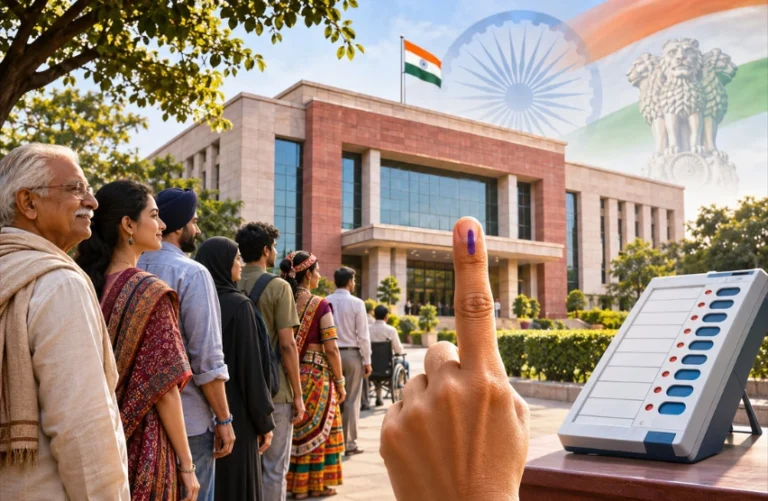
- Polling & EVM-VVPAT Integration: Conducts voting using Electronic Voting Machines (EVMs) paired with Voter Verifiable Paper Audit Trails (VVPATs) for transparency.
- Counting & Certification: Oversees vote counting, declares official results, and submits the constituted house list to the President or Governor.
Election Commission vs State Election Commission
← Swipe left or right to view the full comparison →
| Comparison Feature | Election Commission of India (ECI) | State Election Commission (SEC) |
|---|---|---|
| Constitutional Basis | Article 324 of the Indian Constitution (Part XV). | Articles 243K and 243ZA, introduced by the 73rd and 74th Constitutional Amendments, respectively. |
| Electoral Jurisdiction | Conducts elections to Parliament, State Legislatures, and the offices of President and Vice-President. | Conducts elections to Panchayats and Municipalities (Local Bodies). |
| Appointing Authority | The President of India appoints the Chief Election Commissioner and other Election Commissioners. | The Governor of the respective State appoints the State Election Commissioner. |
| Removal Procedure |
The Chief Election Commissioner
can be removed in the same manner and on the same
grounds as a Supreme Court Judge.
Other Election Commissioners can be removed only on the recommendation of the Chief Election Commissioner. |
The State Election Commissioner can be removed in the same manner and on the same grounds as a High Court Judge. |
Important Supreme Court Judgments
- T.N. Seshan v. Union of India (1995): Upheld the multi-member structure of the Commission and affirmed that the CEC and ECs enjoy equal decision-making status.
- ADR v. Union of India (2002): Mandated candidates contesting elections to disclose criminal antecedents, assets, liabilities, and educational qualifications via affidavit.
- Subramanian Swamy v. ECI (2013): Directed the introduction of VVPATs alongside EVMs to ensure verifiable audit trails and bolster voter confidence.
- Anoop Baranwal v. Union of India (2023): Held that until Parliament enacts a law, the appointment of CEC and ECs must be advised by a committee comprising the PM, LoP, and Chief Justice of India.
Challenges Faced by the Election Commission
- Criminalization of Politics: Rising entry of candidates with serious criminal charges despite mandatory disclosure norms.
- Money & Muscle Power: Unaccounted campaign expenditure, covert voter inducements, and surrogate advertising undermining electoral parity.
- Digital Disinformation: Rapid spread of fake news, deepfakes, and hate speech on social media platforms violating the Model Code of Conduct.
- Institutional Autonomy Concerns: Debates surrounding the absence of parity in removal protection for Election Commissioners compared to the CEC and reliance on executive staff.
Electoral Reforms in India
- VVPAT & EVM Security: Nationwide deployment of VVPATs and mandatory random tallying of VVPAT slips in five polling stations per Assembly segment.
- Electoral Transparency Measures: Introduction of NOTA (None of the Above), C-VIGIL mobile app for citizen MCC violation reporting, and SVEEP voter literacy campaigns.
- Recommended Institutional Reforms: Law Commission and Goswami Committee proposals advocating equal removal protection for ECs, independent secretariats, and state funding of elections.
- Digital Roll Modernization: De-duplication of electoral rolls and linking voter IDs with Aadhaar on a voluntary basis to strengthen Electoral Reforms in India.
Conclusion
- The Election Commission of India remains the institutional bedrock sustaining the world’s largest participatory democracy.
- Strengthening its functional autonomy, financial independence, and statutory enforcement powers is vital for countering modern electoral malpractices.
- Mastery of Election Commission Constitutional Status and reform debates equips civil services aspirants to write analytical, high-scoring answers in Indian Polity and Governance UPSC examinations.
UPSC Prelims: PYQs & Practice Questions
Previous Year Questions (Prelims)
Q: Consider the following statements:
1. The Election Commission of India is a five-member body.
2. Union Ministry of Home Affairs decides the election schedule for the conduct of both general elections and bye-elections.
3. Election Commission resolves the disputes relating to splits/mergers of recognised political parties.
Which of the statements given above is/are correct?
(a) 1 and 2 only
(b) 2 only
(c) 2 and 3 only
(d) 3 only
Answer: (d) 3 only
Explanation:
Statement 1 is incorrect: The Election Commission of India is currently a three-member body consisting of one Chief Election Commissioner (CEC) and two Election Commissioners (ECs).
Statement 2 is incorrect: Under Article 324 of the Constitution, the Election Commission of India, not the Ministry of Home Affairs, is responsible for deciding the election schedule for general elections and bye-elections.
Statement 3 is correct: Under the Election Symbols (Reservation and Allotment) Order, 1968, the Election Commission exercises quasi-judicial authority to resolve disputes relating to splits and mergers of recognised political parties.
Q: Consider the following statements:
1. In India, there is no law restricting the candidates from contesting in one Lok Sabha election from three constituencies.
2. In the 1991 Lok Sabha Election, Shri Devi Lal contested from three Lok Sabha constituencies.
3. As per the existing rules, if a candidate contests in one Lok Sabha election from many constituencies, his/her party should bear the cost of bye-elections to the constituencies vacated by him/her in the event of him/her winning in all the constituencies.
Which of the statements given above is/are correct?
(a) 1 only
(b) 2 only
(c) 1 and 3
(d) 2 and 3
Answer: (b) 2 only
Explanation:
Statement 1 is incorrect: Under Section 33(7) of the Representation of the People Act, 1951, a candidate cannot contest from more than two constituencies in a single general election or bye-election.
Statement 2 is correct: Prior to the 1996 amendment, there was no cap on the number of constituencies, and Shri Devi Lal contested from three Lok Sabha constituencies — Sikar, Rohtak, and Ferozepur — in the 1991 general elections.
Statement 3 is incorrect: There is currently no statutory rule requiring a candidate or political party to bear the cost of bye-elections if a candidate wins multiple seats and vacates the extra seat(s), although the ECI has recommended such a reform.
Practice Questions
Q: With reference to the Chief Election Commissioner and Other Election Commissioners (Appointment, Conditions of Service and Term of Office) Act, 2023, consider the following statements:
1. The Chief Election Commissioner and Election Commissioners are appointed by the President on the recommendation of a Selection Committee comprising the Prime Minister, the Chief Justice of India, and the Leader of Opposition in the Lok Sabha.
2. A Search Committee headed by the Union Law Minister prepares a panel of five persons for consideration by the Selection Committee.
3. If an Election Commissioner is appointed as Chief Election Commissioner, their total combined term in office cannot exceed six years.
Which of the statements given above are correct?
(a) 1 and 2 only
(b) 2 and 3 only
(c) 1 and 3 only
(d) 1, 2, and 3
Answer: (b) 2 and 3 only
Explanation:
Statement 1 is incorrect: Under the 2023 Act, the Selection Committee consists of the Prime Minister, the Leader of Opposition in the Lok Sabha, and a Union Cabinet Minister nominated by the Prime Minister.
Statement 2 is correct: A Search Committee headed by the Minister of Law and Justice, along with two other members not below the rank of Secretary to the Government of India, prepares a panel of five eligible candidates for consideration by the Selection Committee.
Statement 3 is correct: The CEC and ECs hold office for 6 years or until the age of 65 years, whichever is earlier. If an EC is elevated to CEC, the combined tenure as EC and CEC cannot exceed 6 years.
Q: Consider the following statements regarding the constitutional safeguards and jurisdiction of the Election Commission of India (ECI):
1. The Chief Election Commissioner can be removed from office in the same manner and on the same grounds as a Judge of the Supreme Court.
2. The other Election Commissioners enjoy identical constitutional removal protection as the Chief Election Commissioner.
3. The Election Commission of India conducts elections to the offices of the President, Vice-President, Parliament, State Legislatures, and Municipal Corporations.
Which of the statements given above is/are correct?
(a) 1 only
(b) 1 and 2 only
(c) 2 and 3 only
(d) 1, 2, and 3
Answer: (a) 1 only
Explanation:
Statement 1 is correct: Under Article 324(5), the CEC enjoys security of tenure and can be removed only through a parliamentary process similar to that applicable to a Supreme Court Judge, on grounds of proved misbehaviour or incapacity.
Statement 2 is incorrect: Other Election Commissioners do not enjoy identical removal protection. Under Article 324(5), they cannot be removed from office except on the recommendation of the Chief Election Commissioner.
Statement 3 is incorrect: Under Article 324, the ECI conducts elections to Parliament, State Legislatures, President, and Vice-President. Elections to Municipalities and Panchayats are conducted by the State Election Commission under Articles 243K and 243ZA.
UPSC Mains – Previous Year & Practice Questions
Mains Previous Year Questions
Question: Discuss the position of the Election Commission of India while undertaking the revision of electoral rolls. Can it also examine the question of citizenship? (Mains 2026)
Question: Discuss the role of the Election Commission of India in the light of the evolution of the Model Code of Conduct. (Mains 2022)
Question: To enhance the quality of democracy in India, the Election Commission of India has proposed electoral reforms in 2016. What are the suggested reforms and how far are they significant to make democracy successful? (Mains 2021)
Question: Simultaneous election to the Lok Sabha and the State Assemblies will limit the amount of time and money spent in electioneering but it will reduce the government’s accountability to the people. Discuss. (Mains 2017)
Question: With reference to the Representation of the People Act, 1951, discuss the grounds for disqualification of Members of Parliament and State Legislatures. What role does the Election Commission play in this process? (Mains 2014)
Mains Practice Questions
[15 Marks | 250 Words]
Question: Critically examine how the Chief Election Commissioner and Other Election Commissioners (Appointment, Conditions of Service and Term of Office) Act, 2023 impacts the institutional independence of the Election Commission of India in light of the Supreme Court's ruling in Anoop Baranwal v. Union of India.
[15 Marks | 250 Words]
Question: While the Model Code of Conduct (MCC) has served as an effective instrument to ensure a level playing field during elections, its lack of statutory backing limits punitive enforcement in the digital era. Discuss.
[10 Marks | 150 Words]
Question: Analyze the constitutional and structural differences between the Election Commission of India (Article 324) and State Election Commissions (Articles 243K and 243ZA) in upholding grassroots and national democracy.


Election Commission of India-FAQs
What is the Election Commission of India?
The Election Commission of India is an independent constitutional body under Article 324 responsible for conducting elections to Parliament, State Legislatures, and the offices of the President and Vice-President.
How are the Chief Election Commissioner and Election Commissioners appointed?
They are appointed by the President of India under the constitutional and statutory framework governing their appointment. The 2023 law provides for a selection committee comprising the Prime Minister, Leader of Opposition in Lok Sabha and a Union Cabinet Minister.
What are the major powers of the Election Commission?
The ECI supervises electoral rolls and elections, recognises political parties, allots election symbols, enforces the Model Code of Conduct, and performs specified advisory and quasi-judicial functions.
What is the difference between ECI and State Election Commission?
The ECI conducts elections to Parliament, State Legislatures, President and Vice-President, while the State Election Commission conducts elections to Panchayats and Municipalities under Articles 243K and 243ZA.
What are the major challenges faced by the Election Commission?
Key challenges include criminalisation of politics, money and muscle power, digital disinformation, deepfakes, hate speech and concerns regarding institutional autonomy and electoral transparency.