Table of Contents
ToggleBal Gangadhar Tilak
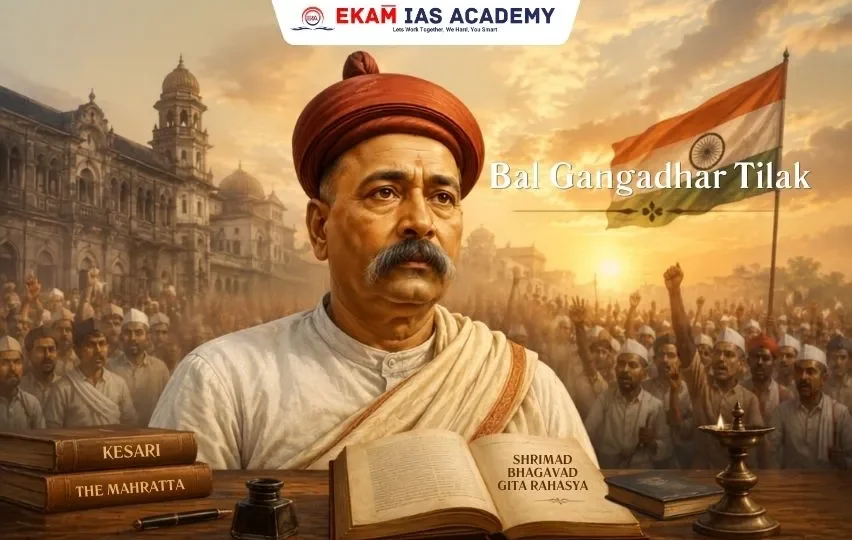
Lokmanya Bal Gangadhar Tilak was one of the greatest leaders of India’s freedom movement and a pioneer of assertive nationalism. Revered as the “Father of Indian Unrest” by British writer Valentine Chirol and popularly known as “Lokmanya” (accepted by the people), Tilak transformed the Indian national movement from an elite political platform into a mass movement. Through his advocacy of Swaraj, Swadeshi, Boycott, and National Education, he inspired millions of Indians to actively participate in the struggle against British colonial rule.
Recently, Prime Minister Narendra Modi paid tribute to Bal Gangadhar Tilak on his birth anniversary (23 July), remembering his immense contribution to India’s independence movement and his enduring legacy of patriotism.
For UPSC aspirants, Bal Gangadhar Tilak is an important topic under Modern Indian History, Indian National Movement, and the Extremist Phase of the Indian National Congress.
Why is Bal Gangadhar Tilak in the News?
Bal Gangadhar Tilak is in the news because Prime Minister Narendra Modi paid tribute to the legendary freedom fighter on his birth anniversary, acknowledging his role in awakening nationalist consciousness and inspiring generations through his vision of Swaraj and self-rule.
Early Life
Bal Gangadhar Tilak was born on 23 July 1856 in Ratnagiri, Maharashtra.
A brilliant scholar and teacher, he believed that education was the foundation of national awakening. His popularity among the people earned him the title “Lokmanya,” meaning “accepted by the people.”
Advocate of Assertive Nationalism
Tilak emerged as one of the foremost leaders of the Extremist (Assertive Nationalist) wing of the Indian National Congress.
He promoted four major principles:
- Swaraj (Self-rule)
- Swadeshi
- Boycott of foreign goods
- National Education
Unlike the Moderates, Tilak believed that political rights could only be secured through active public participation and mass mobilisation.
Famous Declaration
Tilak’s most famous slogan became the rallying cry of India’s freedom movement:
“Swaraj is my birthright, and I shall have it.”
This declaration inspired millions of Indians to demand self-government and intensified the nationalist movement across the country.
Lal-Bal-Pal
Bal Gangadhar Tilak formed the famous nationalist trio “Lal-Bal-Pal”, comprising:
- Lala Lajpat Rai (Punjab)
- Bal Gangadhar Tilak (Maharashtra)
- Bipin Chandra Pal (Bengal)
Together, they became the leading voices of assertive nationalism in India.
Journalism and Political Awakening
Tilak effectively used journalism to spread nationalist ideas.
He founded:
- Kesari (Marathi)
- The Mahratta (English)
Through these newspapers, he criticised British policies, promoted nationalism, and educated the public about their political rights.
Contribution to Education
Tilak believed that education was essential for creating national consciousness.
He helped establish:
- New English School (1880)
- Deccan Education Society (1884)
- Fergusson College
These institutions played an important role in promoting modern education alongside patriotic values.
Ganapati Festival
In 1893, Tilak transformed Ganesh Chaturthi from a private religious celebration into a large public festival.
The festival became a platform for:
- Social unity
- Political awareness
- Nationalist mobilisation
- Public participation
This innovative approach helped bring ordinary people into the freedom movement.
Shivaji Festival
Beginning in 1895, Tilak popularised the Shivaji Festival.
He projected Chhatrapati Shivaji Maharaj as a symbol of:
- Courage
- Self-rule
- National pride
- Resistance against oppression
The festival strengthened nationalist sentiments across western India.
Role in the Swadeshi Movement
Following the Partition of Bengal (1905), Tilak strongly supported:
- Swadeshi
- Boycott of foreign goods
- National education
- Passive resistance
His leadership made the Swadeshi Movement one of the most significant phases of India’s freedom struggle.
Surat Split (1907)
Tilak became the principal leader of the Extremist faction during the Surat Session of the Indian National Congress (1907).
Differences between the Moderates and Extremists led to the historic split within the Congress.
Sedition Trial and Mandalay Imprisonment
In 1908, Tilak was convicted on charges of sedition and sentenced to six years’ imprisonment in Mandalay, Burma (present-day Myanmar).
Rather than weakening his influence, his imprisonment elevated him to the status of one of India’s foremost nationalist leaders.
Gita Rahasya
During his imprisonment in Mandalay, Tilak authored Shrimad Bhagavad Gita Rahasya.
In this work, he interpreted the Bhagavad Gita as emphasizing:
- Karma Yoga
- Selfless action
- Active participation in society
- Duty over renunciation
The book became one of his most influential philosophical contributions.
Home Rule Movement
In 1916, Tilak founded the Indian Home Rule League.
At the same time, Annie Besant established another Home Rule League.
The movement demanded self-government for India within the British Empire and revitalized the national movement.
Lucknow Pact (1916)
Tilak supported the historic Lucknow Pact (1916) between the Indian National Congress and the All India Muslim League.
The agreement represented an important step towards Hindu–Muslim political cooperation during the freedom struggle.
Legacy
Bal Gangadhar Tilak passed away on 1 August 1920.
His contribution to India’s freedom movement earned widespread admiration.
- Mahatma Gandhi described him as the “Maker of Modern India.”
- Jawaharlal Nehru later referred to him as the “Father of the Indian Revolution.”
His ideas of Swaraj, national education, and mass political participation continue to inspire generations.
Significance for UPSC
Bal Gangadhar Tilak is an important personality for UPSC because of his role in:
- Assertive Nationalism
- Swadeshi Movement
- Home Rule Movement
- Surat Split
- Indian National Congress
- Freedom Struggle
- National Education
UPSC Prelims Quick Facts
| Topic | Fact |
|---|---|
| Birth | 23 July 1856 |
| Birthplace | Ratnagiri, Maharashtra |
| Popular Name | Lokmanya Tilak |
| Famous Slogan | “Swaraj is my birthright, and I shall have it.” |
| Newspapers | Kesari, The Mahratta |
| Major Organisations | Deccan Education Society, Home Rule League |
| Famous Trio | Lal-Bal-Pal |
| Important Book | Shrimad Bhagavad Gita Rahasya |
| Imprisonment | Mandalay, Burma (1908–1914) |
| Death | 1 August 1920 |
UPSC Mains Perspective
GS Paper I
- Modern Indian History
- Indian National Movement
- Extremist Phase of Congress
- Home Rule Movement
- Swadeshi Movement
Important Themes
- Assertive Nationalism
- Lal-Bal-Pal
- Surat Split
- National Education
- Political Journalism
- Home Rule League
- Freedom Struggle
Conclusion
Lokmanya Bal Gangadhar Tilak was one of the principal architects of India’s nationalist movement, transforming the demand for Swaraj into a powerful mass movement. Through his leadership in the Swadeshi Movement, promotion of National Education, establishment of the Home Rule League, and use of journalism as a tool of political awakening, he laid a strong foundation for India’s struggle for independence. His enduring slogan, “Swaraj is my birthright, and I shall have it,” continues to symbolize the spirit of freedom and self-determination. For UPSC aspirants, Tilak remains a key figure in Modern Indian History, representing assertive nationalism, political awakening, and the evolution of the Indian freedom movement.



Frequently Asked Questions (FAQs) About Bal Gangadhar Tilak
Who was Bal Gangadhar Tilak?
Bal Gangadhar Tilak, popularly known as Lokmanya Tilak, was a prominent Indian freedom fighter, nationalist leader, social reformer, and educationist. He was one of the leading figures of the Extremist (Assertive Nationalist) phase of the Indian National Congress and played a crucial role in India’s struggle for independence.
Why is Bal Gangadhar Tilak known as the 'Father of Indian Unrest'?
Bal Gangadhar Tilak earned the title “Father of Indian Unrest” for inspiring mass political awakening and advocating Swaraj (self-rule), Swadeshi, Boycott of foreign goods, and National Education. His assertive approach challenged British colonial rule and mobilised people across India.
What was Bal Gangadhar Tilak's famous slogan?
Bal Gangadhar Tilak’s most famous declaration was “Swaraj is my birthright, and I shall have it.” This slogan became a powerful symbol of India’s freedom movement and inspired millions of Indians to demand self-rule.
What were the major contributions of Bal Gangadhar Tilak to India's freedom struggle?
Tilak played a key role in the Swadeshi Movement, founded the Indian Home Rule League in 1916, promoted Ganesh Chaturthi and Shivaji festivals as platforms for nationalist mobilisation, established the newspapers Kesari and The Mahratta, and authored Shrimad Bhagavad Gita Rahasya during his imprisonment in Mandalay.
Why is Bal Gangadhar Tilak important for UPSC preparation?
Bal Gangadhar Tilak is an important topic for UPSC under Modern Indian History because of his leadership in the Assertive Nationalist Movement, the Swadeshi Movement, the Home Rule Movement, the Surat Split (1907), the Lal-Bal-Pal trio, and his lasting contribution to India’s freedom struggle. His life and ideas are relevant for both UPSC Prelims and GS Paper I (Mains).