Table of Contents
ToggleChandra Shekhar Azad
Why in News?
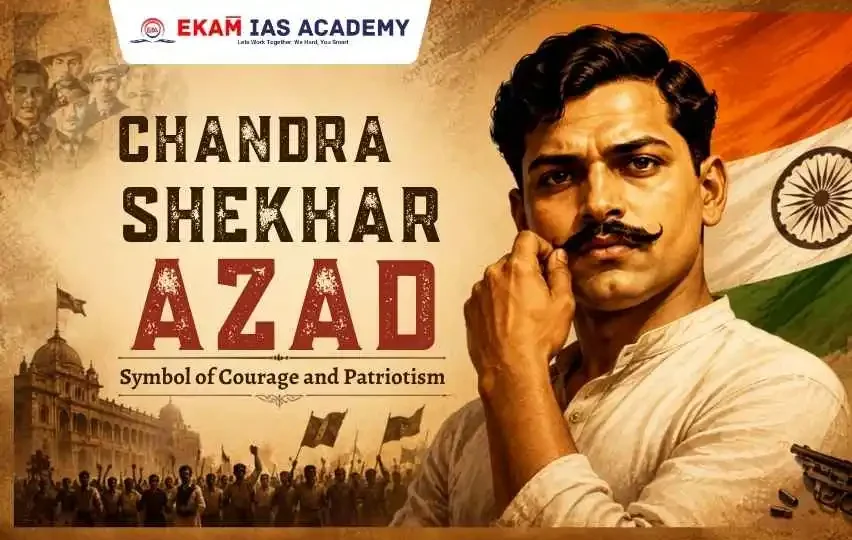
Prime Minister Narendra Modi paid tribute to freedom fighter Chandra Shekhar Azad on his birth anniversary, highlighting him as a symbol of courage and patriotism who inspired “countless young Indians.”
Early Life
- Born on 23 July 1906 as Chandra Shekhar Tiwari in Bhabra village (now Chandrashekhar Azad Nagar), Madhya Pradesh.
- Grew up in a low-income household and moved to Benaras to study Sanskrit.
- Influenced by the Jallianwala Bagh Massacre, he joined the Non-Cooperation Movement (1920–22) at age 15.
After detention, he adopted the name “Azad”, declared his residence as “Jail,” and vowed never to be captured alive.
Revolutionary Contributions
Hindustan Republican Army (HRA)
- Joined under Ram Prasad Bismil
- Organized revolutionary activities against British rule
Kakori Train Action (1925)
- Participated in the conspiracy to collect funds for revolutionary activities
- Successfully evaded arrest and remained underground
Formation of HSRA (1928)
- Reorganized HRA into Hindustan Socialist Republican Association (HSRA)
- Advocated socialism alongside independence struggle
- Oversaw military branch while Bhagat Singh managed ideological leadership
Lahore Action (1928)
- Planned retaliation against British officer John Saunders
- Assisted Bhagat Singh and Rajguru in escape and coordinated resistance against pursuing police forces
Slogan and Legacy
Azad’s famous declaration:“Dushman ki goliyon ka hum saamna karenge. Azad hi rahein hain, azad hi rahenge.”
“Dushman ki goliyon ka hum saamna karenge. Azad hi rahein hain, azad hi rahenge.”
This reflected his lifelong commitment to remain free until his final moment.
Conclusion
Chandra Shekhar Azad remains an enduring symbol of courage, sacrifice, and unyielding patriotism. His leadership in the HRA and HSRA, participation in the Kakori and Lahore actions, and commitment to freedom continue to inspire generations of Indians.



Chandra Shekhar Azad-FAQs Answered
Who was Chandra Shekhar Azad?
Chandra Shekhar Azad was a revolutionary freedom fighter who played a key role in India’s struggle for independence and became a symbol of courage and patriotism.
When and where was he born?
He was born on 23 July 1906 in Bhabra village, now Chandrashekhar Azad Nagar, Madhya Pradesh.
What revolutionary organizations was he associated with?
Azad was a prominent leader in the Hindustan Republican Army (HRA) and later helped reorganize it into the Hindustan Socialist Republican Association (HSRA).
What were his major revolutionary activities?
He participated in the Kakori Train Action (1925), planned the Lahore Action (1928) against British officer John Saunders, and oversaw the HSRA’s military operations.
What was his famous slogan?
His famous declaration was:
“Dushman ki goliyon ka hum saamna karenge. Azad hi rahein hain, azad hi rahenge.”
It reflected his lifelong commitment to remain free until his last moment