
Table of Contents
Togglebatukeshwar dutt Revolutionary freedom fighter
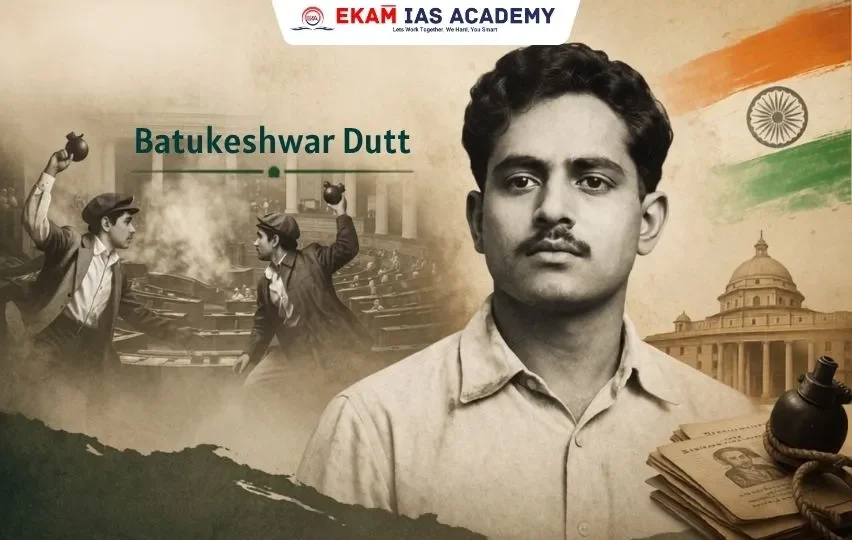
Batukeshwar Dutt was one of India’s most courageous revolutionary freedom fighters who played a significant role in the struggle against British colonial rule. Best remembered for his association with Bhagat Singh and the historic Central Legislative Assembly bombing of 1929, Dutt dedicated his life to awakening the nation against colonial oppression. His sacrifices, imprisonment, and participation in the freedom movement made him one of the prominent revolutionaries of the Indian independence struggle.
Recently, Union Home Minister Amit Shah and Defence Minister Rajnath Singh paid tribute to Batukeshwar Dutt on his death anniversary, remembering his immense contribution to India’s freedom movement.
For UPSC aspirants, Batukeshwar Dutt is an important topic under Modern Indian History, Freedom Struggle, Revolutionary Movements, and National Personalities.
Why is Batukeshwar Dutt in the News?
Batukeshwar Dutt was recently remembered on his death anniversary, with national leaders paying tribute to his courage and sacrifices during India’s struggle for independence.
His legacy continues to inspire generations for his unwavering commitment to the ideals of freedom, justice, and patriotism.
Who was Batukeshwar Dutt?
Batukeshwar Dutt was an Indian revolutionary born on 18 November 1910.
During his college years, he came into contact with Bhagat Singh, whose revolutionary ideas greatly influenced him.
He subsequently became an active member of:
- Hindustan Socialist Republican Association (HSRA)
- Naujawan Bharat Sabha
These organizations sought to overthrow British colonial rule through revolutionary means and inspire patriotic sentiments among Indians.
Association with Bhagat Singh
Batukeshwar Dutt shared a close association with Bhagat Singh, one of India’s most celebrated revolutionaries.
Both believed that revolutionary action was necessary to expose the injustices of British rule and awaken the masses.
Together, they planned one of the most iconic events in India’s freedom struggle—the Central Legislative Assembly bombing.
Central Legislative Assembly Bombing (1929)
On 8 April 1929, Batukeshwar Dutt and Bhagat Singh threw two handmade bombs into the Central Legislative Assembly in Delhi.
The bombs were deliberately thrown into an unoccupied section of the Assembly to ensure that no one was killed or seriously injured.
The objective was not violence but to protest against oppressive British laws and draw national attention to India’s freedom movement.
Purpose of the Bombing
The revolutionary act aimed to:
- Protest against repressive colonial legislation.
- Awaken public opinion against British rule.
- Demonstrate resistance to colonial oppression.
- Inspire Indians to join the freedom movement.
After throwing the bombs, both revolutionaries raised the famous slogan:
“Inquilab Zindabad” (Long Live the Revolution)
They also distributed pamphlets explaining that:
“It takes a loud voice to make the deaf hear.”
Instead of escaping, both voluntarily surrendered to the authorities to use the trial as a platform for spreading revolutionary ideas.
Imprisonment and Hunger Strike
Following the Assembly bombing, Batukeshwar Dutt was sentenced to life imprisonment.
During his imprisonment, he actively fought for the rights of political prisoners.
He participated in several hunger strikes, including the historic 114-day hunger strike alongside Bhagat Singh.
Their demands included:
- Better treatment for political prisoners.
- Equal rights with European prisoners.
- Improved food quality.
- Access to books and newspapers.
- Humane prison conditions.
These protests drew nationwide attention to the inhuman conditions faced by Indian political prisoners.
Participation in the Quit India Movement
Batukeshwar Dutt was released from prison in 1938.
Despite years of imprisonment and deteriorating health, he continued participating in India’s freedom struggle.
During the Quit India Movement of 1942, he once again joined the national movement against British rule, reaffirming his commitment to India’s independence.
Legacy of Batukeshwar Dutt
Batukeshwar Dutt is remembered as:
- A fearless revolutionary.
- Close associate of Bhagat Singh.
- Symbol of patriotism and sacrifice.
- Defender of prisoners’ rights.
- Hero of India’s revolutionary movement.
His courage demonstrated that the struggle for freedom extended beyond armed resistance to include the fight for justice, dignity, and civil liberties.
Significance for India's Freedom Movement
Batukeshwar Dutt’s contribution remains significant because:
- He inspired nationalist sentiments among Indians.
- His actions exposed British repression.
- He strengthened revolutionary movements.
- His imprisonment highlighted the plight of political prisoners.
- He continued serving the nation even after release.
His life exemplifies courage, self-sacrifice, and unwavering dedication to the nation.
UPSC Prelims Quick Facts
| Topic | Fact |
|---|---|
| Freedom Fighter | Batukeshwar Dutt |
| Born | 18 November 1910 |
| Revolutionary Organisation | Hindustan Socialist Republican Association (HSRA) |
| Associated Organisation | Naujawan Bharat Sabha |
| Closest Associate | Bhagat Singh |
| Famous Event | Central Legislative Assembly Bombing (8 April 1929) |
| Slogan | “Inquilab Zindabad” |
| Sentence | Life Imprisonment |
| Hunger Strike | 114 days with Bhagat Singh |
| Later Movement | Quit India Movement (1942) |
UPSC Mains Perspective
GS Paper I
- Modern Indian History
- Revolutionary Nationalism
- Freedom Movement
- Role of Revolutionary Organizations
Important Themes
- Hindustan Socialist Republican Association (HSRA)
- Bhagat Singh and Revolutionary Movement
- Political Prisoners
- Quit India Movement
- Nationalist Ideology
Conclusion
Batukeshwar Dutt occupies a distinguished place in India’s freedom struggle as a fearless revolutionary who dedicated his life to the cause of independence. His role in the Central Legislative Assembly bombing, prolonged imprisonment, participation in hunger strikes, and continued involvement in the Quit India Movement reflect his unwavering commitment to the nation. Alongside Bhagat Singh, he inspired countless Indians to fight against colonial oppression through courage and sacrifice. For UPSC aspirants, Batukeshwar Dutt remains an important personality in Modern Indian History, symbolizing revolutionary nationalism, patriotism, and the enduring spirit of India’s struggle for freedom.



Frequently Asked Questions (FAQs) About Batukeshwar Dutt
Who was Batukeshwar Dutt?
Batukeshwar Dutt was a prominent Indian revolutionary and freedom fighter who actively participated in the struggle against British rule. He was a close associate of Bhagat Singh and a member of the Hindustan Socialist Republican Association (HSRA).
Why is Batukeshwar Dutt famous in India's freedom struggle?
Batukeshwar Dutt is best known for participating in the Central Legislative Assembly bombing on 8 April 1929 along with Bhagat Singh. The bombs were thrown in an unoccupied area to protest against oppressive British laws and to draw national attention to India’s freedom movement without causing casualties.
What was Batukeshwar Dutt's role in the Central Legislative Assembly bombing?
Batukeshwar Dutt and Bhagat Singh threw two low-intensity bombs into the Central Legislative Assembly while raising the slogan “Inquilab Zindabad.” After distributing revolutionary pamphlets, they voluntarily surrendered to spread their message through the trial.
What contributions did Batukeshwar Dutt make after his imprisonment?
While serving a life sentence, Batukeshwar Dutt participated in several hunger strikes, including a 114-day hunger strike with Bhagat Singh, demanding better treatment for political prisoners. After his release in 1938, he also joined the Quit India Movement in 1942.
Why is Batukeshwar Dutt important for UPSC preparation?
Batukeshwar Dutt is an important topic for UPSC under Modern Indian History because of his role in the revolutionary freedom movement, his association with Bhagat Singh and the HSRA, the Central Legislative Assembly bombing, and his contribution to the Quit India Movement. His life is relevant for both UPSC Prelims and GS Paper I (Mains).