Table of Contents
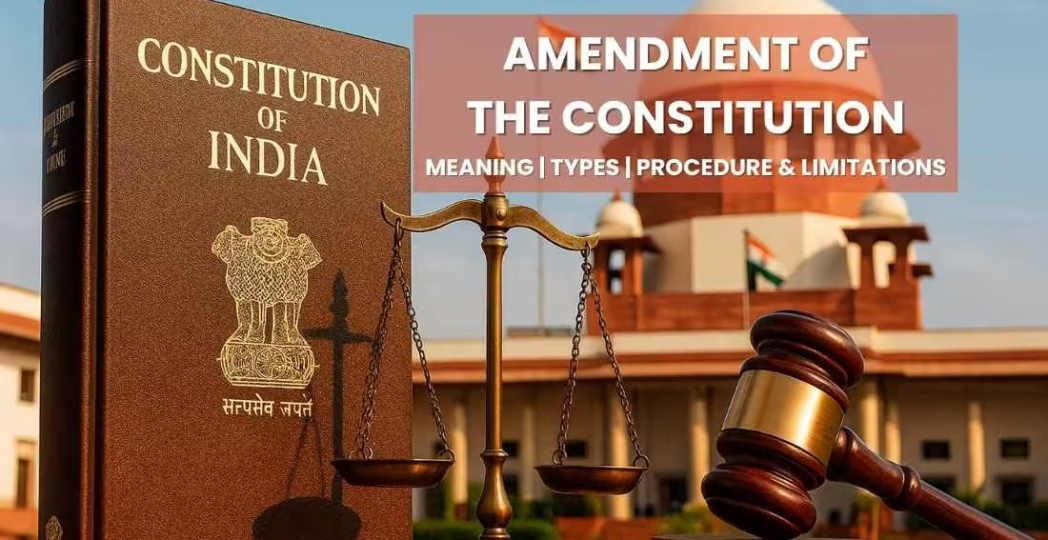
ToggleThe Constitution of India is a living document — flexible enough to adapt to changing times while preserving the fundamental principles on which the nation stands. To ensure this adaptability, the framers included provisions for its amendment under Article 368.
An amendment allows the Constitution to evolve with the needs of society, ensuring that the democratic and federal character of India remains relevant in the face of socio-economic and political changes.
Meaning of Constitutional Amendment
The term “amendment” refers to a formal change or addition made to the Constitution.
It involves modifying, adding, or deleting provisions of the Constitution to address new challenges or correct deficiencies that may arise over time.
- The framers of the Indian Constitution foresaw that the document would need periodic revision.
- Hence, they created a process that is neither too rigid (as in the USA) nor too flexible (as in the UK) — maintaining a balance between stability and change.
Dr. B.R. Ambedkar described this process as the means to ensure that the Constitution remains both flexible and permanent.
Constitutional Provision: Article 368
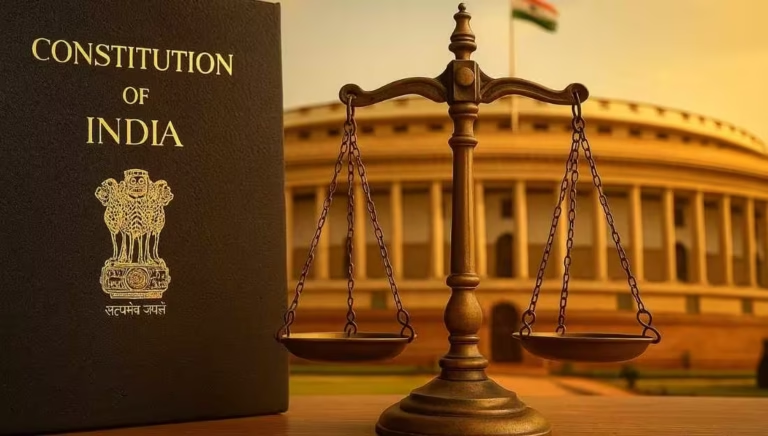
- Article 368 (Part XX) of the Constitution deals with the Power of Parliament to Amend the Constitution and the Procedure thereof.
- It empowers the Parliament to amend the Constitution by adding, varying, or repealing any provision in accordance with the prescribed procedure.
- However, the basic structure of the Constitution cannot be altered (as laid down in Kesavananda Bharati v. State of Kerala, 1973).
Types of Constitutional Amendments in India
The Constitution provides for three methods of amendment, depending on the nature of the provision to be amended. These are:
| Type of Amendment | Procedure | Examples |
|---|---|---|
| 1. Amendment by Simple Majority of Parliament | Certain provisions can be amended like an ordinary law, by a simple majority of members present and voting in both Houses of Parliament. | Admission or establishment of new states, formation of new states and alteration of boundaries (Art. 2, 3); citizenship provisions; salaries and allowances of constitutional authorities, etc. |
| 2. Amendment by Special Majority of Parliament | Requires a special majority: a majority of the total membership of each House and a two-thirds majority of members present and voting. | Fundamental Rights (Part III), Directive Principles (Part IV), President’s rule (Art. 356), Union Judiciary (Part V), and Parliament itself. |
| 3. Amendment by Special Majority + Ratification by States | Requires both special majority in Parliament and ratification by at least half of the State Legislatures. | Matters affecting the federal structure: election of the President, distribution of legislative powers (Seventh Schedule), representation of States in Parliament, Supreme Court & High Courts jurisdiction, etc. |
Procedure for Amendment (Article 368)
Introduction of the Bill
- The amendment bill can be introduced in either House of Parliament (Lok Sabha or Rajya Sabha).
- It can be introduced by a Minister or a Private Member.
- No prior permission of the President is required.
Passage in Parliament
- The bill must be passed by the special majority in both Houses:
- Majority of the total membership of the House, and
- Two-thirds majority of members present and voting.
Ratification by the States (if required)
- For certain amendments that affect the federal structure, the bill must be ratified by not less than one-half of the State Legislatures by a simple majority.
Presidential Assent
- After being passed by both Houses and ratified (if applicable), the bill is presented to the President for assent.
- The President must give his assent — he cannot withhold or return the bill.
Amendment Becomes Law
- Once the President gives assent, the Constitution stands amended in accordance with the bill.
Important Constitutional Amendments
Amendment | Year | Significance |
1st Amendment | 1951 | Added 9th Schedule, curtailed Right to Property, introduced reasonable restrictions on Fundamental Rights. |
7th Amendment | 1956 | Reorganized states on linguistic basis. |
24th Amendment | 1971 | Explicitly gave Parliament power to amend any part of the Constitution including Fundamental Rights. |
42nd Amendment | 1976 | Known as Mini-Constitution — added words “Socialist” and “Secular” to the Preamble; curtailed judiciary’s power. |
44th Amendment | 1978 | Restored fundamental rights curtailed by the 42nd Amendment; made Right to Property a legal right. |
73rd & 74th Amendments | 1992 | Added Panchayati Raj and Urban Local Bodies to the Constitution. |
86th Amendment | 2002 | Made Right to Education a Fundamental Right (Art. 21A). |
101st Amendment | 2016 | Introduced Goods and Services Tax (GST). |
Limitations on the Amending Power
Although Parliament has wide powers to amend the Constitution, there are certain limitations imposed by judicial interpretation.
Basic Structure Doctrine
- Propounded in the landmark case of Kesavananda Bharati v. State of Kerala (1973).
- The Supreme Court held that Parliament cannot alter the basic structure or essential features of the Constitution.
- Elements of the basic structure include:
- Supremacy of the Constitution
- Sovereign, democratic, and republican nature of the polity
- Secularism
- Separation of powers
- Judicial review
- Federal character
- Unity and integrity of India
- Rule of law
Judicial Review
- Any amendment that violates the basic structure can be struck down by the Supreme Court.
- This ensures that the Constitution remains supreme and is not distorted by the will of the temporary majority in Parliament.
Federalism
- Amendments that affect the distribution of powers between the Centre and States require ratification by States, ensuring federal balance.
Procedural Limitations
- An amendment bill must be passed by both Houses separately — there is no provision for a joint sitting in case of disagreement.
Judicial Landmarks Related to Constitutional Amendments
Case | Year | Significance |
Shankari Prasad v. Union of India | 1951 | Parliament can amend Fundamental Rights under Article 368. |
Golaknath v. State of Punjab | 1967 | Parliament cannot amend Fundamental Rights. |
Kesavananda Bharati v. State of Kerala | 1973 | Parliament can amend any part of the Constitution but not its basic structure. |
Indira Nehru Gandhi v. Raj Narain | 1975 | Free and fair elections form part of the basic structure. |
Minerva Mills v. Union of India | 1980 | Judicial review and balance between Fundamental Rights and DPSPs are part of the basic structure. |
Conclusion
The amendment procedure under Article 368 has ensured that the Constitution of India remains dynamic. It allows Parliament to adapt the Constitution to changing times while safeguarding its core values and spirit.
While excessive rigidity could make the Constitution obsolete, excessive flexibility could threaten its stability. The basic structure doctrine thus maintains the perfect equilibrium — ensuring that India’s Constitution continues to evolve without losing its foundational identity.
Criticism of the Amendment Procedure
While the amendment procedure under Article 368 provides a balance between rigidity and flexibility, it is not free from criticism. Constitutional experts and scholars have raised several concerns regarding the nature, scope, and process of amendments in India.
Here are the major criticisms of the amendment procedure:
S.No. | Ground of Criticism | Explanation |
1. Absence of a Special Constituent Body | Unlike other countries such as the United States, where amendments are made by a Constitutional Convention or a specially constituted body, India has no separate constitutional authority for this purpose. The Parliament itself, which also performs legislative functions, has been entrusted with the power to amend the Constitution. This can blur the distinction between ordinary law-making and constitutional amendment. | |
2. No Distinctive Amendment Process | Except for the requirement of a special majority, the procedure for amending the Constitution closely resembles that of ordinary legislation. There is no elaborate process involving multiple stages of scrutiny or public participation. This makes it easier for a ruling majority in Parliament to push through amendments for political convenience. | |
3. Parliament’s Monopoly Over Initiation | The power to initiate an amendment rests solely with the Parliament. State legislatures or the public have no authority to propose constitutional amendments (except for resolutions related to creating or abolishing Legislative Councils under Article 169). This undermines the federal spirit of the Constitution. | |
4. Limited Role of States in the Amendment Process | Though India is a federal polity, most amendments can be passed by Parliament alone. The ratification of half the states is required only for a few provisions that affect the federal structure (like distribution of powers, representation of states, etc.). Thus, the centre dominates the amendment process. | |
5. No Provision for Joint Sitting | There is no provision for a joint sitting of both Houses of Parliament in case of a deadlock over a constitutional amendment bill. If either House rejects or fails to pass the bill, the amendment automatically fails, leading to parliamentary deadlocks in crucial cases. | |
6. Lack of Clarity and Ambiguity in Procedure | The provisions of Article 368 are too brief and sketchy, leaving much room for interpretation and judicial intervention. Over time, the Supreme Court has had to clarify several aspects (through cases like Kesavananda Bharati and Minerva Mills), indicating procedural vagueness in the constitutional design. | |
7. Risk of Political Misuse | Since the amending power lies with Parliament, a strong political majority can alter key constitutional provisions to serve its political interests, potentially threatening constitutional balance and democratic norms. | |
8. No Direct Role of Citizens | Unlike some countries where amendments require referendums or public ratification, Indian citizens have no direct role in approving constitutional changes. This limits democratic participation in constitutional evolution. |
Analytical Insight
Despite these criticisms, it must be acknowledged that the Indian amendment procedure has ensured a stable yet adaptable constitutional framework. Over 100 amendments have been made since 1950 — many of them aimed at strengthening democracy, promoting social justice, and modernizing governance.
However, it also underscores the need for constitutional morality — the ethical responsibility of Parliament to use the amending power wisely and in harmony with the basic structure doctrine laid down by the Supreme Court.
Amendment of the Constitution - FAQs Answered
What is meant by a Constitutional Amendment?
A constitutional amendment is a formal change made to the Constitution through modification, addition, or deletion of its provisions under Article 368.
How many types of constitutional amendments exist in India?
India has three types of amendments:
- Simple Majority, 2) Special Majority,
- Special Majority + State Ratification.
What is Article 368?
Article 368 provides the power and procedure for Parliament to amend the Constitution, including special majorities and presidential assent.
What is the Basic Structure Doctrine?
The Basic Structure Doctrine, from the Kesavananda Bharati (1973) judgment, states that Parliament cannot alter the Constitution’s core features, even through amendments.
What are common criticisms of the amendment procedure?
Key criticisms include: lack of a separate constitutional body, Parliament’s dominance, limited state involvement, risk of political misuse, and ambiguity in Article 368.