Table of Contents
ToggleThe devices of parliamentary proceedings are the procedural tools, formal mechanisms, and practices through which India’s legislatures—the Parliament at the Union level and State Legislatures—conduct debates, ensure accountability, and make laws. Understanding these devices is crucial to grasp how legislative business is conducted efficiently, how the government is held accountable, and how public issues are addressed.
Key Devices of Parliamentary Proceedings
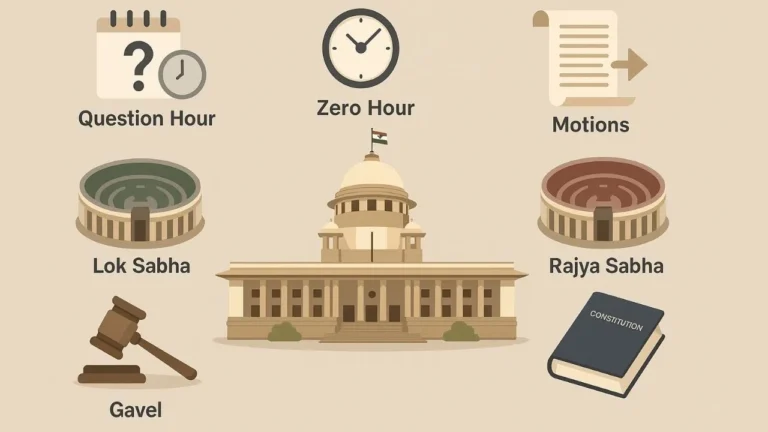
Question Hour
- Definition: Time allocated for Members of Parliament (MPs) to question ministers on matters of public interest.
- Timing: First hour of every sitting of both Lok Sabha and Rajya Sabha.
- Types of Questions:
- Starred Questions: Oral replies with supplementary questions allowed; printed in green.
- Unstarred Questions: Written replies only; no supplementary; printed in white.
- Short Notice Questions: Urgent matters with <10 days’ notice; orally answered; printed in light pink.
- Questions to Private Members: Directed at non-ministers; printed in yellow.
Zero Hour
- Definition: Time immediately following Question Hour where MPs can raise urgent matters without prior notice.
- Significance: Informal device unique to India, not mentioned in the official Rules of Procedure.
Motions
A motion is a formal proposal by an MP to initiate discussion on an issue. No discussion occurs unless admitted by the presiding officer.
Types of Motions
- Substantive Motion: Independent proposals on major issues (e.g., impeachment of President).
- Subsidiary Motion: Dependent on another motion. Examples:
- Ancillary Motion: Routine business procedure.
- Superseding Motion: Supersedes ongoing debate.
- Amendment Motion: Seeks to alter parts of an original motion.
- Special Motions:
- Closure Motion: Ends debate; types include Simple Closure, Kangaroo Closure, Guillotine Closure, etc.
- Privilege Motion: Raised if ministerial misconduct or breach of House privilege occurs.
- Calling Attention Motion: Draws ministerial attention to urgent public issues.
- Adjournment Motion: Suspends business to discuss urgent issues (requires 50 MPs; not allowed in Rajya Sabha).
- No-Confidence Motion: Expresses loss of majority support; passed → Council of Ministers resign.
- Censure Motion: Disapproves government policies; no resignation required.
- Motion of Thanks: Passed after President’s address; non-passage considered a defeat of government.
- No-Day-Yet-Named Motion: Scheduled for discussion later.
Other Devices
- Point of Order: Raised if proceedings violate established rules; temporarily halts business.
- Half-an-Hour Discussion: Provides clarifications on debated factual issues.
- Short Duration / Two-Hour Discussion: Taken up on urgent matters.
- Special Mention (Rajya Sabha) & Rule 377 (Lok Sabha): For raising matters not covered by other rules.
- Resolutions: Formal statements highlighting public issues.
- Private Members’ Resolution: Raised by MPs other than ministers.
- Government Resolution: Moved by ministers.
- Statutory Resolution: Based on constitutional/legislative provisions.
Importance of Devices of Parliamentary Proceedings
Purpose | Importance |
Debate & Deliberation | Platforms for MPs to discuss policies, issues, and proposed laws. |
Decision-Making | Formal mechanism for approval or rejection of proposals. |
Accountability | Ensures ministers answer for their policies and actions. |
Representation | MPs voice the concerns of citizens effectively in the legislature. |
Transparency | Questions and motions make government functioning visible to the public. |
Consensus Building | Encourages dialogue and democratic decision-making. |
Good Governance | Maintains checks and balances, ensures responsive policies. |
Empowerment of Citizens | Citizens’ interests are articulated through elected representatives. |
The devices of parliamentary proceedings are essential for effective legislation, government accountability, and democracy in India. Tools like Question Hour, Zero Hour, and various motions allow MPs to scrutinize the executive, address urgent public concerns, and ensure that laws and policies are debated and enacted in a transparent, responsible manner. They represent the backbone of parliamentary democracy and enable the smooth functioning of governance.
Prelims Questions (Objective / MCQs)
Question Hour in Indian Parliament
Q: Which of the following statements about Question Hour are correct?
- It is the first hour of every sitting of Parliament.
- Starred Questions require written replies only.
- Short Notice Questions can be asked with less than 10 days’ notice.
Select the correct answer:
a) 1 and 2 only
b) 1 and 3 only
c) 2 and 3 only
d) 1, 2 and 3
Zero Hour
Q: Consider the following statements about Zero Hour in the Indian Parliament:
- It begins immediately after Question Hour.
- It is mentioned in the official Rules of Procedure of Parliament.
- MPs can raise urgent matters without prior notice.
Which of the statements given above is/are correct?
a) 1 only
b) 1 and 3 only
c) 2 and 3 only
d) 1, 2 and 3
Motions in Parliament
Q: Which of the following motions in the Indian Parliament can force the Council of Ministers to resign if passed?
a) Censure Motion
b) No-Confidence Motion
c) Adjournment Motion
d) Calling Attention Motion
Adjournment Motion
Q: Which of the following statements are true regarding Adjournment Motion?
- It can be moved in Lok Sabha only.
- It requires the support of at least 50 MPs.
- It can be used in Rajya Sabha to discuss urgent public issues.
Select the correct answer:
a) 1 and 2 only
b) 2 and 3 only
c) 1 and 3 only
d) 1, 2 and 3
Special Mention and Rule 377
Q: Which of the following correctly pairs the House with its device for raising issues not covered by other rules?
a) Special Mention → Lok Sabha, Rule 377 → Rajya Sabha
b) Special Mention → Rajya Sabha, Rule 377 → Lok Sabha
c) Both apply to Lok Sabha
d) Both apply to Rajya Sabha
Resolutions in Parliament
Q: Which of the following is/are correct regarding Resolutions?
- Private Members’ Resolution can be moved by any MP except ministers.
- Government Resolutions are moved by ministers only.
- Statutory Resolutions are based on constitutional/legislative provisions.
Select the correct answer:
a) 1 and 2 only
b) 2 and 3 only
c) 1 and 3 only
d) 1, 2 and 3
Mains Questions (Descriptive / Analytical)
Short Answer (50 words)
Question: “Zero Hour is an informal but essential device of Parliamentary proceedings in India.” Explain its significance and unique features.
Medium Answer (150 words)
Question: Explain the role of Question Hour and its different types in ensuring accountability of the executive in India’s parliamentary democracy.
Analytical Essay (250–300 words)
Question: “Motions in Parliament serve as vital instruments for debate, control, and decision-making.” Discuss the various types of motions and their importance in parliamentary proceedings.
Critical Evaluation (250–300 words)
Question: Evaluate the significance of Adjournment Motions, No-Confidence Motions, and Censure Motions in holding the government accountable. How do these devices balance legislative oversight with executive efficiency?
Comparative Question (150–200 words)
Question: Compare Special Mention in Rajya Sabha and Rule 377 in Lok Sabha as procedural devices for raising issues not covered by other rules. How do they enhance citizen representation in Parliament?
Case-Based Question (200 words)
Question: In a scenario where the Lok Sabha rejects a government’s important policy and 50 MPs demand immediate discussion, which parliamentary devices can be used? Discuss the procedure, limitations, and impact of these devices on governance.
Devices of Parliamentary Proceedings – UPSC FAQ Guide
What are the devices of parliamentary proceedings in India?
The devices of parliamentary proceedings are tools and procedures—like Question Hour, Zero Hour, and various motions—used by Members of Parliament to discuss, debate, and ensure government accountability.
What is the Question Hour in Parliament and why is it important?
Question Hour is the first hour of a parliamentary sitting where MPs ask questions to ministers on public issues. It promotes transparency, accountability, and executive responsibility.
What is the difference between Question Hour and Zero Hour?
Question Hour is a formal and scheduled part of parliamentary proceedings governed by rules, whereas Zero Hour is informal and unscheduled, allowing MPs to raise urgent matters without prior notice.
What is a No-Confidence Motion in the Indian Parliament?
A No-Confidence Motion is introduced in the Lok Sabha to express loss of confidence in the Council of Ministers. If passed by a majority, the government must resign, ensuring executive accountability.
Why are parliamentary devices important for democracy?
These devices enable debate, discussion, and accountability, ensuring that government policies are examined transparently and that citizens’ interests are effectively represented in the legislature.