
INDIA–TALIBAN ENGAGEMENT POLICY
TOPIC: (GS2) INTERNATIONAL RELATIONS: THE HINDU
India recently hosted Taliban Foreign Minister Amir Khan Muttaqi, marking the highest-level interaction between New Delhi and the Taliban regime since 2021.
Background
- Taliban returned to power in August 2021 after the U.S. withdrawal.
- India had invested heavily in Afghan development during 2001–21 and fears losing influence.
- Pakistan–Taliban relations have worsened recently, creating geopolitical openings for India.
India’s Key Objectives in Afghanistan
- Protect Past Investments: India invested ~$3 billion in Afghanistan’s infrastructure, health, education & governance. Wants to ensure earlier projects remain intact and operational.
- Prevent Terrorism Against India: India wants assurance Afghan soil won’t support anti-India groups such as LeT, JeM, IS-K, TTP. Security cooperation is a priority.
- Prevent Pakistan’s Strategic Depth: Taliban historically linked to Pakistan’s military establishment. India aims to explore Taliban autonomy & limit Pakistan’s dominance.
Current Approach: Engage but Don’t Recognise
- India follows a policy of gradual, conditional engagement — not full diplomatic recognition.
- Supports humanitarian aid & infrastructure revival, while monitoring Taliban conduct.
Arguments for Engagement
- Taliban appear more stable than in the 1990s.
- Regional powers like Russia & China have already established diplomatic channels.
- Pakistan–Taliban rift gives India diplomatic leverage.
- Engagement helps India safeguard projects and maintain ground influence.
Risks of Recognising Taliban Now
Human Rights & Governance Concerns
- Severe restrictions on women’s education, work, and public participation.
- Governance run by a small, Pashtun male-only leadership.
- Deep economic crisis — economy shrunk significantly, ~half the population needs aid.
Terror Network Linkages
- UN reports indicate Taliban still shelter al-Qaeda & other jihadist groups.
- Haqqani network remains influential inside Taliban power structure.
- Terror sanctuaries could resurface if domestic instability increases.
India’s Long-Term Strategy
- Maintain strategic patience; avoid hasty recognition.
- Use diplomatic engagement to push for moderation, basic rights, and stability.
- Work through regional forums & UN mechanisms.
- Keep focus on Afghan stability, inclusive governance, economic recovery — key for long-term peace.
Conclusion:
India should stay engaged with the Taliban without according formal recognition.
Cautious diplomacy allows India to protect its interests, support the Afghan people, and maintain leverage, while preventing extremist influence from spreading in the region.
This article has been updated and published in detail on our new platform. Please visit the link below for the latest version:
INDIA’S SHIPPING SECTOR
TOPIC: (GS3) ECONOMY: THE HINDU
India celebrated India Maritime Week, where major investments in the maritime sector were announced and the Prime Minister emphasised the strategic value of shipping.
Background
- Under liberalisation policies since the late 1990s, government support for India’s shipping industry reduced.
- SCI, once a major global player in ship ownership, weakened as policy protections were removed.
- India focused more on port development and seafarer training, not on building a strong domestic merchant fleet.
Key Concerns
Strategic Vulnerability
- India relies heavily on foreign ships for international trade.
- During COVID-19 disruptions, India had limited control over maritime trade routes and ship availability.
- Growing global protectionism and geopolitical tensions make maritime self-reliance critical.
Weak Domestic Fleet
- SCI nearly faced privatisation and struggled without priority shipping rights.
- Private Indian shipping players remain small in global comparison.
Shipbuilding Lag
- Limited progress in merchant shipbuilding, especially high-tech vessels like LNG carriers and green fuel ships.
- Lack of shipbuilding capacity weakens industrial and technical expertise.
Recent Government Measures
- Strengthening SCI: Initiatives launched to expand SCI’s fleet and revive national shipping strength.
- Port-Focused Investments: Majority of investment announcements focus on: Port modernisation, Sagarmala connectivity projects, Trans-shipment hubs (e.g., Andaman project by Chennai & Kolkata ports)
- Landlord Port Model: Government ports lease terminals to private & foreign players, share revenue.
- Encouraging Foreign Firms to Register Ships in India: Aim: secure rights over ships operating in Indian trade routes. Boosts allied sectors like marine insurance and support services.
Way Forward
- India needs focused push in merchant shipbuilding, including advanced and green-fuel vessels.
- Strengthen domestic shipyards through technology tie-ups, incentives, and long-term orders.
- Maintain port growth but balance with fleet expansion and manufacturing capacity.
- Government must ensure shipping sustainability not only as a business but as a strategic national priority.
Conclusion
India’s maritime vision is progressing through port development and policy support, but achieving true shipping strength requires a strong domestic fleet, advanced shipbuilding capability, and strategic planning. When India builds world-class vessels at scale, its maritime sector will fully “cruise ahead.”
This article has been updated and published in detail on our new platform. Please visit the link below for the latest version:
DOCTRINE OF SEVERABILITY
TOPIC: (GS2) INDIAN POLITY: THE HINDU
The Supreme Court recently clarified that the Doctrine of Severability can be applied in Specific Performance suits, but only in rare situations. This reaffirmed that courts may remove unconstitutional parts of legal contracts or statutes while keeping valid portions intact.
What is the Doctrine of Severability?
- It is a constitutional principle that helps courts strike down only those parts of a law that violate Fundamental Rights, instead of cancelling the entire legislation.
- If a section of a law is unconstitutional but can be removed without affecting the purpose or operation of the rest, only that part is held invalid.
- In simple terms, unconstitutional provisions are cut out, and the rest of the law survives if it still functions properly.
Key Features
- When good and bad parts of a law exist together, courts check whether good provisions operate independently.
- If the valid part does not depend on the invalid one, the valid section continues to exist.
- If a law allows both legal and illegal actions, and they cannot be separated, the entire provision becomes void.
- When constitutional and unconstitutional parts are interlinked deeply, the whole Act may be struck down.
- Also known as the Doctrine of Separability.
Judicial Tests for Severability
- The unconstitutional part is clearly identifiable.
- Removing the invalid portion does not change the intent of the law.
- The remaining law is workable and meaningful.
Landmark Judgements
- A.K. Gopalan vs State of Madras (1950): Preventive detention clause that violated rights removed; rest of the law remained.
- Minerva Mills vs Union of India (1980): Certain parts of the 42nd Amendment struck down as beyond Parliament’s power; rest upheld.
- Kihoto Hollohan vs Zachillhu (1992): Paragraph 7 of the Tenth Schedule declared unconstitutional; the rest of the anti-defection provisions retained.
Significance
- Protects the Constitution by removing only unconstitutional elements.
- Maintains legislative intent and stability in the legal system.
- Ensures balance between judicial review and parliamentary authority.
This article has been updated and published in detail on our new platform. Please visit the link below for the latest version:
MAPPING HIGHWAY BLACK SPOTS WITH E-DAR
TOPIC: (GS3) SCIENCE AND TECHNOLOGY: THE HINDU
The Ministry of Road Transport & Highways (MoRTH) is set to release 2023–24 highway “black spot” data using real-time accident systems e-DAR/iRAD.
What are Highway Black Spots?
- A black spot is a 500-metre road stretch where: ≥ 5 accidents causing death/serious injury, or ≥ 10 deaths occur within 3 years.
- These spots are priority areas for immediate safety upgrades due to high accident frequency.
Background
- India records one of the highest road accident fatalities globally, with many deaths on National Highways.
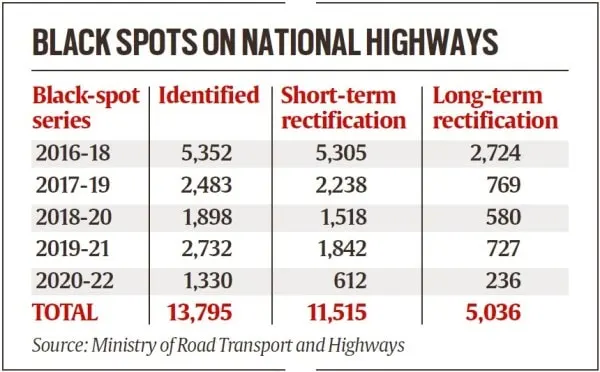
- Parliamentary panel (March 2025) criticised MoRTH for slow action: Out of 13,795 black spots identified (2016–22), only ~5,036 permanently corrected.
- The panel termed this a major governance lapse.
Government Action Plan
- Three-Category Timeline for Fixing Spots
- High-risk areas → Permanent solution in 30 days
- Moderate-risk → Within 90 days
- Low-risk → Within 180 days
- Agencies missing deadlines may face penalties.
- Mandatory 3-month & 12-month post-fix audits.
- Proposal for public dashboard to track rectification progress.
e-DAR / iRAD System
- e-DAR: Electronic Detailed Accident Report
- iRAD: Integrated Road Accident Database
- Mobile-based system developed by MoRTH to feed real-time geo-tagged accident data from police.
Key Functions
- Generates unique accident IDs
- Captures photos, videos, GPS location, and time
- Alerts road engineers instantly
- Creates dashboards for black-spot mapping
- Helps families fast-track compensation claims
Data Accuracy Steps
- TRW (Transport Research Wing) verifies state-submitted accident data.
- Data mismatch between TRW & e-DAR has reduced to below 5% after coordination with states.
Significance
- Enables evidence-based road safety planning
- Faster identification & fixing of dangerous locations
- Supports India’s target to eliminate highway black spots by 2027-28
- Contributes to mission of 95% fatality reduction by 2028
Conclusion
Modern digital tools like e-DAR & iRAD mark a shift toward data-driven road safety governance, but timely execution and strict accountability will be critical to truly saving lives on India’s highways.
This article has been updated and published in detail on our new platform. Please visit the link below for the latest version:
AI-DRIVEN CORPORATE LAYOFFS & WORKFORCE RESTRUCTURING
TOPIC: (GS3) ECONOMY: THE HINDU
Several major global technology companies — such as Amazon, Meta, Microsoft, and TCS — have recently cut thousands of jobs while simultaneously expanding investment in Artificial Intelligence systems and AI-skilled talent.
Background
- Rapid adoption of automation, cloud technology, and AI tools in business operations.
- Layoffs are not always due to machines replacing workers directly, but due to cost optimisation, business restructuring, and redeployment towards AI-focused roles.
- Companies are prioritising AI-powered growth sectors over traditional functions.
Recent Layoff Trends
Company | Workforce Action |
Amazon | ~14,000 jobs cut as part of AI-aligned restructuring |
Meta | ~600 layoffs in superintelligence division overhaul |
TCS | ~12,000 roles reduced while shifting to AI-driven functions |
Microsoft | ~4% workforce trimmed amid major AI investments |
Global trend:
- 1.12 lakh jobs cut globally across 218 firms in 2025 (so far).
- Fewer companies cutting jobs, but larger layoffs per firm — signalling structural shifts, not seasonal cuts.
AI Hiring Trends
- AI-related hiring growing sharply — especially in India (33%+), Brazil, Saudi Arabia.
- Workers with strong AI skills earn ~56% higher wages, particularly in IT services, retail, energy, and communication sectors.
- High pay indicates high value-creation potential in AI-based roles, not just talent shortage.
Investment Pattern
- Global corporate AI spending touched ~$250+ billion in 2024, a 13-fold rise over a decade.
- Major investment areas:
- Gen-AI tools
- Data centres & semiconductor hardware
- Cloud infrastructure
- Workforce re-skilling programs
Implications
Positive
- New jobs in AI, cybersecurity, cloud computing, data analysis
- Higher productivity and innovation capacity
Concerns
- Skill gaps and worker displacement
- Income inequality and job insecurity
- Pressure on governments to reskill citizens
Way Forward for India
- Strengthen digital skilling missions (Skill India, PMKVY, Digital India)
- Promote AI research, startups, and domestic chip manufacturing
- Develop reskilling support and social safety nets
- Encourage human-AI collaborative work systems
Conclusion
AI is reshaping labour markets by shifting corporate priorities rather than replacing workers overnight.
This article has been updated and published in detail on our new platform. Please visit the link below for the latest version:
CROWD CRUSHES & SAFETY MANAGEMENT IN INDIA
TOPIC: (GS3) DISASTER MANAGEMENT: THE HINDU
A tragic crowd collapse in Srikakulam, Andhra Pradesh, at an unregistered temple led to several deaths.
Background
- India witnesses frequent stampedes, especially during religious festivals, pilgrimages, and temple gatherings.
- Despite having National Disaster Management Authority (NDMA) guidelines (2014) and National Building Code (NBC), implementation remains weak.
Recent Incidents
- Srikakulam (2025): One entry-exit route, unsafe construction area used, inadequate crowd control.
- Hathras (2024): Crowd exceeded permitted limit; inadequate exits and supervision failures.
- Sabarimala (2011): Narrow pathways and poor circulation management triggered fatalities during peak footfall.
Key Issues
- Lack of licensing & oversight at religious locations
- Overcrowding beyond approved capacity
- Single entry-exit points & bidirectional movement
- Temporary barricades without safety certification
- Limited trained personnel for real-time monitoring
- Use of unsafe structures or under-construction areas
Root Causes
- Focus on available space instead of evacuation capacity & exit planning
- Poor gate management & crowd flow control
- No real-time crowd analytics or communication systems
- Weak enforcement despite guidelines
Best Practices Available in India
Examples exist where guidelines work effectively:
- Tirumala: Integrated Command & Control Centre managing density & flow
- Sabarimala recent seasons: Licensed plans, capacity calculation, barricade certification, trained stewards
Way Forward
- Mandatory licensing for religious events, tied to safety plans
- Enforcement of NDMA & NBC crowd-safety norms
- Real-time density monitoring & trained crowd stewards
- Certified barricades & controlled entry/exit routing
- Treat large gatherings as engineered public systems, not informal events
Conclusion
Most stampedes are predictable and preventable. India must shift from reactive response to strict planning, licensing, and disciplined execution of crowd-safety standards to avoid recurring tragedies.
This article has been updated and published in detail on our new platform. Please visit the link below for the latest version:
UNESCO CREATIVE CITIES NETWORK (UCCN)
TOPIC: (GS1) INDIAN ART AND CULTURE: THE HINDU
Lucknow has recently been added to the UNESCO Creative Cities Network (UCCN) in the Gastronomy category.

What is UCCN?
- Initiated by UNESCO in 2004 to encourage cities that place creativity and cultural industries at the heart of their development plans.
- Promotes international collaboration among cities using arts, culture, and innovation to achieve sustainable urban growth.
Purpose & Vision
Key Objectives
- Promote creativity as a tool for inclusive and sustainable development.
- Strengthen cultural diversity, social inclusion, and resilience against modern urban challenges like climate change and inequality.
- Support creative economies and generate opportunities for artists, artisans, and creative professionals.
- Encourage partnerships among government, private sector, and civil society for cultural advancement.
Core Focus Areas (7 Creative Fields)
- Crafts & Folk Arts
- Media Arts
- Film
- Design
- Gastronomy
- Literature
- Music
Significance
- Encourages cities to develop into centres of innovation and culture-driven growth.
- Boosts global visibility, tourism, and creative industry investment.
- Helps cities contribute to UN Sustainable Development Goals (SDGs) using cultural resources.
This article has been updated and published in detail on our new platform. Please visit the link below for the latest version:
GSAT-7R COMMUNICATION SATELLITE
TOPIC: (GS3) SCIENCE AND TECHNOLOGY: THE HINDU
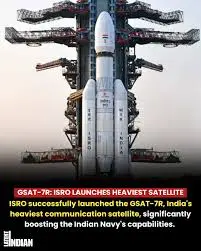
ISRO has successfully launched GSAT-7R, the Indian Navy’s latest military communication satellite. It is India’s heaviest indigenous communication satellite (approx. 4,400 kg), launched using LVM3 from Sriharikota.
Key Highlights
About GSAT-7R
- Successor to GSAT-7 (Rukmini) series designed for the Indian Navy.
- Fully indigenously developed satellite.
- Weighs ~4.4 tonnes — heaviest Indian-made communication satellite launched from India.
- Inserted into Geosynchronous Transfer Orbit (GTO); will move to Geostationary Orbit using onboard propulsion.
Launch Vehicle
- Launched on LVM3-M5 mission, ISRO’s most powerful operational rocket.
- Demonstrates capability to launch 4-tonne+ satellites routinely to GTO.
- Supports future missions like Gaganyaan (human spaceflight).
Importance for Indian Navy & National Security
Enhanced Maritime Communication
- Provides secure, high-capacity communication across the Indian Ocean Region.
- Supports voice, data, and video links.
- Functions across multiple frequency bands ensuring reliable connectivity.
Strategic Military Capability
- Strengthens real-time communication between: Navy ships, Submarines, Maritime aircraft, Naval command centers
- Improves maritime domain awareness and situational intelligence.
- Boosts capability for network-centric warfare.
Indigenous & Strategic Significance
- Reinforces Atmanirbhar Bharat in space and defence technology.
- Reduces dependence on foreign launch services for heavy satellites.
- Enhances India’s strategic deterrence and secure communication shield in maritime theatres.

This article has been updated and published in detail on our new platform. Please visit the link below for the latest version: