Table of Contents
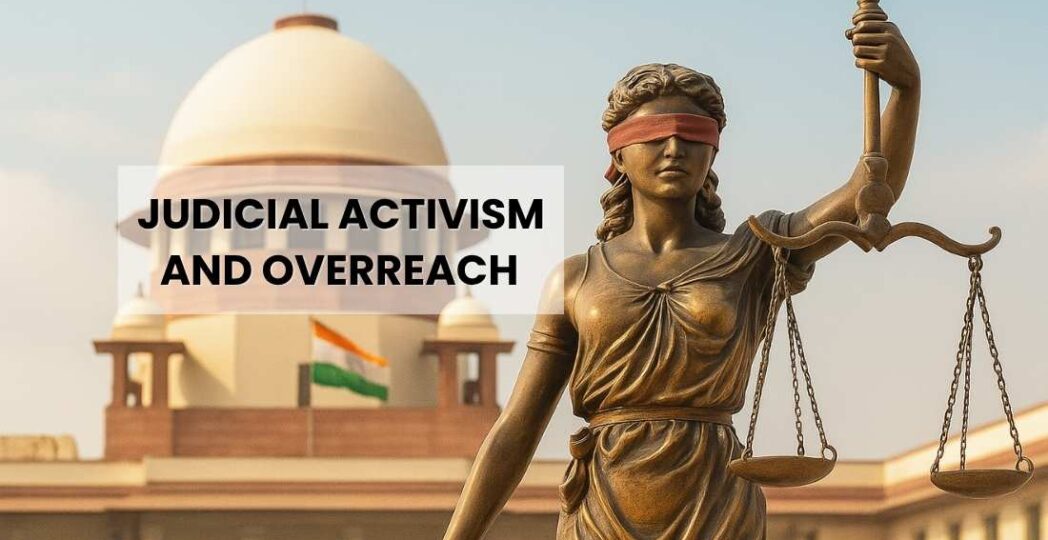
ToggleThe judiciary in India plays a crucial role as the guardian of the Constitution and the protector of fundamental rights. In fulfilling this duty, the courts often interpret the Constitution and laws dynamically — a phenomenon known as Judicial Activism. However, when the judiciary crosses its constitutional boundaries and encroaches upon the domain of the legislature or executive, it leads to Judicial Overreach.
What is Meant by Judicial Activism and Judicial Overreach?
Concept | Meaning |
Judicial Activism | Judicial activism refers to the proactive role played by the judiciary in interpreting and shaping the law beyond its literal meaning to meet the changing needs of society. It often involves expanding or redefining rights and ensuring justice when other organs fail to act. |
Judicial Overreach | Judicial overreach occurs when the judiciary exceeds its jurisdiction by encroaching upon the roles of the legislature or executive, thereby disturbing the constitutional balance of power and violating the principle of separation of powers. |
Constitutional Basis
Judicial activism draws legitimacy from the following constitutional provisions:
- Article 13: Empowers courts to strike down laws violating Fundamental Rights.
- Article 32 & 226: Empower individuals to move the Supreme Court or High Courts for enforcement of Fundamental Rights.
- Article 141: Decisions of the Supreme Court are binding on all courts.
- Article 142: Supreme Court’s power to do complete justice in any case.
Judicial Activism and Overreach – Key Cases in India
Examples of Judicial Activism
Case | Year | Key Principle Established |
Kesavananda Bharati v. State of Kerala | 1973 | Introduced the Basic Structure Doctrine, holding that Parliament cannot amend the basic structure of the Constitution. |
Maneka Gandhi v. Union of India | 1978 | Expanded the scope of Article 21 — Right to life and liberty includes the right to travel abroad; ensured due process of law. |
Vishakha v. State of Rajasthan | 1997 | Laid down guidelines to prevent sexual harassment at the workplace in absence of legislation. |
National Legal Services Authority v. Union of India (NALSA case) | 2014 | Recognized transgender persons’ right to self-identify their gender; upheld dignity and equality. |
Examples of Judicial Overreach
|
Case |
Year |
Observation / Issue |
|
Shyam Narayan Chouksey v. Union of India |
2016 |
Supreme Court made it mandatory for all cinema halls to play the National Anthem — seen as beyond the scope of the Prevention of Insults to National Honour Act, 1971. |
|
Liquor Ban near Highways |
2017 |
Court banned sale of liquor within 500m of highways — criticized as an administrative matter, not judicial. |
|
Arun Gopal v. Union of India |
2017 |
Court fixed firecracker timings during Diwali — considered an executive domain issue. |
|
M.C. Mehta v. Union of India |
2018 |
Banned sale of BS-IV vehicles beyond March 2020 — court involved in policy-level decision-making. |
Significance of Judicial Activism
Aspect | Explanation |
Protection of Fundamental Rights | Activist judiciaries safeguard individual liberties and rights of marginalized groups. Example: Vishakha guidelines led to the POSH Act, 2013. |
Promotion of Rule of Law | Ensures government functions within constitutional boundaries. |
Strengthening Democracy | Prevents abuse of power and enforces accountability. |
Social Transformation | Progressive judgments on environmental protection, gender equality, and human rights encourage reform. Example: NALSA judgment led to Transgender Persons (Protection of Rights) Act, 2019. |
Constitutional Interpretation | Adapts the Constitution to evolving social and political contexts. |
Checks and Balances | Keeps the legislature and executive within constitutional limits. Example: Kesavananda Bharati ensured that Parliament’s amending power is not absolute. |
Criticism of Judicial Overreach
Issue | Explanation |
Violation of Separation of Powers | Judiciary assumes roles meant for legislature/executive, weakening the constitutional framework. |
Judicial Delays | Overextension adds to case backlog and delays justice. |
Overburdened Judiciary | Excessive intervention diverts focus from core adjudicatory functions. |
Lack of Accountability | Judges are unelected; excessive power without checks undermines accountability. |
Lack of Expertise | Judges may not have technical or policy expertise in administrative matters. |
Creates Uncertainty | Frequent interference disrupts predictability in governance and law. |
Erodes Public Trust | Overreach may lead to perception of judicial authoritarianism. |
Judicial Restraint – The Balancing Principle
Aspect | Description |
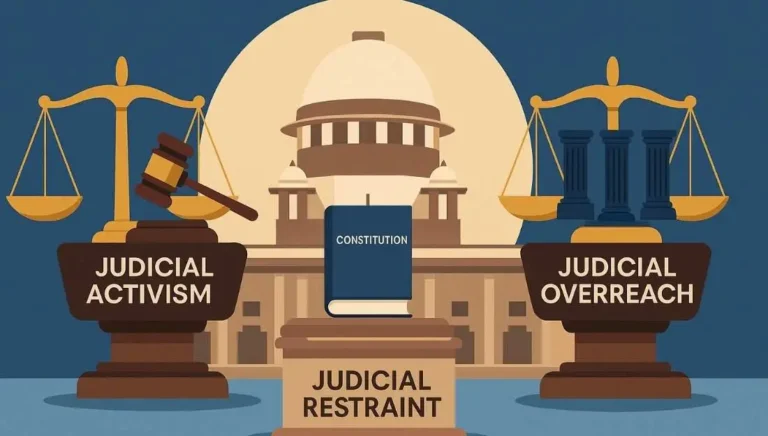
Definition | Judicial restraint implies judges respect the constitutional boundaries and avoid interfering in legislative or executive functions. |
Case Reference | Divisional Manager, Aravali Golf Club v. Chander Hass (2007) — Supreme Court emphasized the need for judicial restraint to maintain inter-branch harmony. |
Purpose | 1. Maintain equality among the three organs of government. 2. Protect judicial independence and credibility. |
Justice A.S. Anand’s View | Warned that excessive activism can lead to “judicial adventurism,” making decisions unpredictable and subjective. |
Measures to Ensure Judicial Restraint and Accountability
Measure | Explanation |
Ensuring Accountability | Through judicial review, reasoned judgments, and transparency in decision-making. |
Judicial Code of Conduct | Enforcing ethics and impartiality among judges. |
Diversity in Judiciary | Promoting social and gender diversity in appointments to ensure broader perspectives. |
Training and Sensitization | Enhancing judicial awareness of constitutional boundaries and governance principles. |
Balanced Approach | Judiciary must interpret the law dynamically but respect institutional limits. |
Judicial Activism vs. Judicial Overreach vs. Judicial Restraint
| Aspect | Judicial Activism | Judicial Overreach | Judicial Restraint |
|---|---|---|---|
| Nature | Proactive interpretation of law | Excessive interference beyond jurisdiction | Respect for institutional limits |
| Objective | Ensure justice and protect rights | Enforce subjective views or policy | Maintain balance of powers |
| Impact | Strengthens democracy | Weakens separation of powers | Preserves institutional harmony |
| Examples | Vishakha Case, Kesavananda Bharati | Liquor Ban, Firecracker Timings | Aravali Golf Club Case |
Judicial activism has played a transformative role in deepening constitutionalism, protecting human rights, and strengthening democracy in India. However, when activism crosses its legitimate limits, it becomes judicial overreach — threatening the delicate balance between the three organs of the State.
Hence, the need is for a balanced approach where the judiciary remains dynamic yet disciplined — “active but not activist; vigilant but not intrusive.”
Judicial Activism and Judicial Overreach - FAQs Answered
What is meant by Judicial Activism in India?
Judicial Activism refers to the proactive role of the judiciary in interpreting laws and the Constitution to protect Fundamental Rights, ensure justice, and fill gaps where the legislature or executive fails to act.
What is the difference between Judicial Activism and Judicial Overreach?
Judicial Activism strengthens democracy by safeguarding rights, while Judicial Overreach occurs when courts exceed their limits and interfere with legislative or executive functions, disturbing the separation of powers.
Which constitutional articles empower the judiciary to exercise activism?
Key empowering provisions include Article 13, Article 32, Article 226, Article 141, and Article 142, which enable courts to strike down unconstitutional laws, enforce rights, and do complete justice.
What are some famous examples of Judicial Activism in India?
Landmark cases include Kesavananda Bharati (Basic Structure Doctrine), Maneka Gandhi (Expanded Article 21), Vishakha Guidelines, and NALSA (Transgender Rights) — all examples of progressive judicial reform.
Why is Judicial Overreach considered harmful for democracy?
Judicial Overreach disrupts the balance of power, creates administrative hurdles, lacks accountability, and weakens the authority of elected institutions, causing friction among the Executive, Legislature, and Judiciary.