Table of Contents
ToggleWhat is a Parliamentary Committee?
A Parliamentary Committee is a group of Members of Parliament (MPs) elected or nominated by the Speaker of the Lok Sabha or the Chairman of the Rajya Sabha. These committees assist Parliament in carrying out its functions more effectively by scrutinizing policies, bills, budgets, and administrative actions of the government.
The concept of Parliamentary Committees originated in the British Parliament, reflecting the principle that effective governance requires detailed discussion and continuous oversight beyond full House debates.
These committees work under the direction of the Speaker or Chairman, and their reports are presented to the respective Houses of Parliament.
Constitutional Basis of Parliamentary Committees
Article | Provision | Relevance |
Article 105 | Powers, privileges, etc., of the Houses of Parliament and of the members and committees thereof. | Provides protection and privileges to committees. |
Article 118 | Each House of Parliament may make rules for regulating its procedure and the conduct of its business. | Empowers each House to create committees and define their procedures. |
Thus, Parliamentary Committees derive their authority directly from the Constitution of India.
Classification of Parliamentary Committees
Parliamentary Committees in India are broadly classified into two categories:
- Standing Committees
- Ad hoc Committees
Standing Committees
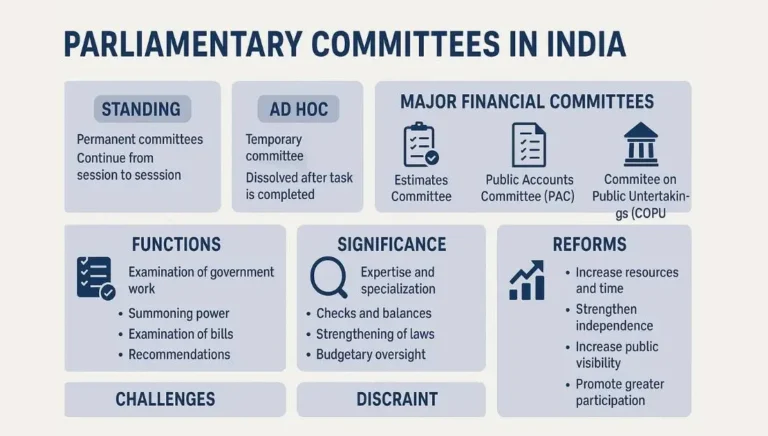
Standing Committees are permanent committees constituted by Parliament. They deal with specific subjects and continue from one session to another.
These committees are reconstituted annually or periodically, depending on parliamentary rules, and perform continuous oversight over government functioning.
Major Standing Committees
| Name of Committee | Number of Members | Tenure | Mode of Selection |
|---|---|---|---|
| Estimates Committee | 30 | 1 year | Elected by Lok Sabha |
| Public Accounts Committee (PAC) | 22 (15 from LS + 7 from RS) | 1 year | Elected by both Houses |
| Committee on Public Undertakings (COPU) | 22 (15 from LS + 7 from RS) | 1 year | Elected by both Houses |
Other Types of Standing Committees
Category | Examples |
Committees to Inquire | Committee on Petitions, Committee on Privileges, Ethics Committee |
Committees to Scrutinize and Control | Committees on Government Assurances, Subordinate Legislation, Papers Laid on the Table, Welfare of SCs and STs, Empowerment of Women, Joint Committee on Offices of Profit |
Committees Relating to Day-to-Day Business of the House | Business Advisory Committee, Rules Committee, Committee on Private Members’ Bills and Resolutions, Committee on Absence of Members |
Housekeeping or Service Committees | General Purposes Committee, House Committee, Library Committee, Joint Committee on Salaries and Allowances of Members |
Departmentally Related Standing Committees (DRSCs) | Committees on Commerce, Home Affairs, Human Resource Development, Industry, etc. |
Ad hoc Committees
Ad hoc Committees are temporary committees set up for a specific purpose. They cease to exist after the completion of their assigned task.
Types of Ad hoc Committees
- Inquiry Committees – Formed to investigate specific matters of public importance.
- Advisory Committees – Constituted to consider and report on particular Bills or issues.
Examples:
- Select and Joint Committees on Bills.
- Railway Convention Committee.
- Joint Committee on Food Management in Parliament House Complex.
Once their report is submitted, ad hoc committees are dissolved automatically.
Powers and Functions of Parliamentary Committees
Function | Description |
1. Examination of Government Work | Committees scrutinize government policies, programs, and administrative actions, and recommend improvements. |
2. Summoning Power | They can summon ministers, officials, and experts to seek clarifications and explanations. |
3. Examination of Bills | Committees review draft Bills clause by clause before passage, ensuring constitutionality and sound policy. |
4. Recommendations | They suggest amendments or improvements to laws, ensuring alignment with constitutional and legal provisions. |
Significance of Parliamentary Committees
Process of a Money Bill – Step-by-Step (Article 110 & 109)
| Step No. | Stage | Details | Authority Involved |
|---|---|---|---|
| 1 | Recommendation of the President | A Money Bill can be introduced only with the prior recommendation of the President. | President of India |
| 2 | Introduction in Lok Sabha | The Bill can be introduced only in the Lok Sabha (never in Rajya Sabha), and only by a Minister. | Lok Sabha |
| 3 | Consideration & Passage in Lok Sabha | The Lok Sabha debates, amends, and passes the Bill by a simple majority. | Lok Sabha Members |
| 4 | Transmission to Rajya Sabha | After passage, the Bill is sent to Rajya Sabha for recommendations. Rajya Sabha cannot amend or reject it. | Rajya Sabha |
| 5 | Time Limit for Rajya Sabha | Rajya Sabha must return the Bill within 14 days, with or without recommendations. If not returned, it is deemed passed by both Houses. | Rajya Sabha |
| 6 | Lok Sabha’s Decision on Recommendations | Lok Sabha may accept or reject any or all of Rajya Sabha’s suggestions. The decision of Lok Sabha is final. | Lok Sabha |
| 7 | President’s Assent | After passage in Lok Sabha, the Bill is sent to the President for assent. The President cannot return or withhold assent to a Money Bill. | President of India |
| 8 | Becomes an Act | Once the President gives assent, the Money Bill becomes an Act of Parliament and is enforced as law. | President & Government of India |
Issues and Challenges
| Challenge | Description | Example / Observation |
|---|---|---|
| Resource Constraints | Lack of expert staff and research assistance limits committee depth. | NCRWC (2002) noted the absence of specialist advisors for DRSCs. |
| Limited Powers | Committees can only recommend; they cannot enforce compliance. | Government often ignores committee reports. |
| Lack of Independence | Political influence can compromise committee objectivity. | Some reports reflect party positions rather than evidence. |
| Low Participation | Poor attendance by MPs reduces effectiveness. | During 2009–14, average attendance was 49% in DRSC meetings. |
| Poor Number of Sittings | Fewer Parliament sittings restrict committee activity. | In the 17th Lok Sabha’s 1st Session, Parliament sat only for 37 days. |
| Lack of Detailed Scrutiny | Limited discussion of Bills and budgets in committees. | Only 17% of the budget was discussed in the 16th Lok Sabha. |
Measures to Enhance the Role of Parliamentary Committees
Measure | Description |
1. Increase Resources and Time | Allocate dedicated funds and expert research staff to assist committees. (NCRWC, 2002) recommended this. |
2. Strengthen Independence | Protect committees from political and executive influence. |
3. Increase Public Visibility | Hold public hearings, publish reports, and invite citizen feedback. |
4. Promote Greater Participation | Provide incentives for MPs to engage in committee work and recognize quality contributions. |
5. Build Technical Capacity | Train MPs in policy analysis, budgeting, and legal drafting. |
Conclusion
Parliamentary Committees are the backbone of India’s legislative oversight system.
They enhance the efficiency, accountability, and transparency of parliamentary functioning. Despite challenges like limited powers and resource constraints, their role in strengthening Indian democracy is indispensable.
With reforms to empower committees, enhance research support, and increase public participation, they can serve as even stronger instruments of democratic governance.
Major Parliamentary Committees of India
| Type / Committee | Composition | Main Functions / Role | Key Facts / Highlights |
|---|---|---|---|
| Public Accounts Committee (PAC) | 22 members (15 LS + 7 RS). Chairperson from Opposition. | Examines CAG reports on expenditure to ensure funds are used as approved by Parliament. | Ensures financial accountability; oldest financial committee (1950). |
| Committee on Public Undertakings (COPU) | 22 members (15 LS + 7 RS). Chairperson from Lok Sabha (non-minister). | Examines reports and accounts of PSUs and CAG reports on PSUs. | Focuses on PSU performance and efficiency; established in 1964. |
| Estimates Committee | 30 members (Lok Sabha only). Chairperson from ruling party. | Examines budget estimates, suggests economies, and improves administrative efficiency. | Can suggest alternative policies; origin in 1921. |
| Departmentally Related Standing Committees (DRSCs) | 24 committees – 16 for LS, 8 for RS. 31 members each (21 LS + 10 RS). | Examine Demands for Grants, Bills, and policy documents of ministries. | Introduced in 1993; enhance policy scrutiny and legislative oversight. |
| Committee on Estimates (Sub-Committees) | Formed by Estimates Committee for specific ministries. | Conduct detailed examination of ministries/programmes. | Improves efficiency and performance in implementation. |
| Committee on Government Assurances | 15 LS members; 10 RS members. | Examines assurances, promises, or undertakings made by ministers in Parliament. | Ensures ministerial accountability. |
| Committee on Subordinate Legislation | 15 LS + 15 RS members. | Checks if delegated legislation conforms to the Constitution and parent Act. | Ensures executive law-making stays within limits. |
| Committee on Petitions | 15 LS + 10 RS members. | Examines petitions on public grievances and legislative requests. | Acts as a bridge between citizens and Parliament. |
| Committee on Privileges | 15 LS + 10 RS members. | Examines cases of breach of privilege of MPs or House. | Protects dignity and rights of Parliament and members. |
| Business Advisory Committee | 15 LS + 11 RS members. | Allocates time for discussion of government business. | Decides House agenda and schedule. |
| Rules Committee | 15 LS + 15 RS members. | Considers procedure matters and recommends amendments to House rules. | Chaired by Speaker (LS) / Chairman (RS). |
| Committee on Papers Laid on the Table | 15 LS + 10 RS members. | Examines papers/reports laid by ministers to ensure compliance. | Ensures transparency in government reporting. |
| Committee on Welfare of SCs/STs | 30 members (20 LS + 10 RS). | Monitors welfare programmes and safeguards for SCs/STs. | Strengthens social justice oversight. |
| Committee on Empowerment of Women | 30 members (20 LS + 10 RS). | Examines measures for women’s equality, status, and security. | Established in 1997; focuses on gender justice. |
| Committee on Public Undertakings (State-Level) | (At state legislatures) Similar composition. | Examines State PSUs and Audit Reports. | Mirrors COPU at state level. |
| Joint Parliamentary Committee (JPC) | Formed for specific purpose; members from both Houses. | Investigates issues or scandals (e.g., 2G Spectrum, Stock Market Scam). | Temporary; dissolved after report submission. |
| Select Committee (Ad hoc) | Formed to examine a specific Bill clause by clause. | Scrutinizes Bills in detail and submits report. | Ceases to exist after submitting report. |
| Joint Committee on Offices of Profit | 15 LS + 10 RS members. | Examines offices held by MPs to prevent disqualification. | Prevents conflict of interest among MPs. |
Parliamentary Committees – Prelims Practice Questions
Question 1
Q: Which of the following Committees examines the accounts showing the appropriation of sums granted by Parliament?
Options:
(a) Estimates Committee
(b) Committee on Public Undertakings
(c) Public Accounts Committee ✅
(d) Departmental Standing Committee
Answer: (c) Public Accounts Committee
Explanation: PAC ensures that expenditure is incurred in accordance with Parliament’s decision and reports of the CAG.
Question 2
Q: Consider the following statements about the Estimates Committee:
- It consists entirely of members from Lok Sabha.
- A Minister can be appointed as a member of this committee.
Options:
(a) 1 only ✅
(b) 2 only
(c) Both 1 and 2
(d) Neither 1 nor 2
Answer: (a) 1 only
Explanation: Only Lok Sabha members are part of the Estimates Committee; Ministers are not eligible for membership.
Question 3
Q: Which of the following is NOT a Departmentally Related Standing Committee?
Options:
(a) Committee on Agriculture
(b) Committee on Defence
(c) Committee on Finance
(d) Committee on Privileges ✅
Answer: (d) Committee on Privileges
Explanation: Committee on Privileges is a Standing Committee, but not Departmentally Related.
Question 4
Q: Which article of the Constitution empowers each House of Parliament to make rules for the conduct of its business?
Options:
(a) Article 105
(b) Article 110
(c) Article 118 ✅
(d) Article 120
Answer: (c) Article 118
Explanation: Article 118 gives power to each House to regulate its own procedure.
Question 5
Q: Which of the following statements is/are correct regarding the Public Accounts Committee (PAC)?
- It is a Financial Committee.
- The Speaker of Lok Sabha appoints the Chairman of the PAC.
- The Chairman is traditionally from the opposition party.
Options:
(a) 1 only
(b) 1 and 2 only
(c) 1 and 3 only
(d) 1, 2 and 3 ✅
Answer: (d) 1, 2 and 3
Explanation: PAC ensures financial accountability; Chairperson from Opposition since 1967.
Question 6
Q: The Committee on Government Assurances ensures that:
Options:
(a) Public expenditure is within limits
(b) Bills conform to constitutional principles
(c) Assurances made by ministers in Parliament are implemented ✅
(d) Rules framed by ministries are consistent with Acts
Answer: (c)
Explanation: It checks that assurances made on the floor of Parliament are fulfilled.
Question 7
Q: Which of the following Committees examines whether delegated legislation is within the scope of the parent Act?
Options:
(a) Committee on Petitions
(b) Committee on Subordinate Legislation ✅
(c) Business Advisory Committee
(d) Rules Committee
Answer: (b)
Explanation: It scrutinizes executive-made rules and regulations.
Question 8
Q: The Committee on Public Undertakings was established in:
Options:
(a) 1949
(b) 1950
(c) 1953
(d) 1964 ✅
Answer: (d) 1964
Explanation: COPU was set up in 1964 to examine working of PSUs.
Question 9
Q: Which of the following statements about Joint Parliamentary Committees (JPCs) is correct?
Options:
(a) They are permanent committees.
(b) They are formed to examine ordinary bills.
(c) They are ad hoc committees constituted for a specific purpose. ✅
(d) Their recommendations are binding on the government.
Answer: (c)
Explanation: JPCs are ad hoc committees, temporary in nature.
Question 10
Q: Who among the following presides over the Rules Committee of Lok Sabha?
Options:
(a) Prime Minister
(b) Deputy Speaker
(c) Speaker ✅
(d) Leader of Opposition
Answer: (c) Speaker
Explanation: The Speaker of Lok Sabha chairs the Rules Committee.
Parliamentary Committees – Mains Practice Questions
Classification of Parliamentary Committees
Question: Explain the classification of Parliamentary Committees in India. How do they ensure accountability of the Executive to the Legislature?
Answer Approach: Mention Standing and Ad hoc committees; cite PAC, COPU, DRSCs. Explain financial control, policy review, checks and balances.
Role of Departmentally Related Standing Committees
Question: Discuss the role and significance of the Departmentally Related Standing Committees (DRSCs) in the Indian Parliamentary system.
Answer Approach: Trace origin (1993), composition, functions—examine Demands for Grants, bills, and policy oversight. Highlight expert scrutiny and non-partisan discussions.
Efficiency of Parliament and Committees
Question: “The efficiency of Parliament largely depends upon the functioning of its Committees.” Elucidate with suitable examples.
Answer Approach: Give examples—PAC, COPU, Committee on Empowerment of Women, DRSCs. Discuss how committees aid detailed scrutiny and continuity of work.
Issues in Functioning of Committees
Question: Examine the issues and challenges faced by Parliamentary Committees in India. Suggest measures to strengthen their functioning.
Answer Approach: Mention limited research support, political interference, low attendance, poor follow-up. Suggest independent research staff, more sittings, public access.
Comparing PAC, Estimates Committee, and COPU
Question: Differentiate between Public Accounts Committee (PAC), Estimates Committee, and Committee on Public Undertakings (COPU) in terms of their composition and functions.
Answer Approach: Tabulate differences — PAC (CAG audit, post-expenditure check), Estimates (pre-budget economy), COPU (PSU performance).
Mini-Parliament in Action
Question: “Parliamentary Committees represent the mini-Parliament in action.” Discuss.
Answer Approach: Explain their composition (cross-party), bipartisan deliberations, confidential discussions, technical scrutiny.
Committees and Separation of Powers
Question: Examine how Parliamentary Committees contribute to the principle of separation of powers and accountability in governance.
Answer Approach: Discuss legislative oversight of executive, committee autonomy, and checks and balances.
Committees in an Era of Polarization
Question: Critically analyze the relevance of Parliamentary Committees in the era of increasing political polarization and reduced sittings of Parliament.
Answer Approach: Point out decreasing working days, media-driven debates; argue that committees retain deliberative strength and need revitalization.
Significance of Ad hoc Committees
Question: What is the significance of ad hoc committees like the Joint Parliamentary Committee (JPC)? How do they differ from Standing Committees?
Answer Approach: Compare temporary vs. permanent nature, function, examples like JPC on 2G Spectrum and Bofors.
Recommendations for Strengthening Committees
Question: The National Commission to Review the Working of the Constitution (2002) made key recommendations to strengthen committees. Discuss these recommendations and their contemporary relevance.
Answer Approach: Mention more research support, dedicated budget, public hearings, enhanced transparency, and accountability.
Parliamentary Committees - FAQs Answered
What are Parliamentary Committees and why are they important?
Parliamentary Committees are groups of MPs formed to examine Bills, budgets, policies, and government functioning in detail. They ensure accountability, improve legislative quality, and enable deeper scrutiny than full House debates.
What is the difference between Standing Committees and Ad hoc Committees?
Standing Committees are permanent, reconstituted every year, while Ad hoc Committees are temporary and dissolve after submitting their report. Standing Committees ensure continuous oversight, whereas Ad hoc Committees handle specific issues.
What are the major financial committees of Parliament?
The three major Financial Committees are:
- Public Accounts Committee (PAC)
- Committee on Public Undertakings (COPU)
- Estimates Committee
They ensure financial accountability, monitor government expenditure, and review CAG reports.
What powers do Parliamentary Committees have?
They have the power to summon officials, review Bills, examine policies, gather expert evidence, and recommend amendments. However, their recommendations are advisory, not binding.
What are the main challenges faced by Parliamentary Committees?
Key challenges include limited resources, political influence, poor attendance, non-binding recommendations, and insufficient scrutiny due to fewer Parliament sittings.