Table of Contents
ToggleThe Supreme Court of India, established on January 28, 1950, is the apex judicial body and the final court of appeal in the country. It serves as the guardian of the Constitution and the protector of citizens’ fundamental rights. Located in New Delhi, the Supreme Court has the power of judicial review, ensuring that all laws and executive actions comply with the Constitution of India.
It functions not only as a court of law but also as a balancing institution that maintains harmony between rights and control, and between the executive, legislature, and judiciary.
Historical Evolution of the Supreme Court
Period/Act | Key Development |
Regulating Act of 1773 | Established the Supreme Court of Judicature at Calcutta, with jurisdiction over Bengal, Bihar, and Orissa. |
King George III | Established Supreme Courts at Madras (1800) and Bombay (1823). |
Indian High Courts Act, 1861 | Replaced the old Supreme Courts with High Courts at Calcutta, Bombay, and Madras. |
Government of India Act, 1935 | Created the Federal Court of India to settle disputes between provinces and the central government. |
Post-Independence | The Supreme Court of India was formally established on January 28, 1950, replacing the Federal Court. |
Article 130 | Allows the Supreme Court to sit in Delhi or any other place designated by the Chief Justice with Presidential approval. |
Constitutional Provisions
- Articles 124 to 147 (Part V, Chapter IV) of the Indian Constitution deal with the organisation, powers, jurisdiction, and procedures of the Supreme Court.
- Parliament has the authority to regulate these provisions when necessary.
Composition of the Supreme Court
- Original strength (1950): 8 judges (including the Chief Justice).
- Current strength (after successive amendments): 34 judges, including the Chief Justice of India (CJI).
- Article 124 empowers Parliament to increase or decrease the number of judges as needed.
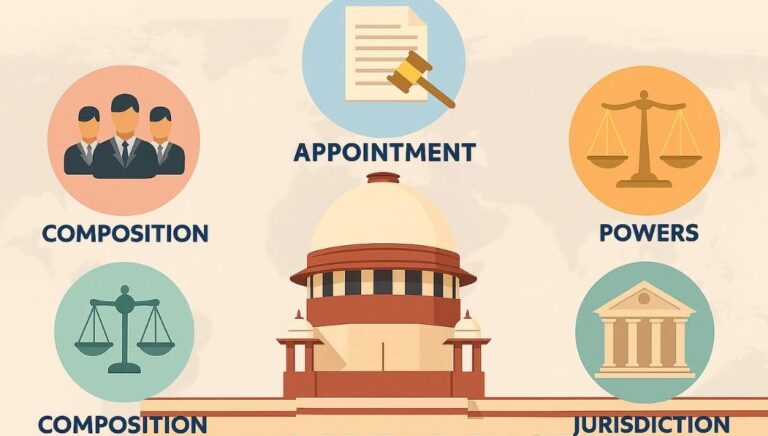
Appointment of Supreme Court Judges
- hand and seal.
- Tenure: Until the age of 65 years.
- Mandatory Consultation: The President must consult the Chief Justice of India for every appointment other than the CJI.
Evolution of the Appointment Process
Case | Year | Key Outcome |
First Judges Case (S.P. Gupta v. Union of India) | 1981 | Executive had primacy in judicial appointments. |
Second Judges Case | 1993 | Judicial primacy established; created the Collegium System. |
Third Judges Case (Presidential Reference) | 1998 | Collegium to include CJI + 4 senior-most judges; President bound by their recommendation. |
Collegium System
The Collegium System is a judicial mechanism by which judges of the Supreme Court and High Courts are appointed and transferred.
If the CJI recommends a name without consulting the collegium, such a recommendation is not binding on the President.
Qualifications (Article 124(3))
A person is qualified for appointment as a Supreme Court Judge if they:
- Are a citizen of India, and
- Fulfil any one of the following:
- Have been a judge of a High Court (or of two or more High Courts in succession) for at least 5 years, or
- Have been an advocate of a High Court (or of two or more High Courts in succession) for at least 10 years, or
- Are, in the opinion of the President, a distinguished jurist.
Oath or Affirmation
Before entering office, every judge swears an oath before the President of India, promising to:
- Uphold the Constitution and sovereignty of India.
- Perform duties faithfully and without fear, favour, affection, or ill-will.
- Protect and uphold the laws of the nation.
Salaries and Allowances
- Determined by Parliament.
- Cannot be reduced to the judge’s disadvantage except during a Financial Emergency (Article 360).
- Drawn from the Consolidated Fund of India.
Acting, Ad Hoc, and Retired Judges
Type | Article | Description |
Acting Chief Justice | Article 126 | When the office of the CJI is vacant or unavailable, the President appoints another judge to act as CJI. |
Ad Hoc Judges | Article 127 | The CJI can, with Presidential approval, appoint a High Court judge temporarily to the Supreme Court to meet case load requirements. |
Retired Judges | Article 128 | A retired judge of the Supreme Court, Federal Court, or High Court may be requested to sit and act as a Supreme Court judge, with Presidential approval. |
Removal of Judges
- Judges can be removed only on the grounds of proved misbehaviour or incapacity.
- The process is governed by the Judges (Inquiry) Act, 1968.
Procedure
- A motion for removal is signed by 100 Lok Sabha members or 50 Rajya Sabha members.
- The Speaker or Chairman may admit or reject the motion.
- If admitted, a three-member committee is formed (comprising one SC judge, one HC Chief Justice, and one distinguished jurist).
- If the committee finds the judge guilty, the motion is voted upon by both Houses.
- If passed by a special majority in both Houses, the President issues the removal order.
Jurisdiction and Powers of the Supreme Court
Type of Jurisdiction | Articles | Scope and Details |
Original Jurisdiction | Article 131 | Disputes between the Centre and one or more States, or between States. |
Appellate Jurisdiction | Articles 132–134 | Appeals from High Courts in constitutional, civil, or criminal matters. |
Special Leave to Appeal | Article 136 | The SC can grant special leave to appeal from any court or tribunal (except Armed Forces tribunals). |
Advisory Jurisdiction | Article 143 | The President can seek the Supreme Court’s opinion on questions of law or public importance. |
Writ Jurisdiction | Article 32 | The SC can issue writs (Habeas Corpus, Mandamus, Prohibition, Quo Warranto, Certiorari) for enforcement of Fundamental Rights. |
Court of Record | Article 129 | The SC is a Court of Record and can punish for contempt of itself. |
Judicial Review | Derived Power | The SC can review legislative and executive actions for constitutionality. |
Independence of the Supreme Court
Safeguard | Explanation |
Mode of Appointment | Consultative process ensures political neutrality. |
Security of Tenure | Judges can be removed only by constitutional procedure. |
Fixed Service Conditions | Salaries and pensions cannot be altered to their disadvantage. |
Expenses Charged on Consolidated Fund | Financial independence. |
Conduct Not Discussed in Parliament | Judicial conduct cannot be debated except during impeachment. |
Ban on Practice After Retirement | Judges cannot practice in any court or tribunal post-retirement. |
Challenges Before the Supreme Court
Issue | Description |
Judicial Pendency | Over 80,000 pending cases (as of April 2024). Causes delay in justice delivery. |
Judicial Appointments | Collegium system criticised for opacity, nepotism, and lack of accountability. |
Judicial Overreach | Instances of judiciary intruding into executive domain (e.g., liquor ban near highways). |
Lack of Diversity | Only 11 women judges since inception; inadequate caste and regional representation. |
Way Forward
- Increase Judicial Strength: Expand the number of judges to reduce pendency.
- Modernise Infrastructure: Implement full e-courts, virtual hearings, and digital filing systems.
- Enhance Transparency: Reform the appointment process to make it merit-based and transparent.
- Promote Diversity: Ensure inclusion across gender, caste, and regional backgrounds.
- Establish Specialised Benches: For faster resolution in fields like environment, taxation, and IPR.
- Public Engagement: Encourage open publication of judgments and rationale to strengthen public trust.
Prelims Practice Questions
Establishment of Supreme Court – Article 124
Q: Which Article of the Indian Constitution deals with the establishment and constitution of the Supreme Court of India?
Options:
(a) Article 32
(b) Article 124 ✅
(c) Article 136
(d) Article 143
Explanation: Article 124 provides for the establishment and constitution of the Supreme Court of India.
Retirement Age of Supreme Court Judges
Q: The retirement age of a judge of the Supreme Court is:
Options:
(a) 60 years
(b) 62 years
(c) 65 years ✅
(d) 68 years
Explanation: As per Article 124(2), a Supreme Court judge holds office until the age of 65 years.
Review Power of Supreme Court
Q: The power of the Supreme Court to review its own judgment is provided under:
Options:
(a) Article 137 ✅
(b) Article 132
(c) Article 141
(d) Article 142
Explanation: Article 137 empowers the Supreme Court to review its own judgments or orders.
Jurisdiction of Supreme Court
Q: Which of the following statements about the jurisdiction of the Supreme Court is incorrect?
Options:
(a) It has original jurisdiction in disputes between Centre and States.
(b) It can give advisory opinions under Article 143.
(c) It can transfer cases from one High Court to another.
(d) It can issue writs under Article 226 ✅
Explanation: Article 226 empowers High Courts, not the Supreme Court, to issue writs for enforcement of fundamental rights.
Single Integrated Judicial System
Q: The concept of “Single Integrated Judicial System” in India means:
Options:
(a) Judiciary is independent but subordinate to Parliament.
(b) Judiciary is hierarchical with the Supreme Court at the top ✅
(c) States have separate judicial systems.
(d) Federal courts exist in each State.
Explanation: India has a single unified judicial system with the Supreme Court at the apex, followed by High Courts and Subordinate Courts.
Appointment of Supreme Court Judges
Q: Who appoints the judges of the Supreme Court?
Options:
(a) Prime Minister
(b) Parliament
(c) President ✅
(d) Chief Justice of India
Explanation: The President appoints Supreme Court judges after consultation with the CJI and other senior judges (as per the Collegium system).
Power to Do Complete Justice
Q: Which Article gives the Supreme Court the power to do “complete justice” in any case?
Options:
(a) Article 136
(b) Article 142 ✅
(c) Article 144
(d) Article 145
Explanation: Article 142 empowers the Supreme Court to pass such decrees or orders as are necessary for doing complete justice.
Writ Jurisdiction of Supreme Court
Q: Which of the following is not a writ issued by the Supreme Court?
Options:
(a) Habeas Corpus
(b) Mandamus
(c) Certiorari
(d) Quo Warranto
(e) Curative ✅
Explanation: ‘Curative’ is not a writ; it is a type of petition devised by the Supreme Court for correcting miscarriage of justice.
Mains Practice Questions
1. Role of the Supreme Court as Guardian of the Constitution
Question: Discuss the role of the Supreme Court of India as the guardian of the Constitution.
(GS Paper 2 – Polity)
Focus: Judicial review, protection of Fundamental Rights, and interpretation of the Constitution.
2. Significance of Article 32 – “Heart and Soul” of the Constitution
Question: Explain the significance of Article 32 in the Indian Constitution. Why did Dr. B.R. Ambedkar call it the “heart and soul” of the Constitution?
(GS Paper 2)
Focus: Writ jurisdiction and enforcement of Fundamental Rights.
3. Supreme Court and Federal Balance
Question: “The Supreme Court is not only a judicial body but also a guardian of the federal balance.” Explain.
(GS Paper 2)
Focus: Original jurisdiction under Article 131 and Centre-State disputes.
4. Doctrine of Judicial Review and Constitutional Supremacy
Question: Examine the importance of the doctrine of Judicial Review in maintaining the supremacy of the Constitution.
(GS Paper 2)
Focus: Articles 13, 32, and 136; cases like Kesavananda Bharati and Minerva Mills.
5. Collegium System and Judicial Appointments
Question: What is the Collegium System of judicial appointments? Critically analyze its functioning and recent reforms suggested.
(GS Paper 2)
Focus: Evolution through SP Gupta, Second and Third Judges cases, and reforms proposed.
6. Advisory Jurisdiction under Article 143
Question: Evaluate the effectiveness of the Supreme Court’s advisory jurisdiction under Article 143.
(GS Paper 2)
Focus: Non-binding nature; examples like Berubari and Ayodhya (2019).
7. Extraordinary Powers under Article 142
Question: “Article 142 of the Constitution has conferred extraordinary powers on the Supreme Court.” Examine with recent examples.
(GS Paper 2)
Focus: Role in environmental cases, electoral reforms, and its limitations.
8. Judicial Activism vs Judicial Restraint
Question: How does the Supreme Court balance judicial activism and judicial restraint in a constitutional democracy?
(GS Paper 2)
Focus: Case studies like Vishaka, NJAC, and Sabarimala.
Supreme Court of India – UPSC PYQs
1. Constitutionalisation of Environmental Problems
Question: “The most significant achievement of modern law in India is the constitutionalisation of environmental problems by the Supreme Court.” Discuss this statement with the help of relevant case laws.
(UPSC Mains 2022)
2. Federal Supremacy and Harmonious Construction
Question: From the resolution of contentious issues regarding the distribution of legislative powers by the Courts, ‘Principle of Federal Supremacy’ and ‘Harmonious Construction’ have emerged. Explain.
(UPSC Mains 2019)
3. NJAC Judgment and Judicial Appointments
Question: Critically examine the Supreme Court’s judgement on the ‘National Judicial Appointments Commission Act, 2014’ with reference to the appointment of judges of higher judiciary in India.
(UPSC Mains 2018)
4. Judiciary – Constitutional Provisions (Prelims 2021)
Question: With reference to Indian Judiciary, consider the following statements:
- Any retired judge of the Supreme Court of India can be called back to sit by the Chief Justice of India with prior permission of the President of India.
- A High Court in India has the power to review its own judgement as the Supreme Court does.
Which of the statements given above is/are correct?
(a) 1 only
(b) 2 only
(c) Both 1 and 2
(d) Neither 1 nor 2
✅ Answer: (a)
5. 44th & 99th Amendments – Judicial Review (Prelims 2019)
Question: Consider the following statements:
- The 44th Amendment to the Constitution of India introduced an article placing the election of the Prime Minister beyond judicial review.
- Supreme Court of India struck down the 99th amendment to the Constitution of India as being violative of the independence of the judiciary.
Which of the statements given above is/are correct?
(a) 1 only
(b) 2 only
(c) Both 1 and 2
(d) Neither 1 nor 2
✅ Answer: (b)
Supreme Court of India - FAQs Answered
What is the role of the Supreme Court of India in the Indian Constitution?
The Supreme Court of India acts as the guardian of the Constitution, the final court of appeal, and the protector of Fundamental Rights. It ensures all laws and executive actions follow the Constitution through judicial review.
What is the Collegium System and how does it appoint Supreme Court judges?
The Collegium System is a judicial mechanism where the Chief Justice of India and senior judges recommend the appointment and transfer of judges. It evolved through the First, Second, and Third Judges Cases and plays a critical role in ensuring judicial independence.
What are the key powers and jurisdictions of the Supreme Court?
The Supreme Court exercises Original Jurisdiction (Article 131), Appellate Jurisdiction (Articles 132–134), Writ Jurisdiction (Article 32), Advisory Jurisdiction (Article 143), and Judicial Review. It is also a Court of Record (Article 129).
What is the procedure for the removal (impeachment) of a Supreme Court judge?
A judge can be removed only for proved misbehaviour or incapacity under a strict procedure involving a judicial inquiry committee, followed by a special majority in both Houses of Parliament, as per the Judges Inquiry Act, 1968.
What are the major challenges faced by the Supreme Court of India today?
The key challenges include judicial pendency, lack of transparency in the Collegium System, concerns of judicial overreach, inadequate diversity, and the need for modern judicial infrastructure like e-courts and virtual hearings.