Table of Contents
ToggleThe Divine Rhythm: Evolution of Dance in Ancient India
In the Indian context, dance has never been a mere form of entertainment; it is Sadhana (spiritual discipline). Ancient Indian dance is rooted in the concept of Natya, which combines drama, music, and dance to represent the cosmic activities of the divine.
1. Mythological and Vedic Origins
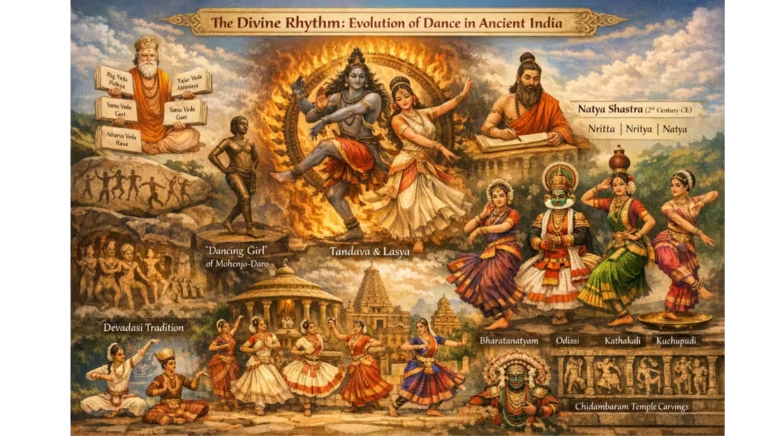
The origins of Indian dance are steeped in mythology, primarily attributed to Lord Brahma, who created the Natyaveda (the fifth Veda) by taking elements from the four existing Vedas:
- Pathya (Words) from Rig Veda.
- Abhinaya (Gestures) from Yajur Veda.
- Geet (Music) from Sama Veda.
- Rasa (Emotions) from Atharva Veda.
The Cosmic Dance of Shiva and Parvati
Ancient texts describe two distinct aspects of dance:
- Tandava: The masculine aspect, characterized by vigor, power, and rhythm. It is performed by Lord Shiva (Nataraja) and represents the cycle of creation, preservation, and destruction.
- Lasya: The feminine aspect, characterized by grace, bhava (expression), and shringar (love). It was introduced by Goddess Parvati.
2. Archaeological Evidence: From Prehistory to Harappa
Dance is one of the oldest recorded arts in India:
- Bhimbetka Rock Paintings (Mesolithic): Depict group dances and ritualistic movements, showing that dance was a communal activity even in the Stone Age.
- The ‘Dancing Girl’ of Mohenjo-Daro (c. 2500 BCE): This bronze statue is the most significant archaeological proof of dance in the Indus Valley Civilization. Her posture—hand on hip and tilted head—suggests a formal dance stance.
3. The Natya Shastra: The Grammar of Dance
Compiled by Bharat Muni (c. 200 BCE – 200 CE), the Natya Shastra is the most authoritative text on performing arts. It provides a detailed classification of dance into three categories:
- Nritta: Pure dance consisting of rhythmic movements without any specific message or emotion.
- Nritya: Interpretative dance where the dancer uses facial expressions and hand gestures to convey a story or theme.
- Natya: The dramatic element, involving a play with multiple characters.
The Nine Rasas (Navarasa)
The essence of ancient dance lies in evoking emotions in the audience:
- Shringara (Love), Hasya (Humor), Karuna (Sorrow), Raudra (Anger), Veera (Heroism), Bhayanaka (Fear), Bibhatsa (Disgust), Adbhuta (Wonder), and Shanta (Peace).
4. The Devadasi Tradition and Temple Dance
In Ancient India, the temple was the center of cultural life. Dance was an integral part of temple rituals.
- The Devadasi System: Girls were dedicated to deities in temples (especially in South India and Odisha). They were highly educated in the arts and performed Sadir (early Bharatanatyam) or Odissi as a form of worship.
- Inscriptions: The Brihadeshwara Temple (Thanjavur) has inscriptions mentioning 400 dancers maintained by King Raja Raja Chola I.
5. Major Classical Traditions in Ancient India
A. Bharatanatyam (Tamil Nadu)
- Source: Derived from the Sadir or Dasi Attam.
- Technique: Focuses on the “Fire Dance” element. It is characterized by the Araimandi (half-sitting) posture and intricate footwork.
- Textual Basis: Heavily relies on Abhinaya Darpana by Nandikesvara.
B. Kathakali (Kerala)
- Ancient Roots: Evolved from earlier ritual arts like Chakiar Koothu and Koodiyattam.
- Features: Known for elaborate “Aharya” (costumes and makeup). It is a “story-play” typically depicting the victory of Dharma over Adharma.
C. Odissi (Odisha)
- Evidence: The Manchapuri Cave (Udayagiri) carvings show dance scenes from the 2nd century BCE.
- The Tribhanga Posture: A unique feature where the body is bent at three points—neck, waist, and knee—creating an ‘S’ curve.
D. Kuchipudi (Andhra Pradesh)
- Origin: Traditionally performed by groups of Brahmins (Kusilavas) who traveled from village to village.
- Unique Act: Tarangam, where the dancer performs on the edge of a brass plate while balancing a pot of water on the head.
6. Technical Elements: Mudras and Karanas
- Mudras (Hand Gestures): There are 28 Asamyuta Hastas (single hand) and 24 Samyuta Hastas (double hand) according to the Abhinaya Darpana. Each gesture has a specific meaning, from representing a bee to a king.
- Karanas: These are the 108 basic dance units (postures combined with movement) described in the Natya Shastra. They are famously carved on the gateways of the Chidambaram temple.
7. Socio-Cultural Significance for UPSC Mains
- Unity in Diversity: Ancient dance forms, while regional, shared a common Sanskritic base (Natya Shastra), illustrating the cultural integration of India.
- Patronage: Dance flourished under the Mauryas, Guptas, Cholas, and Pallavas. The Gupta period is often called the “Golden Age” for the refinement of performing arts.
- Gender Roles: Unlike many contemporary civilizations, ancient India viewed dance as a noble profession for both genders, with kings often being accomplished dancers themselves (e.g., Samudragupta on coins).
8. UPSC Prelims: Quick Revision Box
Form | Ancient Name/Root | Key Feature |
Bharatanatyam | Sadir / Natya | Fire element; Araimandi posture |
Odissi | Odra Magadhi | Water element; Tribhanga stance |
Kathak | Kathakas (Storytellers) | Chakkars (Spins); Footwork |
Mohiniyattam | Dance of the Enchantress | Air element; Swaying movements |
Sattriya | Ankiya Nat | Vaishnavite Bhakti tradition |
UPSC Prelims: PYQs & Practice Questions
Previous Year Questions (PYQs)
Question 1 (2012)
Q: How do you distinguish between Kuchipudi and Bharatanatyam dances?
1. Kuchipudi dancers occasionally speak dialogues, whereas Bharatanatyam dancers do not.
2. Dancing on the edges of a brass plate with a pitcher full of water on the head is a characteristic feature of Bharatanatyam, while Kuchipudi involves different leg movements.
Which of the statements given above is/are correct?
Options:
(a) 1 only
(b) 2 only
(c) Both 1 and 2
(d) Neither 1 nor 2
Answer: (a)
Explanation: Statement 1 is correct: Kuchipudi has strong roots in dance-drama traditions where performers may speak dialogues. Statement 2 is incorrect because dancing on a brass plate (Tarangam) is a well-known feature of Kuchipudi, not Bharatanatyam.
Question 2 (2013)
Q: In the context of the cultural history of India, a pose in dance and dramatics called 'Tribhanga' has been a favorite of Indian artists from ancient times till today. Which one of the following statements best describes this pose?
Options:
(a) One leg is bent and the body is slightly but oppositely curved at the waist and neck.
(b) Facial expressions, hand gestures, and makeup are combined to symbolize certain epic characters.
(c) Movements of body, face, and hands are used to tell a story.
(d) A little smile and certain hand gestures are emphasized to express eroticism.
Answer: (a)
Explanation: Tribhanga involves three distinct bends in the body—typically at the neck, waist, and knee—creating an elegant 'S' shaped posture. It is most prominently associated with Odissi dance.
Question 3 (2014)
Q: With reference to the famous Sattriya dance, consider the following statements:
1. Sattriya is a combination of music, dance, and drama.
2. It is a centuries-old living tradition of Vaishnavites of Assam.
3. It is based on classical Ragas and Talas of devotional songs composed by Tulsidas, Kabir, and Mirabai.
Which of the statements given above is/are correct?
Options:
(a) 1 only
(b) 1 and 2 only
(c) 1, 2 and 3
(d) 2 and 3 only
Answer: (b)
Explanation: Statements 1 and 2 are correct: Sattriya integrates music, dance, and drama and has been preserved within the Vaishnavite monasteries (Sattras) of Assam. Statement 3 is incorrect: Sattriya’s musical foundation is linked with Borgeets composed by Srimanta Sankaradeva and Madhavadeva, not by Tulsidas, Kabir, or Mirabai.
Prelims Practice Questions
Question 1
Q: Consider the following statements regarding the 'Natya Shastra':
Statements:
1. It is the oldest surviving ancient Indian work on performing arts.
2. It classifies dance into three categories: Nritta, Nritya, and Natya.
3. It was authored by Bharat Muni around the 2nd century BCE to 2nd century CE.
Which of the statements given above is/are correct?
Options:
(a) 1 and 2 only
(b) 2 and 3 only
(c) 1 and 3 only
(d) 1, 2 and 3
Answer: (d)
Explanation: The Natya Shastra is the earliest extant comprehensive treatise on performing arts, attributed to Bharata Muni. It lays down the broad framework of Nritta (pure dance), Nritya (expressional dance), and Natya (dramatic enactment), and is generally dated between 2nd century BCE and 2nd century CE.
Question 2
Q: Which of the following classical dances involves the use of 'white marble' as a descriptive feature of its architectural influence in sculptures?
Options:
(a) Kathak
(b) Bharatanatyam
(c) Odissi (or the Amaravati school sculptures)
(d) Mohiniyattam
Answer: (c)
Explanation: While Odissi is closely associated with temple sculpture traditions, the specific archaeological reference to white marble as a descriptive feature is linked to sculptural contexts such as the Amaravati School.
UPSC Mains: Previous Year Questions (PYQs) – Indian Dance & Performing Arts
Temple Architecture & Classical Dance
Question: "The architecture of the ancient Indian temple provided the perfect stage for the development of classical dances." Discuss with examples. (Generic recurrent theme)
Folk Dances & Cultural Repository
Question: Examine the regional diversity reflected in the folk-dance forms of India. How do these dance forms act as a cultural repository for specific communities? (2025 Mock/Mock)
Evolution & Global Status of Classical Dances
Question: Discuss the development of Indian classical dance forms and their status as a global dance form. How have they evolved over time? (2023)
Devadasi Tradition
Question: "The Devadasi tradition was instrumental in the preservation of Indian classical dances but also led to their near extinction during the colonial era." Critically analyze. (Generic theme)
Bhakti Movement, Sattriya & Manipuri
Question: Analyze the impact of the Bhakti movement on the evolution of Sattriya and Manipuri dance forms. (Generic theme)
Mains Practice Questions
Dance as ‘Yajña’
Question: "Indian classical dance is not merely a physical activity but a 'Yajña' or spiritual sacrifice." Elaborate on the religious and spiritual dimensions of ancient Indian dances. (250 Words)
Tandava & Lasya
Question: Compare the 'Tandava' and 'Lasya' aspects of Indian dance. How do these dualities find expression in contemporary classical forms like Odissi and Kathakali? (150 Words)
Patronage & Bharatanatyam Revival
Question: Evaluate the role of state patronage and cultural institutions in the revival of 'Dasi Attam' into modern Bharatanatyam. (250 Words)
Frequently Asked Questions (FAQs)
What is the difference between Nritta, Nritya, and Natya?
- Nritta is pure dance with no emotions or storytelling; Nritya is expressional dance using gestures (mudras) to convey themes; and Natya is the dramatic element involving the imitation of characters and a plot.
Which dance form is known as the "Fire Dance"?
- Bharatanatyam is often referred to as the fire dance because its movements mimic the flickering of a flame.
Who are the 'Maharis' and 'Gotipuas' in the context of Odissi?
- Maharis were female temple dancers (devadasis) who performed inside the temples, while Gotipuas were young boys who dressed as females and performed outside for the public.
Which classical dance is characterized by 'Chakkars' and 'Tatkar'?
- Kathak is famous for its rapid spins (Chakkars) and complex footwork (Tatkar).
Is Chhau a classical or folk dance?
- While the Sangeet Natak Akademi recognizes eight classical dances, the Ministry of Culture has included Chhau in its list, bringing the total to nine recognized classical forms.