Table of Contents
ToggleThe Living Word: A Comprehensive Encyclopedia of Indian Languages and Literature
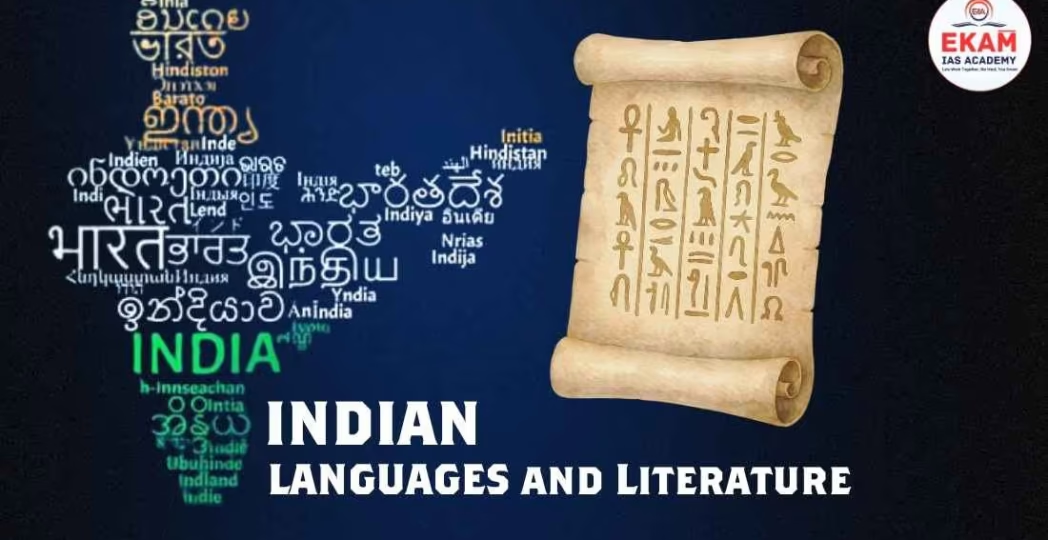
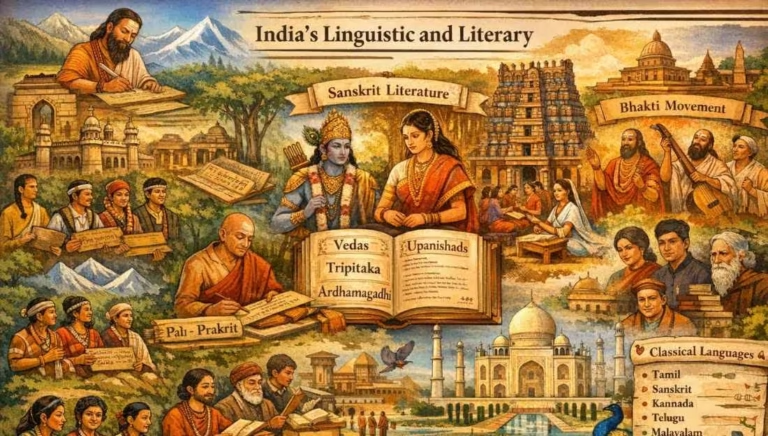
India’s linguistic and literary heritage is a testament to its “Unity in Diversity.” From the precise grammar of Sanskrit to the soulful verses of regional Bhakti poets, the evolution of the written and spoken word in India mirrors the country’s socio-political history.
1. The Classification of Indian Languages
India is home to several hundred languages, primarily belonging to four major families. For UPSC, understanding these roots is essential for tracing cultural migrations.
A. Indo-Aryan Group
This is the largest branch, spoken by about 74% of the population. It is a part of the Indo-European family.
- Ancient: Vedic Sanskrit and Classical Sanskrit.
- Middle: Pali, Prakrit, and Apabhramsa (c. 600 BCE – 1000 CE).
- Modern: Hindi, Bengali, Marathi, Gujarati, Punjabi, Odia, etc.
B. Dravidian Group
Spoken primarily in South India (about 20%). It is indigenous to the subcontinent.
- Major Languages: Tamil (oldest), Telugu, Kannada, and Malayalam.
- Brahui: A unique Dravidian language spoken in parts of Pakistan and Afghanistan, providing evidence of the family’s ancient northern reach.
C. Sino-Tibetan Group
Spoken by tribal groups in the North-East and Himalayas (e.g., Manipuri, Bodo).
D. Austric (Austro-Asiatic) Group
Spoken by tribal groups in Central India (e.g., Santhali, Munda, Khasi).
2. The Sanskrit Tradition: The Language of Gods
Sanskrit is considered the “Mother of many Indian languages.” Its literature is divided into two distinct periods.
A. Vedic Literature (c. 1500–600 BCE)
- The Four Vedas: Rig Veda (hymns), Sama Veda (melodies), Yajur Veda (rituals), and Atharva Veda (magic and medicine).
- Brahmanas: Prose explanations of Vedic rituals.
- Aranyakas: “Forest books” for hermits, focusing on mysticism.
- Upanishads: The peak of Indian philosophy, discussing Brahman, Atman, and Moksha.
B. Classical Sanskrit Literature
- The Epics: Ramayana (Valmiki) and Mahabharata (Ved Vyasa).
- Puranas: 18 major Puranas dealing with cosmology and genealogies.
- The Drama/Kavya:
- Kalidasa: Known as the “Shakespeare of India” (Abhijnanashakuntalam, Meghadutam).
- Bhasa: The earliest playwright (Swapnavasavadatta).
- Banabhatta: Wrote Harshacharita, the first formal biography in India.
3. The Sangam Literature: The Tamil Renaissance
While Sanskrit flourished in the North, South India produced a distinct corpus of secular literature known as Sangam Literature (c. 300 BCE – 300 CE).
- The Academies (Sangams): According to legend, three assemblies of poets were held in Madurai under Pandya patronage.
- Key Compilations:
- Ettutogai (Eight Anthologies) and Pattupattu (Ten Idylls).
- Tolkappiyam: The earliest work on Tamil grammar and poetics.
- The Twin Epics:
- Silappadikaram (The Jewelled Anklet): By Ilango Adigal.
- Manimekalai: By Sattanar (Buddhist influence).
4. Pali and Prakrit: The Languages of the Masses
During the 6th century BCE, the rise of Buddhism and Jainism gave birth to literature in the vernacular.
- Pali: The language of the Buddhist Canon.
- Tripitaka: Vinaya Pitaka (monastic rules), Sutta Pitaka (Buddha’s discourses), and Abhidhamma Pitaka (philosophy).
- Jataka Tales: Stories of Buddha’s previous births.
- Prakrit: The language favored by Jainism.
- Ardhamagadhi: Most Jain scriptures (Angas) were written in this Prakrit dialect.
- Gatha Saptashati: A collection of 700 poems in Maharashtri Prakrit by King Hala.
5. The Rise of Regional Literature (Bhakti Era)
The medieval period (10th–17th Century) saw the decline of Sanskrit’s monopoly and the explosive growth of regional languages.
- Hindi: Developed from Apabhramsa. Famous works include Prithviraj Raso (Chand Bardai) and Ramcharitmanas (Tulsidas).
- Bengali: Influenced by the Vaishnava Bhakti movement (Chaitanya Mahaprabhu).
- Marathi: Saints like Jnaneshwar (Jnaneshwari) and Tukaram (Abhangas) popularized Marathi.
- Kannada & Telugu: Flourished under the Vijayanagara Empire (e.g., Krishnadevaraya’s Amuktamalyada).
6. Classical Languages of India
The Government of India grants the status of “Classical Language” to those with a rich ancient heritage (at least 1500-2000 years old). Currently, there are 11 classical languages (as of 2024 additions):
- Tamil (2004)
- Sanskrit (2005)
- Kannada (2008)
- Telugu (2008)
- Malayalam (2013)
- Odia (2014)
- Marathi (2024)
- Bengali (2024)
- Assamese (2024)
- Pali (2024)
- Prakrit (2024)
7. Modern Indian Literature: The Colonial Impact
The 19th and 20th centuries saw the birth of modern prose, novels, and nationalistic poetry.
- The Bengal Renaissance: Bankim Chandra Chattopadhyay (Anandamath – source of Vande Mataram) and Rabindranath Tagore (the first Asian to win the Nobel Prize for Gitanjali).
- Urdu Literature: Mastered by Mirza Ghalib and Sir Sayyid Ahmed Khan. Allama Iqbal wrote Saare Jahan Se Achha.
Progressive Writers’ Movement: Authors like Munshi Premchand (Godan) shifted focus to social realism and the plight of the peasantry.
UPSC Prelims: PYQs & Practice Questions
Previous Year Questions (PYQs)
Question 1 (2014)
Q: Consider the following languages:
1. Gujarati
2. Kannada
3. Telugu
Which of the above has/have been declared as ‘Classical Language/s’ by the Government?
Options:
(a) 1 and 2 only | (b) 3 only | (c) 2 and 3 only | (d) 1, 2 and 3
Answer: (c)
Explanation: Kannada and Telugu have been notified as Classical Languages (both in 2008). Gujarati is not a Classical Language. As per Government of India updates, five more languages—Marathi, Pali, Prakrit, Assamese, and Bengali—were granted Classical Language status on 3 October 2024, taking the total to 11 Classical Languages. :contentReference[oaicite:1]{index=1}
Question 2 (2017)
Q: Which one of the following was a very important seaport in the Kakatiya kingdom?
Options:
(a) Kakinada | (b) Motupalli | (c) Machilipatnam | (d) Nellore
Answer: (b)
Explanation: Motupalli was a major and strategically important seaport under the Kakatiyas, associated with overseas trade and port-based prosperity of the kingdom. :contentReference[oaicite:2]{index=2}
Question 3 (2018)
Q: With reference to the cultural history of India, consider the following statements:
1. Most of the Tyagaraja Kritis are devotional songs in praise of Lord Krishna.
2. Tyagaraja created several new ragas.
3. Annamacharya and Tyagaraja are contemporaries.
4. Annamacharya kirtanas are devotional songs in praise of Lord Venkateshwara.
Which of the statements given above are correct?
Options:
(a) 1, 2 and 3 | (b) 2, 3 and 4 | (c) 2 and 4 only | (d) 1, 2 and 4
Answer: (c)
Explanation: Statement 1 is incorrect because Tyagaraja’s kritis are predominantly in praise of Lord Rama (though he also composed on other deities). Statement 2 is correct as he contributed to/innovated several ragas in Carnatic tradition. Statement 3 is incorrect because Annamacharya (15th century) and Tyagaraja (18th–19th century) are separated by centuries. Statement 4 is correct because Annamacharya’s sankirtanas are devoted to Lord Venkateshwara. :contentReference[oaicite:3]{index=3}
Previous Year Questions (PYQs)
Question 1 (2013)
Q: Consider the following Bhakti Saints:
1. Dadu Dayal
2. Guru Nanak
3. Tyagaraja
Who among them was/were preaching when the Lodi dynasty fell and Babur took over?
Options:
(a) 1 and 3 | (b) 2 only | (c) 2 and 3 | (d) 1 and 2
Answer: (b)
Explanation: The Lodi dynasty fell in 1526 (First Battle of Panipat). Guru Nanak (1469–1539) was alive and preaching during Babur’s takeover. Dadu Dayal (1544–1603) and Tyagaraja (1767–1847) belonged to later periods, so they were not contemporaries of the 1526 transition.
Question 2 (2012)
Q: With reference to the religious history of medieval India, the Sufi mystics were known to pursue which of the following practices?
1. Meditation and control of breath
2. Severe ascetic exercises in a lonely place
3. Recitation of holy songs to arouse a state of ecstasy in their audience
Select the correct answer:
Options:
(a) 1 and 2 only | (b) 2 and 3 only | (c) 3 only | (d) 1, 2 and 3
Answer: (d)
Explanation: Sufi traditions included spiritual discipline through meditation and sometimes breath control (influenced by wider yogic/ascetic practices). Many Sufis practiced rigorous asceticism and seclusion as part of spiritual training. They also used Sama (devotional musical recitation) to induce spiritual ecstasy and deepen devotion among listeners.
Question 3 (2019)
Q: Which of the following pair(s) is/are correctly matched?
Movement/Saint : Region
1. Nimbarka : Andhra Pradesh
2. Namdev : Maharashtra
3. Vallabhacharya : Gujarat
Options:
(a) 1 and 2 only | (b) 2 and 3 only | (c) 1 and 3 only | (d) 1, 2 and 3
Answer: (d)
Explanation: Nimbarka is associated with the broader Bhakti stream with strong southern linkages in many exam sources; Namdev is a major saint of the Varkari tradition in Maharashtra; and Vallabhacharya is closely linked with the Pushtimarg tradition and is widely associated with the western region including Gujarat through his institutional and sectarian spread.
UPSC Mains: Previous Year Questions (PYQs)
Sangam Literature: Mirror of Early South India
Question: "The Sangam literature is a window into the socio-economic and political life of early South India." Elaborate. (Generic recurrent theme)
Bhakti Movement: Regional Languages & Literature
Question: Examine the contribution of the Bhakti movement to the development of regional languages and literature in medieval India. (2021)
Sanskrit Literature: Upanishads & Philosophical Thought
Question: Discuss the significance of Sanskrit literature in the evolution of Indian philosophical thought, with special reference to the Upanishads. (Generic theme)
Persian Literature: Indo-Islamic Synthesis in Mughal India
Question: "Persian literature in India during the Mughal period reflected the synthesis of Indo-Islamic culture." Discuss with reference to the works of Amir Khusrau and Abul Fazl. (Generic theme)
Bengal Renaissance: Birth of Modern Indian Literature
Question: Evaluate the role of the 19th-century 'Bengal Renaissance' in the birth of modern Indian literature. (Generic theme)
Mains Practice Questions
Democratization of Literature: Pali–Prakrit to Apabhramsa
Question: "The transition from Pali and Prakrit to the rise of regional 'Apabhramsa' dialects marked the democratization of Indian literature." Analyze. (250 Words)
Epics as Cultural & Ethical Foundations
Question: "Indian epics—the Ramayana and the Mahabharata—are not just religious texts but are foundational to the cultural and ethical fabric of the subcontinent." Discuss. (150 Words)
Indo-Aryan vs Dravidian Literary Traditions
Question: Compare and contrast the literary traditions of the Indo-Aryan and Dravidian language families. How have they influenced each other over centuries? (250 Words)
Frequently Asked Questions (FAQs)
What is the criteria for a "Classical Language" in India?
- The criteria include: (1) High antiquity of early texts over a period of 1500–2000 years; (2) A body of ancient literature/texts considered a valuable heritage; (3) The literary tradition must be original and not borrowed from another speech community.
Who is called the "Shakespeare of India"?
- Kalidasa is often given this title because of his mastery over Sanskrit drama and poetry, particularly his masterpiece Abhijnanashakuntalam.
What are the 'Jataka Tales'?
These are a voluminous body of literature native to India concerning the previous births of Gautama Buddha in both human and animal form. They were originally written in Pali.
What is 'Manipravalam'?
- It is a literary style used in medieval South India (especially Kerala) which is a “macaronic” language—a mixture of Sanskrit and Tamil/Malayalam.
Which script is considered the 'Mother of most Indian scripts'?
- The Brahmi Script, which was used by Ashoka for his edicts. Almost all modern Indian scripts (Devanagari, Bengali, Tamil, Telugu, etc.) have evolved from Brahmi.