Table of Contents
ToggleThe Warrior’s Path: A Comprehensive Encyclopedia of Indian Martial Arts
Indian martial arts are not merely systems of physical combat; they are profound expressions of the country’s diverse cultural, spiritual, and historical identity. Rooted in ancient Vedic traditions and refined through centuries of warfare, these arts represent the synthesis of body, mind, and spirit.
1. Historical Foundations: The Ancient Roots
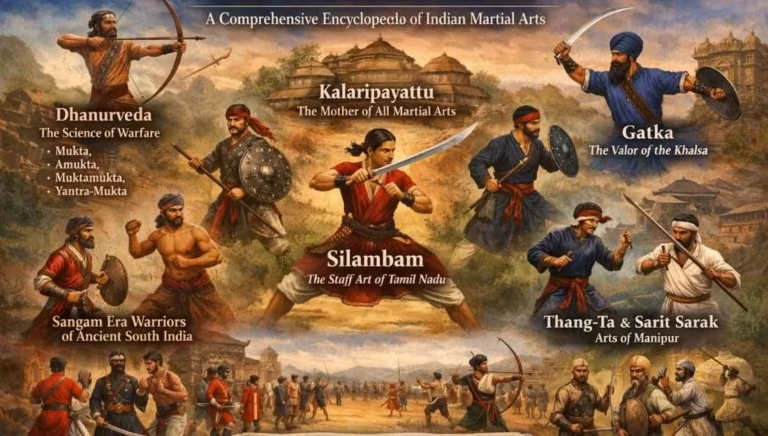
A. Dhanurveda: The Science of Warfare
Martial arts in India find their earliest mentions in the Vedas, particularly the Dhanurveda (an Upaveda of the Yajur Veda).
- Definition: The term ‘Dhanurveda’ literally translates to the “Science of Archery,” but it serves as a comprehensive treatise on all forms of weaponry and combat strategy.
- Classification of Weapons: Ancient texts classified weapons into four categories:
- Mukta (Thrown, e.g., Javelin).
- Amukta (Not thrown, e.g., Sword).
- Muktamukta (Used both ways, e.g., Dagger).
Yantra-mukta (Thrown by machines, e.g., Bow and Arrow).
B. Sangam Literature and Ancient South India
In Southern India, the Sangam era (3rd century BCE to 3rd century CE) literature mentions warriors trained in various combat forms. The concept of ‘Maram’ (heroism and valor) was central to the Tamil martial tradition.
2. Kalaripayattu: The Mother of All Martial Arts
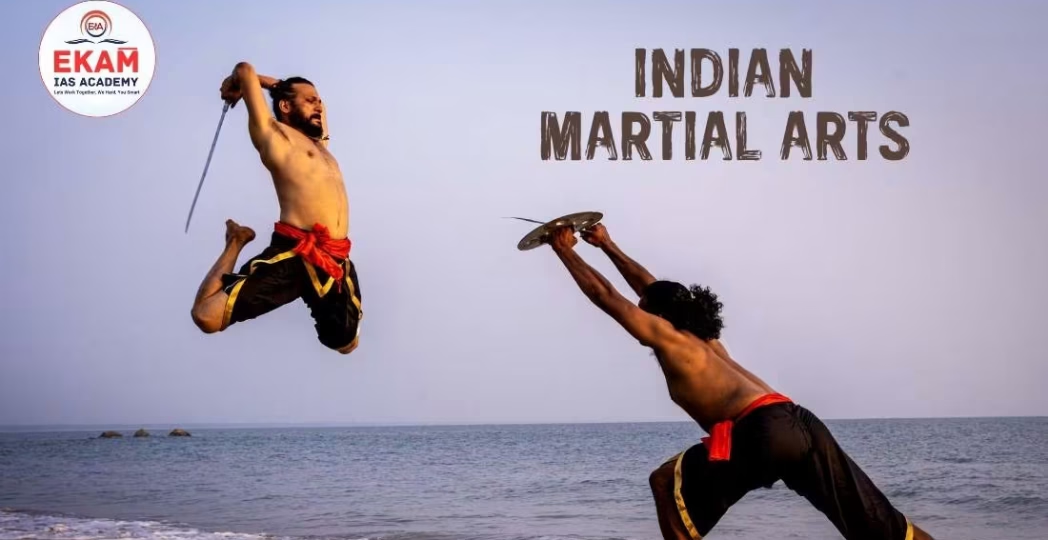
Originating in Kerala, Kalaripayattu is considered one of the oldest surviving martial arts in the world.
- Etymology: ‘Kalari’ means the training ground (school), and ‘Payattu’ means combat or exercise.
- Mythology: Legend credits Sage Parashurama (an avatar of Vishnu) with the creation of the art to protect the land he reclaimed from the sea.
- Stages of Training:
- Meythari: Physical exercises to gain flexibility and balance.
- Kolthari: Training with wooden sticks.
- Ankathari: Training with sharp metal weapons (swords, shields, and the deadly Urumi or flexible sword).
- Verumkai: Unarmed combat and vital point strikes (Marmas).
- Marmachikitsa: Kalaripayattu is deeply integrated with Ayurveda. Master practitioners are also healers who know the 108 vital points of the human body, which can be used to either disable an opponent or heal an injury.
3. Gatka: The Valor of the Khalsa
Gatka is the traditional martial art associated with the Sikhs, primarily in the Punjab region.
- Historical Context: It gained prominence under the Sixth Guru, Guru Hargobind Ji, who introduced the concept of Miri-Piri (Temporal and Spiritual power). It was further refined by Guru Gobind Singh Ji with the creation of the Khalsa.
- Weaponry: The primary weapon is the Soti (a wooden stick) used for practice, and the Kirpan (sword) for actual combat. Other weapons include the Chakram (steel ring) and Khanda.
Philosophy: Gatka is not just about fighting; it is about self-defense and the protection of the weak (Dharma). It is often performed during Sikh festivals like Hola Mohalla.
4. Silambam: The Staff Art of Tamil Nadu
One of the most popular martial arts in Southern India, Silambam is centered around the use of a bamboo staff.
- Legend: It is believed to have been developed by Sage Agastya.
- Technique: It involves rapid footwork (Kaaladi) and various staff-swinging patterns designed to ward off multiple attackers.
- Regional Variations: Different styles like Kuravanji and Kallapathu focus on different grip and striking techniques.
5. Thang-Ta and Sarit-Sarak: The Arts of Manipur
Manipur boasts a rich martial heritage known as Huyen Lallong (The Art of War).
- Thang-Ta (Armed): ‘Thang’ means sword and ‘Ta’ means spear. It is a highly ritualistic art where movements are coordinated with rhythmic breathing.
- Sarit-Sarak (Unarmed): This focuses on using the opponent’s force against them, involving grapples and strikes.
- Cultural Tie: It is often performed during the Lai Haraoba festival.
6. Other Significant Regional Martial Arts
A. Mardani Khel (Maharashtra)
- Developed by the Marathas, specifically during the time of Chhatrapati Shivaji Maharaj. It emphasizes the use of the Patta (gauntlet sword) and Vita (corded spear), suitable for the hilly terrain of the Sahyadri.
B. Musti Yuddha (Varanasi)
- An ancient form of Indian boxing or knuckle-fighting. It involves punches, kicks, and knee strikes, representing the ‘unarmed’ combat tradition of the Indo-Gangetic plain.
C. Pari-Khanda (Bihar)
- Developed by the Rajputs of Bihar. ‘Pari’ means shield and ‘Khanda’ means sword. This art eventually influenced the world-famous Chhau Dance.
D. Thoda (Himachal Pradesh)
- A unique blend of martial art and sport involving Archery. It traces its roots back to the Pandavas and Kauravas.
7. The Decline and Revival
During the British Raj, many Indian martial arts were banned or suppressed as they were seen as a threat to colonial authority. For example, Kalaripayattu was practiced in secret for decades.
- Modern Revival: Post-independence, there has been a resurgence in interest, with these arts being included in the Khelo India Youth Games to preserve India’s “Intangible Cultural Heritage.”
UPSC Prelims: PYQs & Practice Questions
Previous Year Questions (PYQs)
Question 1 (2014)
Q: With reference to India’s culture and tradition, what is ‘Kalaripayattu’?
Options:
(a) It is an ancient Bhakti cult of Shaivism still prevalent in some parts of South India.
(b) It is an ancient style of bronze and brass work still found in the southern part of the Coromandel area.
(c) It is an ancient form of dance-drama and a part of the intangible heritage of Maharashtra.
(d) It is an ancient martial art and a very old tradition still prevalent in some parts of South India.
Answer: (d)
Explanation: Kalaripayattu originated in Kerala and is regarded as one of the oldest surviving martial art traditions. It involves strikes, kicks, grappling, weapon training, and also includes traditional healing practices linked with Ayurveda.
Question 2 (2023)
Q: Consider the following pairs:
Martial Art : State of Origin
Gatka : Punjab
Thang-Ta : Manipur
Kalarippayattu : Kerala
Mallakhamb : Madhya Pradesh
How many of the above pairs are correctly matched?
Options:
(a) Only one pair
(b) Only two pairs
(c) Only three pairs
(d) All four pairs
Answer: (d)
Explanation: All four pairs are correctly matched. Mallakhamb is a traditional Indian sport (gymnastics with a pole/rope) closely associated with Madhya Pradesh and was declared the State Sport of Madhya Pradesh in 2013.
Prelims Practice Questions
Question 1
Q: Consider the following statements regarding the 'Thang-Ta' martial art:
Statements:
1. It is the traditional martial art of the Meitei people of Manipur.
2. It involves the use of a 'Thang' (sword) and a 'Ta' (spear).
3. It is strictly a combat sport and has no ritualistic or religious significance.
Which of the statements given above is/are correct?
Options:
(a) 1 and 2 only
(b) 2 and 3 only
(c) 1 and 3 only
(d) 1, 2 and 3
Answer: (a)
Explanation: Statements 1 and 2 are correct. Statement 3 is incorrect because Thang-Ta has strong ritualistic traditions and is often performed as a spiritual offering during festivals like Lai Haraoba.
Question 2
Q: The martial art form 'Silambam', primarily practiced in Tamil Nadu, is characterized by the use of which weapon?
Options:
(a) Gauntlet Sword
(b) Bamboo Staff
(c) Curved Dagger
(d) Flexible Sword
Answer: (b)
Explanation: Silambam is centered around staff-fencing. The staff—commonly made of bamboo—is used for rapid striking, footwork-driven movement, and defensive patterns.
UPSC Mains: Previous Year Questions (PYQs) – Indian Martial Arts & Traditions
Martial Arts as Spiritual-Physical Discipline
Question: "Indian martial arts are a blend of physical prowess and spiritual discipline." Discuss the cultural significance of any two traditional martial arts of India. (Generic/Frequent theme)
Regional History & Intangible Cultural Heritage
Question: Examine the role of martial arts in the preservation of regional history and the 'Intangible Cultural Heritage' of India. (Generic theme)
Colonial Impact & Revivalist Movements
Question: How did the colonial policy of the British impact the traditional martial art forms of India? Give examples of revivalist movements. (Generic theme)
Influence on Classical & Folk Dance
Question: Discuss the influence of martial arts on Indian classical and folk dance forms. (2014 - Modified)
Paika Akhada & Anti-Colonial Struggle
Question: The 'Paika Rebellion' of Odisha was rooted in the martial traditions of the state. Assess the role of Paika Akhada in the anti-colonial struggle. (2017 - Related to History/Culture)
Mains Practice Questions
Martial Arts & Socio-Religious Identity
Question: "Martial arts in India like Kalaripayattu and Gatka are not merely systems of combat but are integral to the socio-religious identity of their respective communities." Elaborate. (250 Words)
Government Initiatives & Mainstreaming
Question: Evaluate the initiatives taken by the Government of India (like Khelo India) to mainstream traditional martial arts as competitive sports. (150 Words)
Indian Martial Weaponry & Regional Needs
Question: "From the 'Urumi' of Kerala to the 'Patta' of Maharashtra, Indian martial weaponry reflects the geographical and strategic needs of different eras." Discuss. (250 Words)
Frequently Asked Questions (FAQs)
What is 'Marmachikitsa' in Kalaripayattu?
- It is a traditional healing system. Kalaripayattu masters (Gurukkals) identify 108 vital points (Marmas) on the body. Knowledge of these points is used to disable an opponent in combat or to treat injuries through massage and Ayurvedic medicine.
Which martial art is known for the 'Flexible Sword' (Urumi)?
- Kalaripayattu. The Urumi is a long, flexible blade that can be worn around the waist like a belt and requires extreme skill to prevent self-injury.
How is 'Gatka' different from other martial arts?
- Gatka is specifically a Sikh martial art. It focuses on the use of wooden sticks (Soti) and swords (Kirpan). It is unique because it is performed as a form of meditation and self-defense, emphasizing the protection of the oppressed.
What is 'Mallakhamb'?
- It is a traditional Indian sport/martial art where a gymnast performs aerial yoga and wrestling grips on a vertical stationary or hanging wooden pole. It builds incredible core strength and flexibility.
Are Indian martial arts recognized by UNESCO?
- While specific martial arts are not individually listed on the “Representative List of the Intangible Cultural Heritage of Humanity,” they are considered essential components of the broader cultural traditions that UNESCO protects and promotes. Kalaripayattu is currently being promoted for UNESCO recognition.