Table of Contents
ToggleThe Sound of Sovereignty: A Comprehensive Guide to Indian Music for UPSC
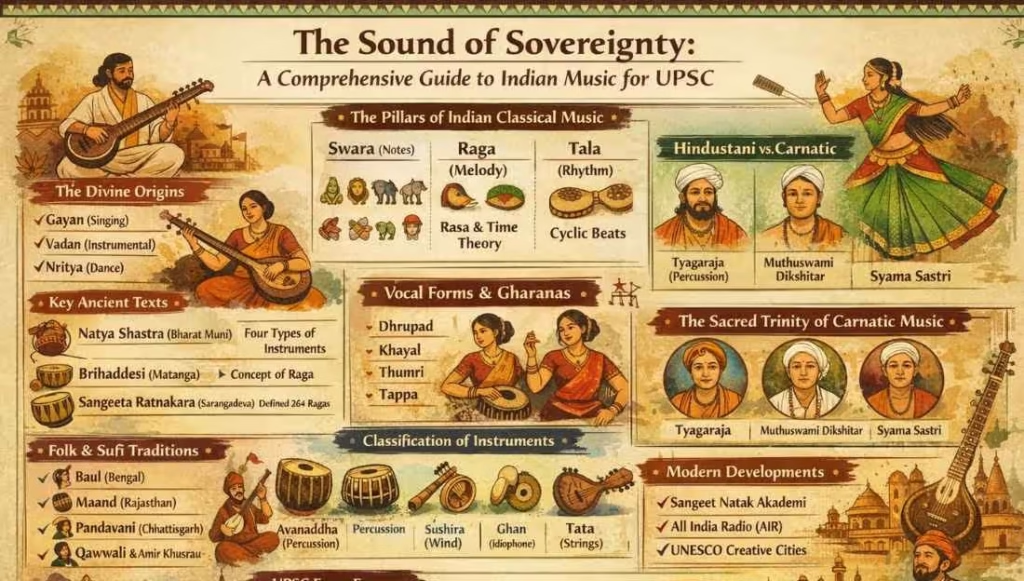
1. Introduction: The Divine Origins
In Indian tradition, music is considered a path to Moksha (salvation). It is classified as an Upaveda of the Sama Veda, known as the Gandharva Veda.
- The Trinity of Sangeet: According to ancient texts, Sangeet is a combination of three elements: Gayan (Singing), Vadan (Instrumental), and Nritya (Dance).
- Key Ancient Texts:
- Natya Shastra (Bharat Muni): The earliest comprehensive treatise on performing arts. It classifies musical instruments into four groups.
- Brihaddesi (Matanga): Introduced the concept of the Raga.
- Sangeeta Ratnakara (Sarangadeva): Defined 264 ragas and is considered the bridge between ancient and medieval music.
2. The Pillars of Indian Classical Music
To understand Indian music, one must master three technical concepts: Swara, Raga, and Tala.
A. Swara (The Notes)
The seven basic notes (Sapta Swara) are derived from the sounds of nature:
- Sa (Shadja) – Peacock
- Ri (Rishabha) – Bull/Lark
- Ga (Gandhara) – Goat
- Ma (Madhyama) – Heron/Crane
- Pa (Panchama) – Cuckoo/Nightingale
- Dha (Dhaivata) – Horse
- Ni (Nishada) – Elephant
B. Raga (The Soul)
A Raga is a melodic structure with a specific set of notes. It must evoke a specific Rasa (emotion).
- Time Theory of Ragas: Unique to India, ragas are assigned to specific times of the day (e.g., Raga Bhairav for dawn, Raga Yaman for evening) or seasons (e.g., Raga Malhar for monsoon).
C. Tala (The Rhythm)
Tala is the cyclic rhythmic framework. It ranges from the simple 4-beat cycles to complex 16-beat cycles like Teental.
3. The Great Schism: Hindustani vs. Carnatic Music
Until the 13th century, India had a unified system. With the Persian influence in North India, the system branched into two.
Feature | Hindustani Music (North) | Carnatic Music (South) |
Influence | Persian, Arab, and Afghan | Purely Indigenous/Sanskritic |
Freedom | Focus on improvisation (Manodharma) | Focus on composed pieces (Kriti) |
Sub-divisions | Based on Gharanas | No Gharana system |
Instruments | Sitar, Sarod, Tabla, Santoor | Veena, Mridangam, Violin, Ghatam |
Ragas | 10 Main Thaat (Bhatkhande) | 72 Melakarta Ragas |
4. Hindustani Classical Music: Forms and Gharanas
A. Major Vocal Forms
- Dhrupad: The oldest and grandest form. It is spiritual, heroic, and traditionally accompanied by the Pakhawaj. Tansen was a master of this style.
- Khayal: Meaning “imagination.” It is more romantic and flexible than Dhrupad, allowing for intricate “Taans” (rapid note sequences).
- Thumri: A semi-classical form focused on the “Shringar Rasa” (love/eroticism). It is often associated with the Braj Bhasha dialect.
- Tappa: Developed from the folk songs of camel riders in North-West India; characterized by quick, jerky notes.
B. The Gharana System
The word Gharana comes from ‘Ghar’ (House). It represents a lineage of teachers (Guru-Shishya) sharing a specific style.
- Gwalior Gharana: The oldest; focuses on simplicity and lucidity.
- Kirana Gharana: Founded by Abdul Karim Khan; focuses on perfect intonation of notes (Swara).
Agra Gharana: Focuses on “Nom-Tom” Alap and powerful singing.
5. Carnatic Music: The Sacred Trinity
Carnatic music is deeply rooted in the Bhakti movement. The “Trinity of Carnatic Music” (18th century) includes:
- Tyagaraja: Known for his Pancharatna Kritis.
- Muthuswami Dikshitar: Famous for his Navagraha Kritis.
- Syama Sastri: Known for complex rhythmic structures.
6. Classification of Musical Instruments (Natya Shastra)
UPSC Prelims often asks about the classification of Vadyas:
- Avanaddha Vadya (Membranophones): Percussion instruments with a stretched skin (e.g., Tabla, Mridangam, Dholak).
- Ghan Vadya (Idiophones): Solid instruments made of metal or wood that don’t require tuning (e.g., Manjira, Ghatam, Kartal).
- Sushira Vadya (Aerophones): Wind instruments (e.g., Bansuri, Shehnai, Nadaswaram).
- Tata Vadya (Chordophones): Stringed instruments (e.g., Sitar, Veena, Sarangi, Santoor).
7. Folk Music: The Pulse of the Masses
Folk music reflects the regional diversity and social life of India.
- Baul (Bengal): Mystical songs of the Baul sect, influenced by Sufism and Sahajyana Buddhism.
- Maand (Rajasthan): Songs of the desert, often telling stories of legendary lovers or kings.
- Pandavani (Chhattisgarh): Narrative singing of the Mahabharata (Famous artist: Teejan Bai).
- Sopana Sangeetham (Kerala): Sung by the side of temple steps (Sopanam).
8. The Indo-Islamic Synthesis & Sufi Music
The arrival of Islam brought the Sufi Sangeet tradition.
- Amir Khusrau: Often called the “Father of Qawwali” and credited with inventing the Sitar and the Tabla (though scholars debate the latter). He introduced Persian melodies into the Indian system.
- Qawwali: A devotional form of music that aims to lead the listener into a state of religious ecstasy (Fana).
9. Modern Developments & Cultural Institutions
Post-Independence, the state took over the patronage of music from the princely states.
- Sangeet Natak Akademi: The apex body for performing arts.
- All India Radio (AIR): Played a crucial role in popularizing classical music among the masses.
- UNESCO Creative Cities Network: Varanasi and Chennai have been recognized for their contribution to music.
UPSC Prelims: PYQs & Practice Questions
Previous Year Questions (PYQs)
Question 1 (2013)
Q: With reference to the history of Indian rock-cut architecture, consider the following statements: (Note: Though tagged as architecture, caves often appear in Art & Culture due to murals, iconography, music/dance motifs, etc.)
1. The caves at Badami are the oldest surviving rock-cut caves in India.
2. The Barabar rock-cut caves were originally made for Ajivikas by Emperor Ashoka.
3. At Ellora, caves were made for different faiths.
Which of the statements given above is/are correct?
Options:
(a) 1 only
(b) 2 and 3 only
(c) 3 only
(d) 1, 2 and 3
Answer: (b)
Explanation: Statement 1 is incorrect: the Barabar caves (3rd Century BCE) are older than Badami (6th Century CE). Statement 2 is correct: Barabar caves are associated with Ashoka’s donations to the Ajivikas. Statement 3 is correct: Ellora is multi-faith (Hindu, Buddhist, Jain) and its cave art includes rich iconography often discussed in Art & Culture context (including music/dance motifs).
Question 2 (2012)
Q: With reference to Dhrupad, one of the major traditions of India that has been kept alive for centuries, which of the following statements are correct?
1. Dhrupad originated and developed in the Rajput kingdoms during the Mughal period.
2. Dhrupad is primarily a devotional and spiritual music.
3. Dhrupad Alap uses Sanskrit syllables from Mantras.
Options:
(a) 1 and 2 only
(b) 2 and 3 only
(c) 1, 2 and 3
(d) None
Answer: (b)
Explanation: Statement 1 is incorrect: Dhrupad is much older than the Mughal period and is rooted in older Indian musical traditions. Statements 2 and 3 are correct: it is known for its devotional/spiritual character, and the Alap commonly uses syllabic/phonetic patterns associated with mantra-like, Sanskritic chanting traditions.
Question 3 (2014)
Q: With reference to the famous Sattriya dance, consider the following statements: (Context: Sattriya is inseparable from its musical accompaniment—Borgeet.)
1. Sattriya is a combination of music, dance, and drama.
2. It is a centuries-old living tradition of Vaishnavites of Assam.
3. It is based on classical Ragas and Talas of devotional songs composed by Tulsidas, Kabir, and Mirabai.
Options:
(a) 1 only
(b) 1 and 2 only
(c) 2 and 3 only
(d) 1, 2 and 3
Answer: (b)
Explanation: Statements 1 and 2 are correct: Sattriya is a classical tradition integrating dance, music, and dramatic elements, developed and preserved within the Assamese Vaishnavite monasteries (Sattras). Statement 3 is incorrect: Sattriya’s musical backbone (Borgeet) is associated with Srimanta Sankardeva and Madhavdeva, not with North Indian Bhakti saints like Tulsidas, Kabir, and Mirabai.
Prelims Practice Questions
Question 1
Q: Consider the following pairs of Musical Instruments and their Categories:
Pairs:
1. Santoor: Tata Vadya (Chordophone)
2. Nadaswaram: Sushira Vadya (Aerophone)
3. Mridangam: Avanaddha Vadya (Membranophone)
4. Ghatam: Ghan Vadya (Idiophone)
Which of the pairs given above are correctly matched?
Options:
(a) 1, 2 and 3
(b) 2 and 4
(c) 1 and 3
(d) 1, 2, 3 and 4
Answer: (d)
Explanation: All are correctly classified as per the Natya Shastra system: Tata (string), Sushira (wind), Avanaddha (covered/membrane), and Ghana (solid/idiophone).
Question 2
Q: Which of the following statements regarding the 'Gharana' system in Hindustani Music is correct?
Options:
(a) It is a feature common to both Hindustani and Carnatic music.
(b) The Kirana Gharana is famous for its focus on the 'Dhrupad' style.
(c) It represents a lineage of teachers and students sharing a specific musical style.
(d) The Gwalior Gharana was founded by Amir Khusrau.
Answer: (c)
Explanation: A Gharana denotes a stylistic lineage transmitted through guru-shishya tradition. Carnatic music does not follow the Gharana system (a is incorrect). Kirana is renowned for Khayal and swara-based elaboration, not Dhrupad (b is incorrect). Gwalior is among the oldest Khayal gharanas but not founded by Amir Khusrau (d is incorrect).
UPSC Mains: Previous Year Questions (PYQs) – Indian Music & Performing Arts
Bhakti Movement & Indian Music
Question: "The Bhakti movement gave a new impetus to Indian music." Discuss with examples from both North and South India. (Generic recurrent theme)
Amir Khusrau & Hindustani Music
Question: Evaluate the contribution of Amir Khusrau to the evolution of Hindustani classical music. (2018 - Modified)
Natya Shastra
Question: Discuss the importance of the 'Natya Shastra' as the foundational text for Indian performing arts. (Generic theme)
Hindustani vs Carnatic Music
Question: "Hindustani and Carnatic music systems are two branches of the same tree, yet they have distinct fruits." Compare and contrast the two systems. (Generic theme)
Folk Music & Regional Identity
Question: Identify the cultural significance of Folk Music in preserving regional identities in India. (2021 - Modified)
Mains Practice Questions
Dhrupad to Khayal
Question: "The transition from Dhrupad to Khayal reflects a shift from ritualistic devotion to aesthetic imagination in Indian music." Elaborate. (250 Words)
Thaat & Melakarta Systems
Question: Explain the technical significance of the 'Thaat' system in Hindustani music and the 'Melakarta' system in Carnatic music. (150 Words)
Technology & Global Media
Question: Evaluate the role of modern technology and global media in the preservation and popularization of Indian classical music. (250 Words)
Frequently Asked Questions (FAQs)
What is the 'Trinity of Carnatic Music'?
- It refers to three composer-saints of the 18th century: Tyagaraja, Muthuswami Dikshitar, and Syama Sastri. They are credited with perfecting the Kriti form and the Melakarta system.
What is the difference between a 'Raga' and a 'Thaat'?
- A Thaat is a parent scale or a framework (Hindustani music has 10). A Raga is a melodic structure derived from a Thaat. While a Thaat is just a sequence of notes, a Raga has specific rules about ascending (Aaroh) and descending (Avroh) notes and must evoke an emotion (Rasa).
Who is known as the "Father of Hindustani Classical Music"?
- Amir Khusrau is often given this title for introducing Persian elements, inventing the Sitar (evolutionary version) and Qawwali, and modifying the Khayal style.
What are 'Shrutis'?
- In Indian music theory, the octave is divided into 22 Shrutis (microtones). While there are 7 basic notes (Swaras), the Shrutis are the subtle variations between them that give Indian music its unique depth.
What is the 'Time Theory' of Ragas?
Unique to the Hindustani system, it dictates that certain Ragas should only be performed at specific times of the day or seasons to be most effective (e.g., Raga Bhairav at dawn, Raga Megha during the monsoon).