Table of Contents
ToggleThe Grand Canvas of India: A Comprehensive Guide to Indian Paintings for UPSC - History - Art and Culture
Indian paintings can be broadly classified into two categories: Wall Paintings (Murals) and Miniature Paintings. While Murals are large-scale works executed on solid structures, Miniatures are small-scale, detailed works usually done on perishable substances like paper or cloth.
Part I: The Dawn of Art – Prehistoric Rock Paintings
Long before the invention of the script, early humans used cave walls as their canvas.
1. The Bhimbetka Caves (Madhya Pradesh)
Discovered by V.S. Wakankar in 1957, these are the oldest examples of art in India.
- Eras: They span from the Upper Paleolithic to the Mesolithic and even the Chalcolithic periods.
- Themes: Primarily secular—hunting scenes, group dances, animal fights, and honey collection.
- Technique: Colors were made from minerals like Ochre (Geru) for red and Manganese for black. They used animal fat as a binding agent.
UPSC Key Point: The transition from the Mesolithic to Chalcolithic is marked by the appearance of copper tools in the paintings and a shift towards more socialized living.
Part II: The Era of Grandeur – Mural Paintings (2nd Century BC – 10th Century AD)
Murals are characterized by their massive size and are found on the walls of caves and temples.
1. The Ajanta Caves (Maharashtra)
- Theme: Purely Buddhist. They depict the life of Buddha and stories from the Jataka Tales.
- Technique: Fresco-secco. A thin layer of clay mixed with cow dung and rice husk was applied to the wall, followed by a coat of lime plaster. Painting was done while the surface was dry.
- Distinctive Feature: Use of natural colors. Interestingly, the color Blue is absent in earlier caves and appears later (imported from Persia/Afghanistan).
Famous Work: The Bodhisattva Padmapani (Buddha holding a lotus), symbolizing compassion
2. The Ellora Caves
- Theme: Unlike Ajanta, Ellora is cosmopolitan, featuring Hindu, Buddhist, and Jain themes.
- Key Site: The Kailash Temple (Cave 16) features murals depicting scenes from the Ramayana and Mahabharata.
3. Other Notable Murals
- Bagh Caves (MP): Similar to Ajanta but more secular in nature.
- Sittannavasal (Tamil Nadu): Important Jain murals from the Pandyan period.
- Lepakshi (Andhra Pradesh): Famous for Veerabhadra temple murals showing distinct “profile” views and sharp features of the Vijayanagara style.
Part III: The Transition – Miniature Paintings (11th Century – 18th Century)
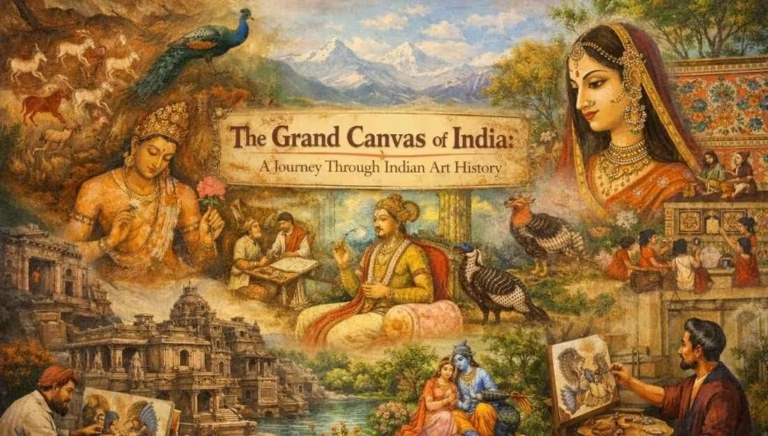
As the large empires decentralized, art moved from cave walls to manuscripts and small sheets of paper.
1. The Pala School (11th–12th Century)
- Location: Bengal and Bihar.
- Medium: Palm leaves and vellum.
- Theme: Vajrayana Buddhism.
- Features: Characterized by sinuous lines and subdued tones. These were precursors to the detailed miniatures of later years.
2. The Western Indian School (Jain School)
- Location: Gujarat and Rajasthan.
- Features: Exaggerated features, sharp noses, and the “protruding eye.” Use of bright colors and later, gold and silver.
3. The Mughal School (The Zenith of Realism)
Mughal painting was a synthesis of indigenous Indian styles and Safavid Persian traditions.
- Babur: Introduced the concept of the Charbagh and naturalistic sketches.
- Humayun: Brought Persian masters Mir Sayyid Ali and Abdus Samad to India, laying the foundation for the Mughal atelier.
- Akbar: Established the Tasvir Khana (department of painting). He shifted focus from individual portraits to Manuscript Illustration (e.g., Hamzanama, Tutinama).
- Jahangir (The Golden Age): Under Jahangir, paintings became more individualistic. He was a naturalist who favored portraits of birds, animals, and flowers (the famous Zebra and Turkey cock by Ustad Mansur). He introduced the Halo in royal portraits.
- Shah Jahan: Focused more on architecture, but paintings became more rigid and “jewel-like” with heavy use of gold and Pietra Dura influences.
Part IV: Regional Schools (Rajasthani & Pahari)
While the Mughals focused on the court, regional schools focused on Bhakti (devotion) and Riti (eroticism/romance).
1. Rajasthani Schools
- Mewar: Bold colors and emotional intensity. Focus on the Rasikapriya and Ramayana.
- Marwar (Jodhpur/Bikaner): Focus on the bravery of Rajputs and desert landscapes.
- Kishangarh: Famous for the Bani Thani painting (the “Mona Lisa of India”) by Nihal Chand. It features elongated eyes, sharp chin, and slender fingers.
- Bund-Kota: Famous for hunting scenes and lush vegetation.
2. Pahari Schools (Himalayan Foothills)
- Basohli: The earliest school, known for its bold, primitive vigor and use of “beetle wings” for decoration.
- Kangra: The most refined Pahari school. Characterized by soft colors (drawn from plants and minerals) and a lyrical depiction of female beauty and the Radha-Krishna love story.
Part V: Folk Paintings – The Art of the People
UPSC often focuses on the geographical indication (GI) and cultural roots of folk art.
- Madhubani (Mithila, Bihar): Traditionally done by women on mud walls using fingers and twigs. Features double-bordered lines and no empty spaces (filled with flowers/birds).
- Pattachitra (Odisha): Painted on cloth (Patta) using natural colors. Themes revolve around Lord Jagannath and the Gita Govinda.
- Kalamkari (Andhra Pradesh): “Kalam” (pen) and “Kari” (work). Two styles: Srikalahasti (hand-painted) and Masulipatnam (block-printed).
- Warli (Maharashtra): Simple geometric shapes (circle, triangle, square) depicting daily life—farming, dancing, and festivals.
- Kalighat (Bengal): Developed near the Kalighat temple in Kolkata. Known for bold sweeps of the brush and satirical themes about the “Babus” of British India.
Part VI: Modern Indian Painting (19th Century – Present)
The colonial encounter forced a change in Indian art styles.
1. The Company School (Patna School)
- Context: British officers commissioned Indian artists to paint Indian flora, fauna, and people.
- Style: Hybrid—Indian subjects with European techniques of perspective and shading.
2. Raja Ravi Varma (The Bridge to Modernity)
- He used Oil on Canvas (European technique) to depict Indian Mythological themes. He is credited with making art accessible to the masses through his lithographic press.
3. The Bengal School of Art
- Leaders: Abanindranath Tagore and E.B. Havell.
- Philosophy: A reaction against “Westernization.” They sought inspiration from Ajanta and Mughal miniatures.
- Nandalal Bose: Famous for the illustrations in the original manuscript of the Constitution of India.
4. Progressive Artists’ Group (PAG)
- Founded by F.N. Souza, S.H. Raza, and M.F. Husain after Independence. They wanted to break away from the “nationalist” shackles and embrace international Modernism.
UPSC Prelims: PYQs & Practice Questions
Previous Year Questions (PYQs)
Question 1 (2013)
Q: With reference to the history of Indian rock-cut architecture, consider the following statements:
1. The caves at Badami are the oldest surviving rock-cut caves in India.
2. The Barabar rock-cut caves were originally made for Ajivikas by Emperor Ashoka.
3. At Ellora, caves were made for different faiths.
Which of the statements given above is/are correct?
Options:
(a) 1 only
(b) 2 and 3 only
(c) 3 only
(d) 1, 2 and 3
Answer: (b)
Explanation: Barabar caves (3rd Century BCE) are much older than Badami (6th Century CE). Ellora has 34 caves dedicated to Hinduism, Buddhism, and Jainism.
Question 2 (2018)
Q: The well-known painting “Bani Thani” belongs to the:
Options:
(a) Bundi school
(b) Jaipur school
(c) Kangra school
(d) Kishangarh school
Answer: (d)
Explanation: Painted by Nihal Chand, “Bani Thani” is the most famous work of the Kishangarh school, known for elegant, elongated facial features and refined courtly aesthetics.
Question 3 (2013)
Q: Consider the following historical places:
1. Ajanta Caves
2. Lepakshi Temple
3. Sanchi Stupa
Which of the above places is/are also known for mural paintings?
Options:
(a) 1 and 2 only
(b) 2 only
(c) 1, 2 and 3
(d) None
Answer: (a)
Explanation: Ajanta is world-famous for Buddhist murals. Lepakshi (Vijayanagara period) has mural paintings on temple ceilings. Sanchi is mainly known for stone sculptures and architecture, not murals.
Prelims Practice Questions
Question 1
Q: Consider the following statements regarding the "Fresco-secco" technique used in Ajanta:
Statements:
1. The paintings were executed on a dry plaster surface.
2. A mix of clay, cow dung, and rice husk was used as the base layer.
3. The color ‘Blue’ was extensively used in the earliest caves (Cave 9 and 10).
Which of the statements given above is/are correct?
Options:
(a) 1 only
(b) 1 and 2 only
(c) 2 and 3 only
(d) 1, 2 and 3
Answer: (b)
Explanation: Statement 3 is incorrect. Blue was absent in the early caves and was introduced later, often linked to imported Lapis Lazuli.
Question 2
Q: Which school of miniature painting is characterized by the use of "Beetle Wings" to denote emeralds and a bold, primitive vigor?
Options:
(a) Basohli School
(b) Kangra School
(c) Mughal School
(d) Mewar School
Answer: (a)
Explanation: The Basohli school (among the earliest Pahari schools) is known for bold, vibrant style and decorative effects like using beetle wings to create a jewel-like emerald appearance.
UPSC Mains: Previous Year Questions (PYQs)
Mesolithic Rock Art
Question: "Mesolithic rock art-not only tells us about the social life of the people but also about their aesthetic sensibility." Discuss. (2015)
Gandhara School of Art
Question: Highlight the unique features of the Gandhara School of Art and the influence of Hellenistic art on it. (Generic recurrent theme)
Mughal School under Jahangir
Question: The Mughal school of painting reached its zenith under Jahangir. Elaborate. (Generic recurrent theme)
Kangra School of Paintings
Question: Discuss the main characteristics of the Kangra School of paintings. (Generic recurrent theme)
Madhubani Paintings (Bihar)
Question: Identify the distinct features of the Madhubani paintings of Bihar. (Generic recurrent theme)
Mains Practice Questions
Miniature Paintings
Question: "Miniature paintings in India were a transition from the 'monumentalism' of caves to the 'individualism' of manuscripts." Analyze. (250 Words)
Bengal School of Art
Question: Evaluate the contribution of the Bengal School of Art in the development of Indian nationalism during the freedom struggle. (150 Words)
Folk Paintings: Warli & Pattachitra
Question: "Folk paintings of India are a visual record of the country's diverse cultural geography." Discuss with examples of Warli and Pattachitra. (250 Words)
Frequently Asked Questions (FAQs)
What is the difference between a Mural and a Miniature?
Murals are large-scale works executed on solid structures like walls or ceilings (e.g., Ajanta). Miniatures are small-scale, highly detailed works usually done on perishable materials like palm leaves, paper, or cloth (e.g., Mughal or Rajasthani schools).
Who is considered the "Father of Modern Indian Art"?
Raja Ravi Varma is often cited as the bridge to modern art for his use of oil on canvas to depict Indian mythology. Later, Abanindranath Tagore founded the Bengal School of Art to move away from Western styles.
What are the 'Shadangas' of Indian painting?
Mentioned in the Kamasutra, these are the six limbs/principles of painting:
- Rupabheda (Knowledge of appearance)
- Pramanam (Accuracy and proportion)
- Bhava (Expression)
- Lavanya Yojanam (Aesthetic grace)
- Sadrisyam (Resemblance)
- Varnikabhanga (Use of brush and colors).
What is the 'Company School' of painting?
Also known as the Patna School, it was a hybrid style that emerged in the 18th-19th centuries where Indian artists used European techniques (perspective and shading) to paint Indian subjects for British officers.
What makes Madhubani paintings unique?
Traditionally done by women in the Mithila region, they use natural dyes and double-bordered lines. They are unique because they leave no empty spaces, filling gaps with motifs of flowers, birds, or geometric patterns.