Table of Contents
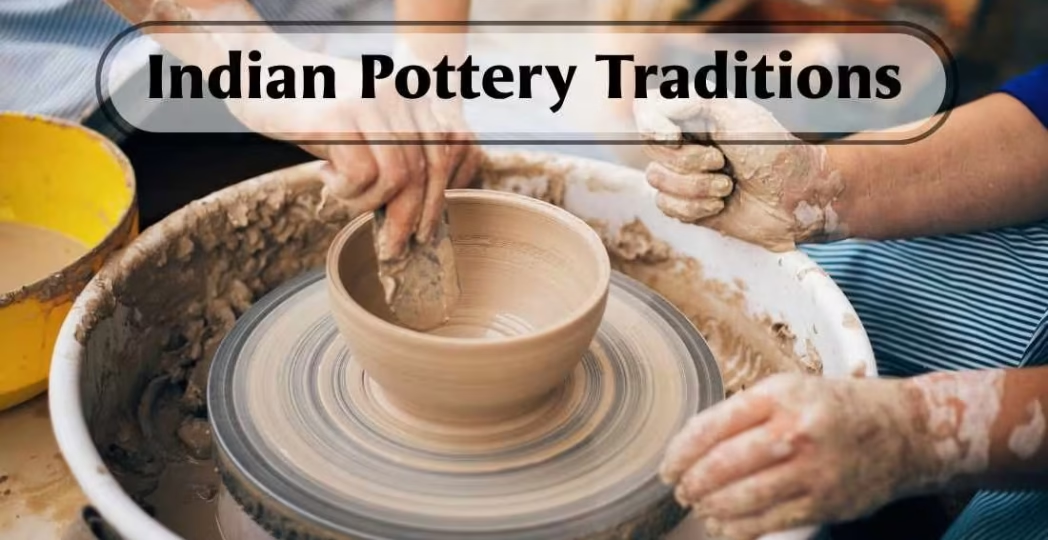
ToggleThe Wheel of Time: A Comprehensive Guide to Indian Pottery Traditions for UPSC
1. Introduction: Why is Pottery Significant for UPSC?
In the study of Ancient Indian History, pottery serves as a “Primary Source.”
- Dating Tool: Each period has a distinct pottery type (e.g., NBPW for the Mauryan era), which acts as an index for stratigraphic dating.
- Technological Progress: The transition from handmade to wheel-turned pottery marks a major milestone in human cognitive and technical evolution.
- Cultural Identity: The decorations, shapes, and motifs provide insights into the religious and aesthetic beliefs of the people.
2. Prehistoric Pottery: The Beginnings
A. Mesolithic Era
The earliest evidence of pottery in India comes from the Mesolithic site of Chopani Mando (Belan Valley, UP).
- Nature: Crude, handmade, and unbaked.
- Function: Primarily used for storage as humans began to transition from pure hunting-gathering to semi-sedentary lifestyles.
B. Neolithic Era: The Invention of the Wheel
The Neolithic period saw a explosion in pottery variety as agriculture became the mainstay.
- Technique: Introduction of the foot-wheel.
- Burzahom (Kashmir): Produced coarse grey pottery.
- Mehrgarh (Pakistan): Showed a progression from plain handmade pots to decorated wheel-made pottery.
- South Indian Neolithic: Known for Ash-mounds and burnished grey ware.
3. Chalcolithic Pottery: The Age of Painted Wares
The Chalcolithic (Copper-Stone) age is characterized by regional diversity in pottery.
- Ahar-Banas Culture: Known for Black and Red Ware (BRW), often decorated with white linear designs.
- Malwa Culture: Considered the most refined Chalcolithic pottery. It is a coarse fabric but heavily painted in black or dark brown over a buff or orange slip.
- Jorwe Culture: Features a matt-surface painted in black. It is well-fired and has a metallic sound when struck.
4. Harappan Pottery: The Industrial Standard
Harappan pottery is a testament to the civilization’s standardized and mass-produced nature.
- Nature: Most Harappan pottery is Wheel-made Red and Black Pottery.
- The “Red and Black” Technique: The pots were treated with a red slip (coating), and then designs were painted in black (manganese).
- Motifs:
- Geometric: Horizontal lines, circles, and squares.
- Naturalistic: Pipal leaves, fish scales, palm trees, and intersecting circles.
- Animal: Bulls, deer, and birds.
- Types:
- Plain Pottery: Used for daily household chores.
- Perforated Pottery: Likely used for straining liquor or as lamps.
- Miniature Pots: Less than half an inch, possibly used for perfumes or cosmetics.
5. The Vedic Period: The Grey and the Painted
The transition from the Bronze Age to the Iron Age saw two major pottery traditions.
A. Ochre Coloured Pottery (OCP) (c. 2000–1500 BCE)
- Found in the Indo-Gangetic divide.
- The pottery is fragile and leaves an ochreous color on the fingers when touched.
- It is often associated with Copper Hoards.
B. Painted Grey Ware (PGW) (c. 1200–600 BCE)
- Context: Often associated with the Later Vedic Period.
- Features: Very fine, smooth, and even-colored grey pottery made from high-quality clay.
- Design: Painted with black geometric patterns (dots and lines).
- Socio-Economic Insight: It was a “Deluxe Ware,” likely used by the elite for special occasions or drinking Soma.
6. Northern Black Polished Ware (NBPW): The Mauryan Pride
The Second Urbanization (Mahajanapada and Mauryan eras) brought the most advanced pottery in ancient India.
- Features: A highly lustrous, mirror-like finish. It is usually coal-black or steel-blue.
- Technique: Achieved by applying a chemical film (possibly containing iron) and firing the pot at very high temperatures.
- Significance: It marks the peak of pottery technology. It was so expensive that even broken pots were sometimes joined with copper wires, indicating its high value.
- Spread: Found from the Himalayas to the Deccan, following the Mauryan trade routes.
7. Post-Mauryan and Gupta Pottery
- Red Polished Ware (RPW): Common in the Kushan period.
- Gupta Period: Pottery became more decorative with the use of Incised Designs (carved into the surface) and Embossed Designs. Temples often featured terracotta plaques which are an extension of the pottery tradition.
8. Medieval Period: The Glazed Revolution
The arrival of Islamic rulers introduced Glazing to Indian pottery.
- Technique: Use of sand, lime, and soda to create a glassy surface.
- Blue Pottery of Jaipur: Though it has Mongol-Persian origins, it was perfected in Jaipur. It is unique because it is made of ground quartz instead of clay.
- Khurja Pottery (UP): Known for colorful floral patterns on a white background.
9. Contemporary Folk Pottery Traditions
For the UPSC Prelims, regional names are crucial:
- Molela Terracotta (Rajasthan): Votive plaques of local deities.
- Longpi Pottery (Manipur): Made from a mixture of black serpentinite stone and clay. It is black and has a metallic finish without using a wheel.
- Bidriware (Karnataka): Though a metal craft, its design philosophy is deeply tied to pottery aesthetics—inlaying silver on a dark alloy.
- Kutch Pottery (Gujarat): Known for hand-painted white designs on red clay.
10. Summary Table for Quick Revision
Pottery Type | Period | Key Feature |
BRW (Black & Red) | Chalcolithic | Inside black, outside red; white paintings. |
Harappan Red/Black | Bronze Age | Mass-produced; Pipal/Fish scale motifs. |
OCP | Early Iron Age | Fragile; associated with Copper Hoards. |
PGW | Later Vedic | Fine grey fabric; elite usage. |
NBPW | Mauryan | Mirror-like polish; high urbanization. |
Blue Pottery | Medieval/Modern | Quartz-based; Persian influence. |
UPSC Prelims: PYQs & Practice Questions
Previous Year Questions (PYQs)
Question 1 (2013)
Q: Which of the following characterizes/characterize the people of Indus Valley Civilization?
1. They possessed great palaces and temples.
2. They worshipped both male and female deities.
3. They employed horse-drawn chariots in warfare.
Select the correct statement/s:
Options:
(a) 1 and 2 only
(b) 2 only
(c) 1, 2 and 3
(d) None
Answer: (b)
Explanation: The Harappans are not known to have built large temples or palaces like later civilizations. Evidence like the “Pashupati” seal and female figurines indicates worship of both male and female deities. Horse-drawn chariots are typically linked to the later Vedic phase, not the mature Harappan period.
Question 2 (2017)
Q: With reference to the religious history of India, consider the following statements:
1. Sautrantika and Sammitiya were the sects of Jainism.
2. Sarvastivadin held that the constituents of phenomena were not wholly momentary, but existed forever in a latent form.
Which of the statements given above is/are correct?
Options:
(a) 1 only
(b) 2 only
(c) Both 1 and 2
(d) Neither 1 nor 2
Answer: (b)
Explanation: Sautrantika and Sammitiya are Buddhist schools, not Jain sects, so statement 1 is incorrect. Sarvastivada is known for the idea that dharmas exist across time (past, present, future), broadly aligning with statement 2.
Question 3 (Static / RS Sharma-based)
Q: The 'Ochre Coloured Pottery' (OCP) is mainly associated with:
Options:
(a) The Harappan Civilization
(b) The Copper Hoard Culture
(c) The Megalithic Burials
(d) The Mauryan Empire
Answer: (b)
Explanation: OCP is mainly reported from the Indo-Gangetic divide and is commonly linked with the Copper Hoard cultural zone, broadly dated to around c. 2000–1500 BCE, often considered contemporaneous with late Harappan developments in some regions.
Prelims Practice Questions
Question 1
Q: Consider the following pairs of Pottery vs. Period:
Pairs:
1. Painted Grey Ware (PGW): Later Vedic Period
2. Northern Black Polished Ware (NBPW): Mauryan Period
3. Black and Red Ware (BRW): Neolithic/Chalcolithic
Which of the pairs given above are correctly matched?
Options:
(a) 1 and 2 only
(b) 2 and 3 only
(c) 1 and 3 only
(d) 1, 2 and 3
Answer: (d)
Question 2
Q: Which of the following features is NOT characteristic of Harappan pottery?
Options:
(a) It was mostly wheel-made.
(b) It was primarily painted in black on a red slip.
(c) It featured the extensive use of blue glaze.
(d) It included perforated pots likely used for straining.
Answer: (c)
Explanation: Glazing was introduced to India much later (commonly associated with Indo-Islamic traditions). Harappan pottery largely used slips and ochre/black paints, along with forms like perforated vessels.
UPSC Mains: Previous Year Questions (PYQs)
PGW to NBPW Transition
Question: "Pottery is the index of the socio-economic and technological status of an ancient society." Discuss with reference to the transition from PGW to NBPW. (Generic recurrent theme)
Harappan Pottery
Question: Analyze the significance of the Harappan pottery in understanding the aesthetic and utilitarian aspects of the Indus Valley Civilization. (Generic theme)
NBPW & Second Urbanization
Question: Evaluate the role of Northern Black Polished Ware (NBPW) in the 'Second Urbanization' of India. (Generic theme)
Pottery & Vedic Culture Extent
Question: How does the study of pottery help in identifying the geographical extent of the Vedic culture? (Generic theme)
Chalcolithic Regional Diversity
Question: Discuss the regional diversity of Chalcolithic pottery in India with special reference to the Malwa and Jorwe cultures. (Generic theme)
Mains Practice Questions
Northern Black Polished Ware (NBPW)
Question: "Northern Black Polished Ware (NBPW) was a 'deluxe ware' that signaled the rise of a stratified urban society." Elaborate. (250 Words)
Indus Valley Pottery vs Painted Grey Ware (PGW)
Question: Compare and contrast the pottery traditions of the Indus Valley Civilization with those of the Painted Grey Ware (PGW) culture. (150 Words)
Neolithic to Harappan Pottery Evolution
Question: Discuss the evolution of pottery from a household craft in the Neolithic age to an industrial mass-production activity in the Harappan era. (250 Words)
Frequently Asked Questions (FAQs)
Why is pottery called the "Alphabet of Archaeology"?
- Because pottery is virtually indestructible compared to wood or cloth, it remains in the soil for millennia. Its changing styles and materials allow archaeologists to create a chronological “alphabet” to read the history of a site.
What is 'Northern Black Polished Ware' (NBPW) famous for?
- It is famous for its unique lustrous, mirror-like finish. It was the highest technology of ancient Indian pottery and is associated with the rise of the Mahajanapadas and the Mauryan Empire.
What was the use of 'Perforated Pottery' in the Harappan civilization?
- Archaeologists believe these pots, which have holes all over the body, were used as strainers for brewing fermented drinks or perhaps as lamps.
Is there any difference between 'Glazed Pottery' and 'Polished Pottery'?
- Yes. Polished pottery (like NBPW) gets its shine from a chemical film and high-temperature firing. Glazed pottery (introduced in the Medieval period) uses a coating of glass-like material (silica) to make it waterproof and shiny.
What is 'Black and Red Ware' (BRW)?
- It is a unique pottery where the pot is fired in a way that the inside and the rim turn black (due to lack of oxygen) while the outside remains red. It is widely found across Neolithic, Chalcolithic, and Megalithic sites in India.