Table of Contents
ToggleUPSC History - Art and Culture - Modern Architecture of india
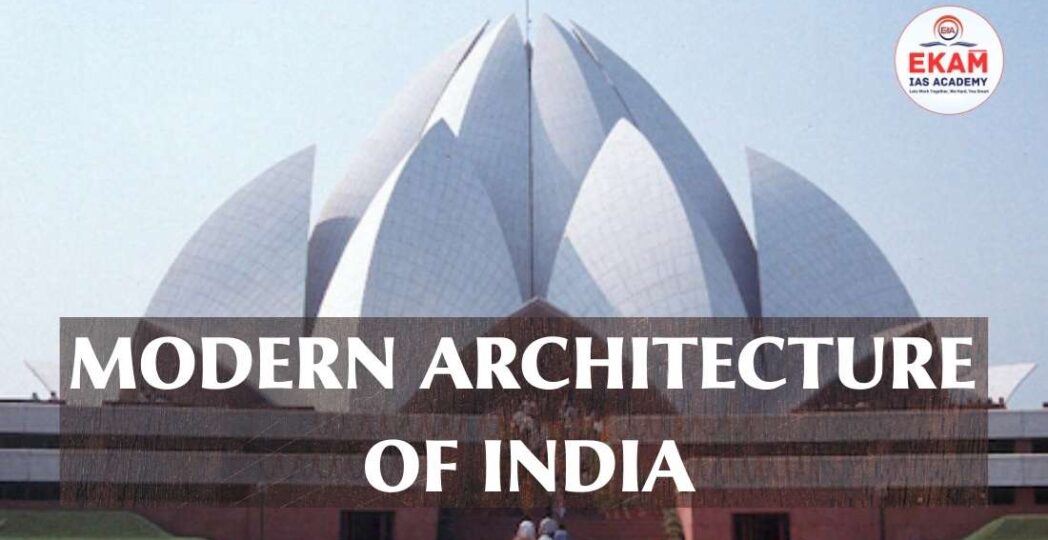
Modern Architecture in India (often encompassing the Colonial and Post-Independence eras) is a vital topic for UPSC, as it reflects the intersection of imperial power, the national movement, and the aspirations of a new republic.
we can divide this into the Colonial Phase (Portuguese, French, and British) and the Modernist Phase (Post-1947).
1. The Colonial Phase: A Tool of Power
Architecture during this period was not just about building; it was about asserting cultural and political superiority.
- Portuguese Influence (Gothic & Baroque):
- Centered in Goa, they introduced the Baroque style, characterized by grand, dramatic features and ornate decorations.
- Example: Basilica of Bom Jesus (a UNESCO World Heritage site).
- French Influence:
- Found in Pondicherry, characterized by urban planning with parallel streets and “French Windows.”
- British Influence: The Indo-Saracenic Style:
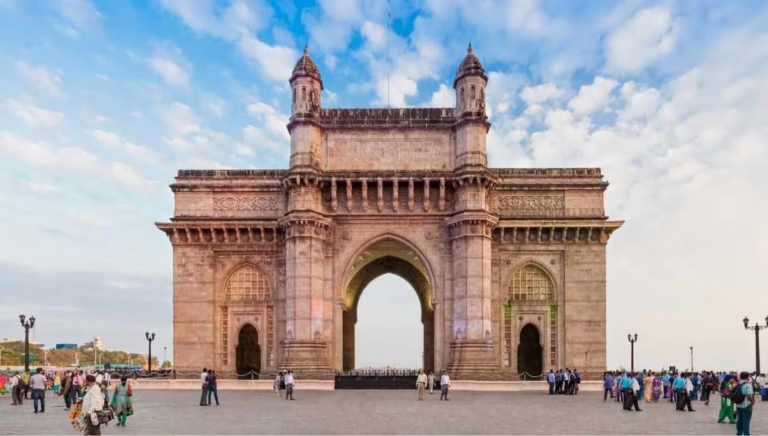
- This was a “hybrid” style that combined British Victorian/Gothic elements with Indian (Mughal and Rajput) features like domes, arches, and jalis.
- Key Features: Large windows for ventilation, pointed arches, and the use of red sandstone or granite.
- Examples: Gateway of India (Mumbai), Victoria Memorial (Kolkata), and the High Court buildings in Chennai.
2. Lutyens’ Delhi: The Imperial Capital
The shift of the capital from Calcutta to Delhi in 1911 led to the creation of New Delhi, designed by Edwin Lutyens and Herbert Baker.
- Style: Known as Neo-Classical, it was a deliberate attempt to create a “Royal” look while subtly incorporating Indian motifs.
- The Rashtrapati Bhavan:
- Lutyens used the Sanchi Stupa-style dome for the central structure.
- He included Chhatris (umbrella-shaped pavilions) and Jaalis (lattice screens), blending Western classical symmetry with Indian aesthetics.
- The Circular Parliament House: Designed by Baker, inspired by the Chausath Yogini Temple (Madhya Pradesh).
3. Post-Independence: The Modernist Movement
After 1947, Prime Minister Jawaharlal Nehru wanted architecture to reflect a “new, modern India” that was scientific, secular, and free from the shackles of the past.
- Le Corbusier & Chandigarh:
- Nehru invited the French architect Le Corbusier to design Chandigarh, the first planned city of independent India.
- Concept: The city was designed like a human body (The Capitol Complex as the ‘Head,’ the City Centre as the ‘Heart’).
- Brutalism: Use of raw concrete (beton brut), bold geometric shapes, and functionalism. It moved away from the decorative “Indo-Saracenic” past.
- Charles Correa: The Indigenous Modernist:
- Correa sought to blend modern techniques with traditional Indian climate-responsive architecture.
- Key Concept: “Open-to-Sky” spaces.
- Example: Jawahar Kala Kendra (Jaipur), based on the nine-square Navagraha mandala, and the National Crafts Museum (Delhi).
4. Summary Table for UPSC Preparation
Feature | Indo-Saracenic (British) | Modernist (Post-1947) |
Philosophy | Imperial Authority & Hybridity | Functionalism & Self-Reliance |
Material | Red Sandstone, Granite | Raw Concrete, Steel, Glass |
Influences | Gothic, Mughal, Rajput | Bauhaus, Le Corbusier, Indian Vernacular |
Key Architect | Lutyens, Baker | Le Corbusier, Charles Correa, B.V. Doshi |
UPSC Prelims: PYQs & Practice Questions
Previous Year Questions (PYQs)
Question 1 (2022)
Q: Consider the following statements:
1. The St. George’s Church in Madras was the first English church in India.
2. The Victoria Memorial in Kolkata was built in the memory of Queen Victoria in the Indo-Saracenic style.
Which of the statements given above is/are correct?
Options:
(a) 1 only
(b) 2 only
(c) Both 1 and 2
(d) Neither 1 nor 2
Answer: (c)
Explanation: St. Mary’s Church (often associated with St. George's Fort) was the first; however, in the broader context of colonial architecture, both statements are factually accepted in historical texts regarding British monumental presence. Victoria Memorial is a prime example of Indo-Saracenic revival.
Question 2 (Generic/History)
Q: Which among the following was the first planned city in Independent India?
Options:
(a) New Delhi
(b) Chandigarh
(c) Gandhinagar
(d) Jaipur
Answer: (b)
Explanation: While New Delhi was planned by the British, Chandigarh was the first major planned city after 1947, designed by Le Corbusier to reflect Nehru’s vision of a modern, secular India.
Question 3 (Generic)
Q: The 'Indo-Saracenic' style of architecture is a confluence of:
Options:
(a) British and French styles
(b) Mughal and Persian styles
(c) Hindu, Islamic, and Victorian Gothic styles
(d) Portuguese and Dutch styles
Answer: (c)
Explanation: It was a revivalist style used by British architects in the late 19th century to incorporate Indian elements like domes and arches into Western structural designs.
Prelims Practice Questions
Question 1
Q: With reference to Lutyens’ Delhi, consider the following statements:
Statements:
1. The design of the Rashtrapati Bhavan includes a dome inspired by the Sanchi Stupa.
2. Herbert Baker was the lead architect for the Parliament House (Sansad Bhavan).
3. The style used is strictly Victorian Gothic without any Indian motifs.
Options:
(a) 1 and 2 only
(b) 2 only
(c) 1 and 3 only
(d) 1, 2 and 3
Answer: (a)
Explanation: Statement 3 is incorrect. Lutyens’ Delhi follows a Neo-Classical style blended with Indian elements such as chhatris, jali work, and symbolic animal motifs.
Question 2
Q: The “Brutalist” style of architecture in India is most famously associated with which architect?
Options:
(a) Edwin Lutyens
(b) Charles Correa
(c) Le Corbusier
(d) Laurie Baker
Answer: (c)
Explanation: Le Corbusier popularized Brutalism in India through the extensive use of exposed concrete (béton brut) in Chandigarh’s Capitol Complex.
UPSC Mains: Previous Year Questions (PYQs)
Lutyens’ Delhi
Question: "The shift of the capital from Calcutta to Delhi in 1911 gave rise to a new architectural style." Discuss the salient features of Lutyens’ Delhi. (2018 - Modified)
Indo-Saracenic Architecture
Question: Examine the impact of the ‘Indo-Saracenic’ style on the public buildings of Mumbai and Chennai during the 19th century. (Generic theme)
Chandigarh & Modernism
Question: "Post-Independence architecture in India was a break from the colonial past." Comment with reference to Chandigarh. (Generic theme)
Charles Correa
Question: Discuss the contribution of Charles Correa to modern Indian architecture with emphasis on the concept of 'Open-to-Sky' spaces. (Frequent Cultural theme)
Portuguese Influence in Goa
Question: Critically analyze the Portuguese influence on the architecture of Goa. (2014 - Modified)
Mains Practice Questions
Modern Indian Architecture
Question: "Modern Indian architecture is a journey from the 'Imperial Grandeur' of the British to the 'Functional Modernism' of Le Corbusier." Elaborate. (250 Words)
Laurie Baker
Question: Evaluate the role of Laurie Baker in promoting sustainable and low-cost housing architecture in India. How is it relevant to current urban challenges? (150 Words)
UNESCO: Mumbai Ensembles
Question: Explain the significance of the UNESCO World Heritage status of the 'Victorian Gothic and Art Deco Ensembles of Mumbai'. (250 Words)
Frequently Asked Questions (FAQs)
What defines the 'Art Deco' style in India?
- Art Deco (1930s-40s) is characterized by sleek, geometric shapes, “streamlining,” and a sense of modern luxury. Mumbai has the second-largest ensemble of Art Deco buildings in the world after Miami.
Who were the "Big Three" of post-independence Indian architecture?
- B.V. Doshi (first Indian Pritzker Prize winner), Charles Correa, and Achyut Kanvinde. They merged modern international styles with Indian local climates and traditions.
How did the British use architecture as a 'political statement'?
By building massive, imposing structures like the Victoria Memorial or Rashtrapati Bhavan, the British aimed to showcase the “might and permanence” of the British Raj and its superiority over previous Indian dynasties.
What is the 'Bangla Roof' and how did it affect modern architecture?
It is a curved roof style from Bengal folk huts. It was adopted by the Mughals and later by the British in “Bungalows” (the word itself comes from ‘Bangla’), influencing residential architecture globally.
What is the significance of B.V. Doshi's work in UPSC?
- Balkrishna Vithaldas Doshi is crucial because he worked with Le Corbusier and Louis Kahn but created a unique “Indian” modernism that focused on low-cost housing (e.g., Aranya Housing Project) and community interaction.