Table of Contents
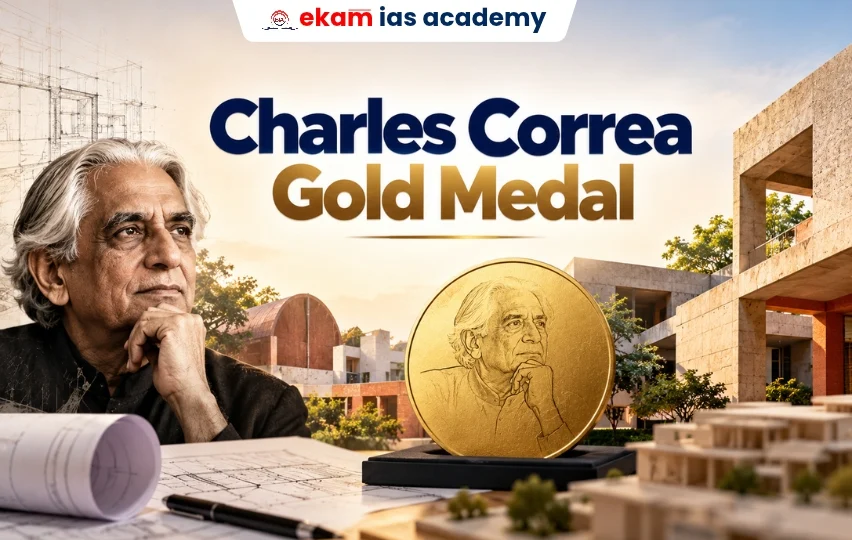
ToggleA Kochi-based architecture student has recently received the 28th Charles Correa Gold Medal in Mumbai, recognising an outstanding undergraduate thesis project. The award honours emerging architectural talent and encourages students to explore innovative responses to contemporary social and urban challenges.
About Charles Correa Gold Medal
The Charles Correa Gold Medal is an annual architecture award instituted in 1998 by renowned Indian architect and urban planner Charles Correa. It recognises excellence among young architecture students for their individual undergraduate thesis undertaken as part of a first professional degree programme.
The award is administered annually by the Charles Correa Foundation (CCF).
Eligibility
The award is open to final-year students pursuing an undergraduate professional architecture degree at an eligible Indian institution approved by the Council of Architecture (COA).
Each participating college can nominate one individual thesis project. The submitted work must be solely created by the student; group projects are not eligible.
Selection
Submissions are assessed by a jury comprising eminent architects and professionals. The jury selects an exceptional thesis project for the Gold Medal.
Initially, participation was limited to architecture colleges in Mumbai and Goa. From 2022 onwards, the award was opened to eligible architecture colleges across India.
For the 2025–2027 period, the medal focuses on thesis projects addressing “Equitability through Design”, highlighting architecture’s potential to respond to issues of inclusion and social equity.
Who was Charles Correa?
Charles Correa was one of India’s most influential architects and urban planners. Born in Secunderabad in 1930, he studied architecture at the University of Michigan and MIT. He died in Mumbai in 2015.
Correa played a major role in shaping modern architecture in post-Independence India. His designs often responded to India’s climate, culture and social realities. He paid particular attention to the needs of the urban poor and incorporated traditional materials and techniques into contemporary design.
A distinctive feature of his architectural philosophy was the “open-to-sky” concept, which connected built spaces with courtyards and outdoor environments.
His major works include the Mahatma Gandhi Memorial at Sabarmati Ashram, National Crafts Museum in New Delhi, Bharat Bhavan in Bhopal, Jawahar Kala Kendra in Jaipur and the British Council building in Delhi. He was also closely associated with the planning of Navi Mumbai.
In 1984, Correa founded the Urban Design Research Institute in Mumbai and later chaired the National Commission on Urbanisation.
Awards and Recognitions
Charles Correa received several major honours, including the Padma Shri (1972) and Padma Vibhushan (2006). He was also awarded the Royal Gold Medal by RIBA in 1984, recognising his contribution to architecture internationally.


FAQs - Charles Correa Gold Medal
What is the Charles Correa Gold Medal?
The Charles Correa Gold Medal is an annual architecture award instituted in 1998. Administered by the Charles Correa Foundation, it recognises outstanding individual undergraduate architecture thesis projects.
Who is eligible for the Charles Correa Gold Medal?
Final-year undergraduate architecture students from eligible Indian institutions approved by the Council of Architecture can participate. Each college may nominate one individual thesis; group projects are not eligible.
What is the theme of the Charles Correa Gold Medal for 2025–2027?
The theme is “Equitability through Design,” encouraging thesis projects that address social inclusion, equity and contemporary architectural challenges.
Who was Charles Correa?
Charles Correa was an influential Indian architect and urban planner known for climate-responsive designs and his “open-to-sky” philosophy. He also contributed to the planning of Navi Mumbai.
What are some famous buildings designed by Charles Correa?
His notable works include the Mahatma Gandhi Memorial at Sabarmati Ashram, Bharat Bhavan in Bhopal, Jawahar Kala Kendra in Jaipur, the National Crafts Museum and the British Council building in New Delhi.