Table of Contents
ToggleSpecial Summary Revision
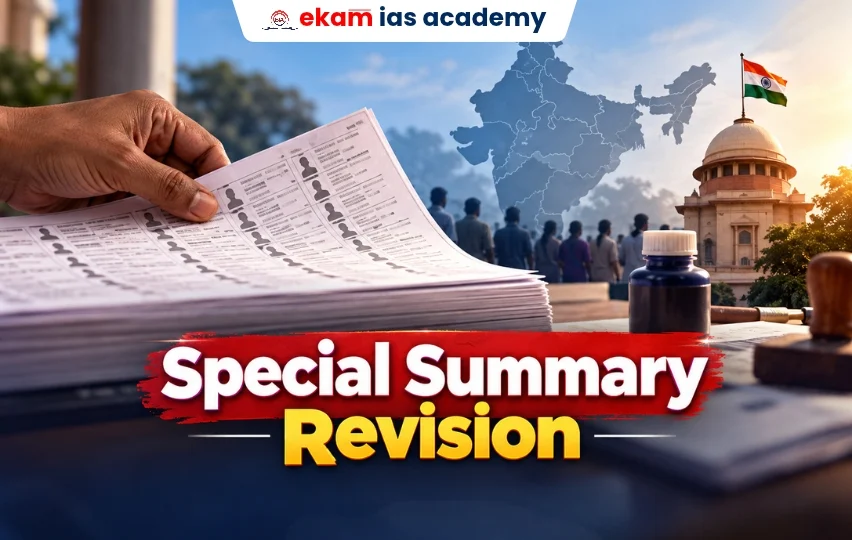
Amid continuing debate over the Special Intensive Revision (SIR) of electoral rolls, the Election Commission (EC) has announced the schedule for the Special Summary Revision (SSR). The annual revision was not undertaken in 2026 and will now be conducted in 17 States and Union Territories, including States preparing for Assembly elections in early 2027.
What Is the Special Summary Revision?
The Special Summary Revision (SSR) is a regular process for updating electoral rolls. The Election Commission derives its authority to prepare electoral rolls from Article 324 of the Constitution, while the procedure is governed by the Representation of the People Act, 1950 and the Registration of Electors Rules, 1960.
Electoral rolls are maintained constituency-wise, with the Electoral Registration Officer (ERO) serving as the statutory authority.
Under Section 21(2) of the Representation of the People Act, electoral rolls are revised before general elections and may also be revised in any year when directed by the EC with reference to a qualifying date.
How SSR Normally Works
SSR is essentially an annual updating exercise. It facilitates the inclusion of newly eligible voters while removing entries relating to deceased electors and those who have permanently shifted residence.
Normally, January 1 serves as the qualifying date. Citizens who attain the age of 18 by this date can apply for inclusion in the electoral roll.
Why Was SSR 2026 Skipped?
The EC had initiated the Special Intensive Revision process in June 2025. Unlike the routine SSR, SIR involved preparing electoral rolls afresh and required existing electors to establish their eligibility again.
Against this background, the regular SSR exercise was not conducted in 2026.
EC’s New SSR Announcement: Key Details
The upcoming SSR will use January 1, 2027 as its qualifying date. It will cover 17 States and UTs, including Assam, Bihar, Chhattisgarh, Gujarat, Kerala, Madhya Pradesh, Punjab, Rajasthan, Tamil Nadu, Uttar Pradesh, Uttarakhand and West Bengal, along with the specified Union Territories.
Timeline for the SSR Process
- Polling station rationalisation: By November 2, 2026
- Draft electoral rolls: November 12, 2026
- Claims and objections: November 12–December 11, 2026
- Disposal of claims and objections: By December 28, 2026
- Final electoral rolls: January 4, 2027
Eligible citizens can use Form 6 for new enrolment and Form 8 for shifting or correcting electoral-roll details.
Conclusion
The return to Special Summary Revision places the existing electoral roll at the centre of the updating process, unlike the more intensive eligibility verification associated with SIR. With several Assembly elections approaching in 2027, the exercise will be important for ensuring that electoral rolls remain accurate, inclusive and up to date, while providing voters adequate opportunities to raise claims and objections.


FAQs: Special Summary Revision (SSR)
What is the Special Summary Revision (SSR) of electoral rolls?
The Special Summary Revision (SSR) is a regular process conducted by the Election Commission of India to update electoral rolls by adding eligible voters, removing deceased electors and correcting outdated entries.
What is the constitutional basis for the Special Summary Revision?
Article 324 of the Constitution empowers the Election Commission to supervise elections. The preparation and revision of electoral rolls are governed by the Representation of the People Act, 1950, and the Registration of Electors Rules, 1960.
Why was the Special Summary Revision not conducted in 2026?
According to the article, the regular SSR was skipped because the Election Commission had initiated the Special Intensive Revision (SIR) process in June 2025, which involved preparing electoral rolls afresh and re-verifying voter eligibility.
What is the qualifying date for SSR 2027?
The qualifying date for the upcoming SSR is January 1, 2027. Citizens who attain the age of 18 by this date can apply for inclusion in the electoral roll, subject to applicable eligibility requirements.
What are the important dates and forms for SSR 2027?
The key dates are:
- Draft electoral rolls: November 12, 2026
- Claims and objections: November 12–December 11, 2026
- Final electoral rolls: January 4, 2027
Eligible citizens can use Form 6 for new voter enrolment and Form 8 for shifting or correcting electoral-roll details.