

Pradesh have renewed concerns about grey-zone warfare.
What is Grey-Zone Warfare?
- Grey-zone warfare (GZW) involves hostile activities conducted below the threshold of open military conflict.
- It uses coercion, ambiguity and deniability to achieve political or territorial objectives.
- Common methods include cyberattacks, misinformation, economic pressure, border incursions and legal claims.
- China’s Three Warfares Strategy involves public opinion warfare, psychological warfare and legal warfare.
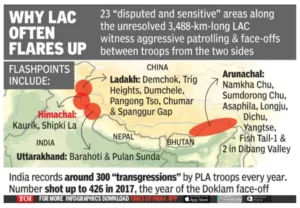
China’s Grey-Zone Tactics Along the LAC
- Infrastructure expansion: Construction of roads, railways, airfields and military facilities enables rapid troop mobilisation.
- Salami slicing: Small, gradual territorial advances attempt to change ground realities without triggering full-scale conflict.
- Border villages: China’s Xiaokang villages near disputed areas may support civilian settlement and military logistics.
- Territorial renaming: Assigning Chinese names to locations in Arunachal Pradesh reinforces Beijing’s territorial claims.
- Strategic pressure: China’s cooperation with Pakistan complicates India’s security planning.
Why is the LAC Vulnerable?
- The LAC is not mutually demarcated, resulting in differing perceptions of its alignment.
- Difficult Himalayan terrain creates challenges for surveillance and troop movement.
- The 2020 Galwan Valley clash demonstrated the danger of escalation.
- Diplomatic engagement has reduced tensions at certain locations but has not resolved the boundary dispute.
Implications for India
- National security: Persistent pressure increases military deployment requirements.
- Economic burden: Border infrastructure and sustained troop mobilisation require substantial resources.
- Diplomatic challenges: Border tensions affect bilateral trust and regional stability.
- Local communities: Restrictions on movement can disrupt livelihoods and traditional grazing practices.
India’s Response and Way Forward
- Strengthen border roads, tunnels, surveillance drones and satellite intelligence.
- Improve coordination between the Indian Army and Indo-Tibetan Border Police (ITBP).
- Enhance cybersecurity, information warfare capabilities and rapid-response logistics.
- Support border settlements through the Vibrant Villages Programme.
- Maintain military deterrence alongside diplomatic dialogue and confidence-building measures.
Conclusion
India must counter grey-zone warfare through integrated military preparedness, resilient border communities, technological superiority and sustained diplomacy.
The Centre reportedly mobilised ₹62,124 crore during April–September 2026 through disinvestment and asset monetisation, reaching nearly 78% of its FY27 budget target.
What is Disinvestment?
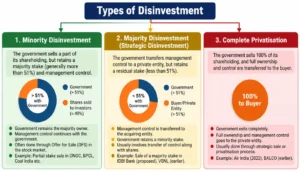
- Disinvestment means the government sells part or all of its ownership in a Public Sector Enterprise (PSE).
- Minority stake sale: Government sells shares without transferring management control.
- Strategic disinvestment: Government transfers substantial ownership along with management control.
- Privatisation: Ownership and control shift from the public sector to private investors.
- Example: Air India’s transfer to the Tata Group in 2022.
Recent Developments
- Total receipts: ₹62,124 crore during April–September 2026, according to the article.
- Disinvestment component: ₹55,757 crore.
- FY27 budget target: ₹80,000 crore.
- IDBI Bank: The proposed strategic sale could increase receipts and private participation.
- LIC IPO, 2022: Expanded retail participation in a major public sector company.
Government Policies
- New Public Sector Enterprise Policy, 2021: Advocates a minimum necessary government presence in strategic sectors.
- Four strategic sectors: Atomic energy, space and defence; transport and telecommunications; power, petroleum, coal and other minerals; and banking, insurance and financial services.
- DIPAM: Department of Investment and Public Asset Management manages central government disinvestment.
- National Monetisation Pipeline (NMP): Unlocks value from operational public infrastructure without necessarily transferring ownership.
- NMP 2.0: The article reports a target of ₹16.72 lakh crore for FY26–FY30.
Economic Significance
- Fiscal consolidation: Non-debt receipts can reduce borrowing requirements.
- Capital investment: Released resources may support infrastructure, health and education.
- Efficiency: Private management may improve productivity and service delivery.
- Market development: Public share sales expand investment opportunities.
- Capital recycling: Monetising existing assets helps finance new projects.
Challenges
- Asset undervaluation: Poorly timed sales may reduce public returns.
- Employment concerns: Workers may face restructuring and job insecurity.
- Strategic interests: Excessive privatisation can weaken public control over essential services.
- One-time receipts: Asset sales cannot permanently replace tax revenue.
- Implementation delays: Regulatory approvals and valuation disputes slow transactions.
Way Forward
- Adopt transparent, competitive and market-based valuation.
- Prepare a rolling three-year disinvestment pipeline.
- Prioritise enterprises with strong investor interest.
- Protect workers through retraining and fair transition measures.
- Strengthen independent regulation and corporate governance.
- Use proceeds for productive investment rather than recurring expenditure.
Conclusion
Disinvestment should be pursued as a transparent, carefully planned structural reform that improves economic efficiency while safeguarding public assets and long-term fiscal stability.
The Archaeological Survey of India (ASI) is planning to restore a headless Vishnu sculpture at the Javari Temple in Khajuraho, Madhya Pradesh.
Historical Background
- The Khajuraho Group of Monuments is located in Chhatarpur district, Madhya Pradesh.
- Built mainly between 950 and 1050 CE under the Chandella dynasty.
- Includes Hindu and Jain temples, reflecting religious coexistence.
- Recognised as a UNESCO World Heritage Site in 1986.
- British engineer T.S. Burt brought the temples to wider colonial attention in 1838.
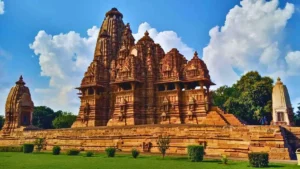
Architectural Features
- Represent the Nagara style of North Indian temple architecture.
- Characterised by towering shikharas, decorated walls and raised platforms.
- Important components include garbhagriha (sanctum), mandapa (hall) and antarala (vestibule).
- Sandstone sculptures depict deities, dancers, everyday activities and intimate relationships.
- Artistic themes reflect the four Purusharthas: Dharma, Artha, Kama and Moksha.
Major Temple Groups
- Western Group: Includes Kandariya Mahadeva, Lakshmana and Vishvanatha temples.
- Eastern Group: Contains Javari Temple and important Jain shrines.
- Southern Group: Includes Duladeva and Chaturbhuja temples.
Cultural Significance
- Demonstrates the artistic and engineering achievements of medieval India.
- Reflects religious traditions, social life and philosophical ideas.
- Supports cultural tourism, employment and regional identity.
Conservation Challenges and Way Forward
- Weathering, tourism pressure and environmental damage threaten sculptures.
- Restoration must preserve historical authenticity and original craftsmanship.
- ASI should use scientific documentation, expert assessment and minimal intervention.
- Encourage sustainable tourism and community participation.
Conclusion
Conserving Khajuraho’s temples means protecting not only magnificent architecture but also India’s rich artistic, religious and cultural legacy.
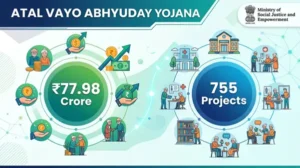
Atal Vayo Abhyuday Yojana (AVYAY) has gained importance as India prepares for a rapidly growing elderly population.
What is AVYAY?
- Launched: 2021, by restructuring the National Action Plan for Senior Citizens (NAPSrC).
- Nodal Ministry: Ministry of Social Justice and Empowerment.
- Nature: Central Sector Scheme, funded by the Union Government.
- Objective: Improve the quality of life of people aged 60 years and above through care, protection and social participation.
Major Components
- Integrated Programme for Senior Citizens (IPSrC): Supports old-age homes and essential care services.
- Rashtriya Vayoshri Yojana (RVY): Provides assisted-living devices to eligible elderly persons with age-related disabilities.
- SAGE Initiative: Encourages innovative products and services for elderly care.
- Elderline (14567): Provides information, guidance and assistance to senior citizens.
Why is the Scheme Important?
- Census 2011: India had approximately 10.38 crore elderly persons.
- The elderly population is projected to reach around 23 crore by 2036.
- Addresses loneliness, neglect, disability, financial insecurity and healthcare needs.
- Promotes healthy ageing, independence and social inclusion.
Challenges and Way Forward
- Improve rural coverage, awareness and last-mile delivery.
- Strengthen coordination with States, NGOs and healthcare institutions.
- Expand community-based care and affordable geriatric services.
- Ensure regular monitoring and accessible grievance redressal.
Conclusion
AVYAY can help transform population ageing from a welfare challenge into an opportunity for dignified, healthy and socially inclusive living