Table of Contents
ToggleIndia’s Balancing Act: Russia, the US and Strategic Autonomy
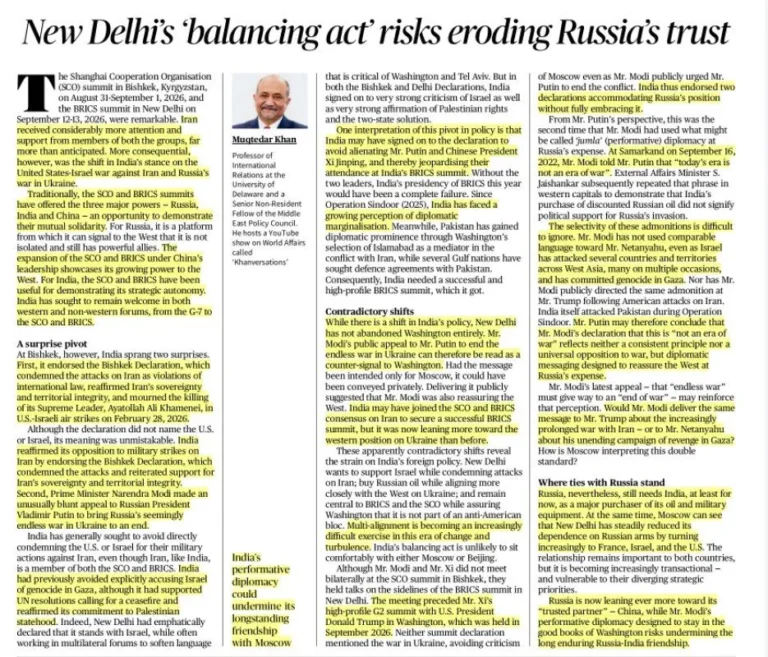
India’s diplomatic positions at the Shanghai Cooperation Organisation (SCO) summit in Bishkek and the BRICS summit in New Delhi highlight the growing complexity of its multi-alignment strategy. While India continues to maintain its longstanding relationship with Russia, its increasing engagement with the United States and its positions on conflicts involving Iran, Israel and Ukraine are creating new challenges for its traditional partnerships.
India’s Traditional Relationship with Russia
Russia has remained an important partner for India, particularly in the areas of defence, energy and strategic cooperation. The SCO and BRICS platforms have traditionally provided opportunities for India, Russia and China to demonstrate cooperation and discuss common interests.
However, the article argues that India’s recent diplomatic positioning has created uncertainty in Moscow regarding the direction of India’s foreign policy.
India’s Position on Iran and Israel
India’s endorsement of the Bishkek Declaration, which condemned attacks on Iran and reaffirmed Iran’s sovereignty and territorial integrity, represented an important diplomatic position.
At the same time, India has maintained strong relations with Israel and has continued to emphasise its support for Palestinian rights. This balancing approach reflects India’s attempt to maintain relationships with multiple partners while protecting its strategic interests.
The Russia-Ukraine Conflict
India has traditionally avoided directly condemning Russia for its military actions in Ukraine. However, the article highlights India’s public appeals for an end to the conflict and Prime Minister Narendra Modi’s emphasis that the present period should not be considered an “era of war.”
From Moscow’s perspective, such statements may create uncertainty about India’s position. At the same time, India continues to purchase Russian oil and defence equipment, demonstrating the continuing importance of bilateral ties.
Strategic Autonomy and Multi-Alignment
India’s foreign policy increasingly reflects strategic autonomy and multi-alignment. New Delhi seeks to maintain productive relations with Russia, the United States, Israel, Iran and other major powers without becoming dependent on any single geopolitical bloc.
This approach provides India with diplomatic flexibility but also requires careful balancing when the interests of major partners come into conflict.
The Road Ahead
India will need to manage its relationships with Russia and the United States while protecting its strategic interests. Maintaining defence and energy cooperation with Russia, strengthening partnerships with the US and engaging actively through platforms such as BRICS and the SCO will require nuanced diplomacy.
Conclusion
India’s foreign policy is increasingly defined by multi-alignment, strategic autonomy and issue-based partnerships. The challenge is to maintain trust with traditional partners while expanding relationships with emerging strategic partners. India’s ability to balance competing interests without compromising its independent decision-making will remain central to its role in an increasingly multipolar world.
Vocabulary
1. Strategic Autonomy – Independent foreign-policy decision-making.
2. Multi-alignment – Engagement with competing global powers.
3. Diplomatic Credibility – Trust generated through consistent foreign-policy positions.
Prelims MCQs
MCQ 1
Consider the following statements:
1. India and Russia are founding members of BRICS.
2. India and Russia are members of the Shanghai Cooperation Organisation.
3. BRICS is a formal military alliance with collective defence obligations.
Which are correct?
A) 1 and 2 only
B) 2 and 3 only
C) 1 and 3 only
D) 1, 2 and 3
Answer: A
UPSC Mains Question
“India’s strategic balancing poses challenges to its traditional ties with Russia.” Examine. (10 Marks)
Frequently Asked Questions (FAQs)
Why is Russia important to India?
Russia remains an important partner for India in defence, energy and strategic cooperation.
What is India’s approach towards the Russia-Ukraine conflict?
India has generally avoided directly condemning Russia while repeatedly calling for an end to the conflict and emphasising dialogue and peace.
What is strategic autonomy?
Strategic autonomy refers to India’s ability to independently make foreign-policy decisions without being tied to a particular geopolitical bloc.
Why are BRICS and SCO important for India?
Both platforms provide India with opportunities to engage major powers, promote multipolarity and advance its strategic and economic interests.
What is the main challenge for India’s Russia policy?
India must preserve its longstanding strategic relationship with Russia while simultaneously deepening ties with the United States and other partners.
Source From : The Hindu
Clean Air in India: Targets, Timelines and Accountability
India continues to face a serious air-pollution challenge despite several policy initiatives aimed at improving air quality. The article highlights a key policy paradox: cities may report improvements in pollution levels, yet the overall burden of poor air quality remains significant. The central issue is therefore not only setting targets but also ensuring timely implementation, institutional coordination and accountability.
Delhi’s Air Quality Challenge
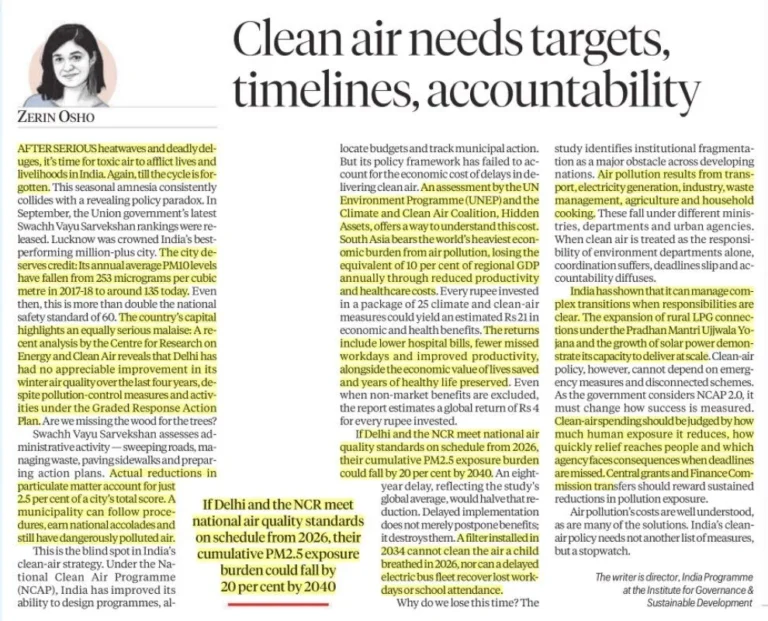
Delhi has recorded a decline in annual average PM10 levels over recent years, but pollution remains well above desirable levels. The article points out that reductions in particulate matter have been modest in comparison with the scale of the problem.
The experience of Delhi also demonstrates that pollution-control measures need to produce measurable improvements in actual air quality rather than merely increasing administrative activity.
National Clean Air Programme
Under the National Clean Air Programme (NCAP), India has sought to strengthen city-level planning and pollution-control measures. However, the article identifies institutional fragmentation as a major obstacle.
Air pollution originates from multiple sectors, including transport, electricity generation, industry, waste management, agriculture and household activities. These sectors often fall under different ministries, departments and local agencies, making coordinated action difficult.
Targets and Economic Benefits
The article highlights the significant economic and health costs of air pollution. A study by the UN Environment Programme (UNEP) and Climate and Clean Air Coalition estimates that air pollution imposes a substantial economic burden through reduced productivity and healthcare costs.
Meeting national air-quality standards on schedule could significantly reduce cumulative PM2.5 exposure. Delayed action, however, can result in prolonged health and economic costs.
Accountability and Implementation
The key challenge is translating policy commitments into measurable outcomes. Clean-air spending should be assessed not simply by the amount allocated but by how quickly pollution exposure is reduced and whether vulnerable populations actually benefit.
Greater coordination among central ministries, state governments, municipalities and pollution-control agencies is therefore essential.
Conclusion
India’s clean-air challenge requires more than ambitious programmes and administrative measures. It requires clear targets, measurable timelines, institutional coordination and accountability for outcomes. Air pollution is a cross-sectoral problem, and effective solutions must therefore integrate transport, energy, industry, agriculture, waste management and public health policies. Clean air should ultimately be measured by the improvement in people’s lives, not merely by the number of schemes implemented.
Vocabulary
1. PM2.5 – Fine particulate matter with a diameter of 2.5 micrometres or less.
2. NCAP – National Clean Air Programme.
3. Institutional Fragmentation – Poor coordination among responsible agencies.
Prelims MCQs
MCQ 1
Consider the following statements:
1. NCAP aims to reduce particulate pollution in Indian cities.
2. PM2.5 particles can penetrate deep into the respiratory system.
3. Swachh Vayu Survekshan exclusively measures actual reductions in air pollution.
Which are correct?
A) 1 and 2 only
B) 2 and 3 only
C) 1 and 3 only
D) 1, 2 and 3
Answer: A
UPSC Mains Question
“India’s clean-air strategy requires measurable targets, strict timelines and institutional accountability.” Discuss. (10 Marks)
Frequently Asked Questions (FAQs)
What is the main challenge in India’s air-pollution management?
The major challenge is translating policy measures into measurable reductions in pollution through coordinated and accountable implementation.
What is the National Clean Air Programme?
NCAP is a national initiative aimed at improving air quality through city-level pollution-control planning and coordinated measures.
Why is institutional coordination important for clean air?
Air pollution comes from multiple sectors and involves several ministries, departments and local agencies. Fragmented responsibility can weaken implementation.
Why are timelines important in air-pollution control?
Delayed implementation prolongs exposure to harmful pollutants and increases associated health and economic costs.
How should clean-air programmes be evaluated?
They should be evaluated through measurable improvements in pollution exposure, public health outcomes and reductions in emissions rather than expenditure or administrative activity alone.