Table of Contents
ToggleSIR Verdict: Serious Constitutional Questions on Electoral Roll Revision
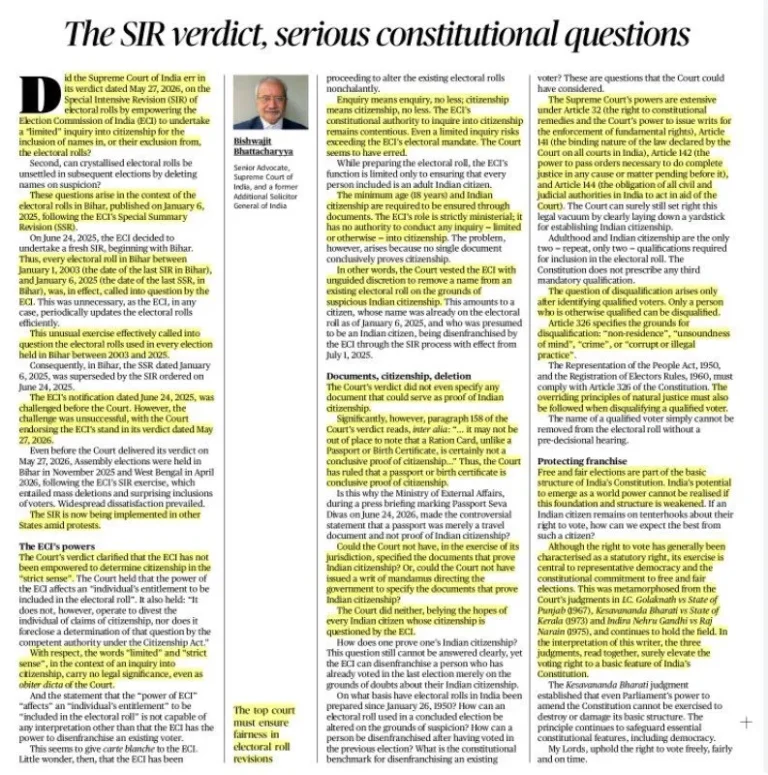
The Supreme Court’s verdict on the Special Intensive Revision (SIR) of electoral rolls has raised important constitutional questions concerning the powers of the Election Commission of India (ECI), citizenship verification, voter eligibility and the protection of the right to vote. The case also highlights the need to balance electoral-roll purification with fairness and inclusion.
What is Special Intensive Revision (SIR)?
SIR is an intensive exercise undertaken to revise electoral rolls. The article discusses the ECI’s decision to conduct SIR in Bihar and subsequently extend the exercise to other States.
The key concern is whether the ECI can undertake an extensive inquiry into citizenship while revising electoral rolls, and whether such an exercise could result in the exclusion of eligible voters.
Powers of the Election Commission
The Supreme Court clarified that the ECI has broad constitutional powers under Article 324 to supervise and control elections. However, the article stresses that such powers must be exercised within constitutional boundaries.
The ECI cannot simply presume that an individual’s name in an electoral roll automatically establishes citizenship. At the same time, the process of electoral-roll revision must ensure procedural fairness.
Citizenship and Documentary Evidence
One of the major issues concerns the documents that may establish citizenship. The article highlights questions surrounding the ECI’s treatment of documents such as birth certificates, passports and other official records.
The Court’s observations raise a larger constitutional question: how can electoral authorities verify eligibility without creating excessive procedural barriers for genuine voters?
Right to Vote and Franchise
The article links the issue to the constitutional importance of electoral participation. Although the right to vote is not itself a Fundamental Right, it is an important statutory and constitutional-democratic entitlement.
The principle of free and fair elections is closely connected with the democratic structure of the Constitution. Therefore, electoral-roll revisions must protect both electoral integrity and the participation of eligible citizens.
Conclusion
The SIR controversy demonstrates the delicate balance between clean electoral rolls and inclusive democracy. Electoral authorities must prevent ineligible entries while ensuring that genuine voters are not excluded through complicated procedures or inadequate documentation. Ultimately, electoral-roll revision must remain transparent, fair and constitutionally accountable so that the integrity of elections is strengthened without weakening citizens’ faith in the democratic process.
Vocabulary
1. Disenfranchisement – Deprivation of voting rights.
2. Adult Suffrage – Voting rights for eligible adult citizens.
3. Due Process – Fair legal procedures before adverse action.
Prelims MCQs
MCQ 1
Consider the following statements:
1. Article 326 provides for adult suffrage in Lok Sabha and State Assembly elections.
2. The Election Commission is empowered to conclusively determine Indian citizenship.
3. Article 324 vests the ECI with superintendence, direction and control of elections.
Which are correct?
A) 1 and 2 only
B) 1 and 3 only
C) 2 and 3 only
D) 1, 2 and 3
Answer: B
UPSC Mains Question
“Electoral roll revisions must balance electoral integrity with the protection of voting rights.” Examine the constitutional challenges. (10 Marks)
Frequently Asked Questions (FAQs)
What is SIR in the electoral context?
SIR stands for Special Intensive Revision, an exercise undertaken to comprehensively revise electoral rolls.
Which constitutional Article gives powers to the Election Commission?
Article 324 provides the Election Commission with the power of superintendence, direction and control over elections.
Does being listed on an electoral roll automatically prove citizenship?
No. The article highlights that inclusion in an electoral roll does not by itself establish citizenship.
Is the right to vote a Fundamental Right?
No. The right to vote is not a Fundamental Right, but it is an important statutory entitlement essential to democratic participation.
What is the major constitutional concern surrounding SIR?
The central concern is balancing electoral-roll integrity with fairness, ensuring that ineligible persons are removed without disenfranchising eligible citizens.
Source From : The Hindu
Inter-State Council: Rebuilding India’s Federal Dialogue
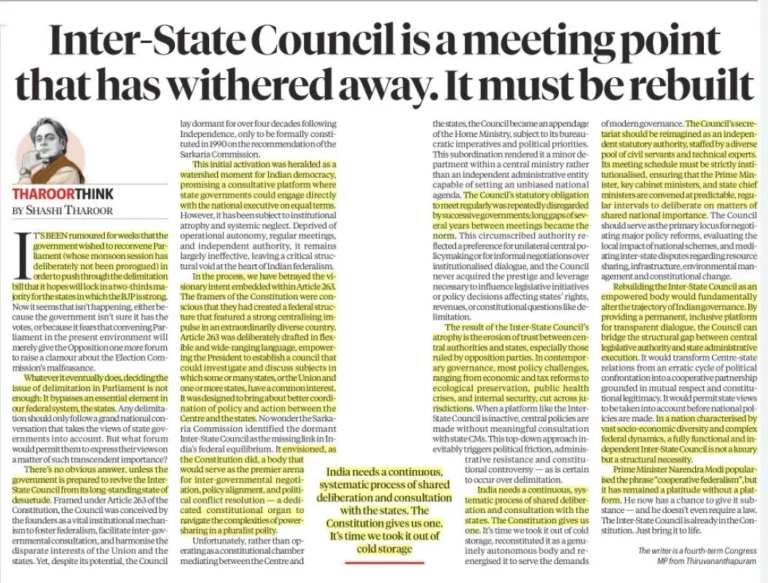
The Inter-State Council (ISC) was envisioned as an important institutional mechanism for strengthening cooperative federalism in India. Established under Article 263 of the Constitution, it was intended to provide a regular forum where the Union and State governments could discuss issues of common interest, resolve differences and improve Centre-State coordination. However, the Council has remained relatively inactive, raising concerns about the effectiveness of India’s federal institutions.
Constitutional Basis of the Inter-State Council
Article 263 empowers the President to establish an Inter-State Council when it appears that such a body would serve the public interest. Its broad purpose includes:
- Inquiring into and advising on disputes between States.
- Investigating and discussing subjects of common interest between the Union and States.
- Making recommendations for better coordination of policies and action.
The idea reflects the Constitution’s vision of a federal structure based on consultation and cooperation.
Why Does the Inter-State Council Matter?
India is a highly diverse country where States have different economic, social and administrative priorities. Issues such as economic and tax reforms, public health, environmental challenges, internal security and infrastructure frequently involve both Union and State governments.
A regularly functioning Inter-State Council can provide a structured platform for dialogue, helping governments address disagreements before they develop into political or constitutional conflicts.
The article argues that the Council’s limited functioning has weakened its potential as a mechanism for managing Centre-State relations. Long gaps between meetings and the Council’s dependence on the administrative priorities of the Union government have reduced its institutional effectiveness.
Need for Reform
The Council could be strengthened by:
- Holding meetings at predictable and regular intervals.
- Giving it greater institutional and administrative autonomy.
- Ensuring participation of Chief Ministers and Union Ministers on matters of national importance.
- Creating a professionally staffed secretariat with civil servants and technical experts.
- Using the Council as a forum for structured negotiations on major policy reforms.
Conclusion
The Inter-State Council can play a crucial role in strengthening India’s cooperative federalism. Rather than remaining a largely underused constitutional mechanism, it can become a permanent platform for Centre-State consultation, policy coordination and dispute resolution. Revitalising the Council would help transform federal relations from political confrontation into structured dialogue and collaborative governance.
Vocabulary
1. Cooperative Federalism – Collaboration between Centre and States.
2. Intergovernmental Relations – Coordination among different levels of government.
3. Institutional Autonomy – Independence in organisational functioning.
Prelims MCQs
MCQ 1
Consider the following statements:
1. Article 263 provides for the establishment of an Inter-State Council.
2. The Inter-State Council was established in 1990 following the Sarkaria Commission’s recommendations.
3. The Inter-State Council has binding judicial powers to settle disputes between States.
Which are correct?
A) 1 and 2 only
B) 2 and 3 only
C) 1 and 3 only
D) 1, 2 and 3
Answer: A
UPSC Mains Question
“Revitalising the Inter-State Council is essential for strengthening cooperative federalism in India.” Discuss. (10 Marks)
Frequently Asked Questions (FAQs)
What is the Inter-State Council?
The Inter-State Council is a constitutional mechanism intended to promote coordination and consultation between the Union and State governments.
Under which Article is the Inter-State Council provided?
The Council is provided for under Article 263 of the Indian Constitution.
What is the main purpose of the Inter-State Council?
Its purpose is to discuss matters of common interest, advise on inter-State disputes and promote coordination between the Union and States.
Why is the Inter-State Council important for cooperative federalism?
It provides a structured platform for the Union and States to discuss policy issues, resolve differences and improve coordination.
How can the Inter-State Council be strengthened?
Regular meetings, greater institutional autonomy, stronger participation of States and a professionally staffed secretariat can improve its effectiveness.