Table of Contents
ToggleGeosynchronous Orbit
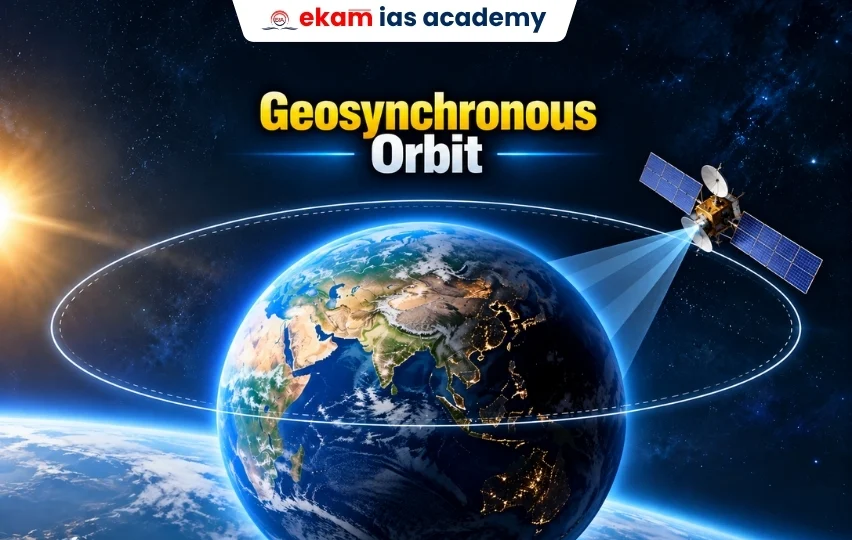
A Geosynchronous Orbit (GSO) is an Earth-centred orbit in which a satellite completes one revolution in the same time that Earth takes to rotate once on its axis. Its orbital period is approximately 23 hours, 56 minutes and 4 seconds, equal to one sidereal day.
A circular geosynchronous orbit is located about 35,786 km above Earth’s surface, with a semi-major axis of nearly 42,164 km from Earth’s centre. It is also associated with the name Arthur C. Clarke, who popularised its use for satellite communication.
Key Features of Geosynchronous Orbit
A geosynchronous satellite does not always appear fixed in the sky. Depending on its inclination and eccentricity, it may move north-south or east-west while returning to the same position every day.
A Geostationary Orbit is a special type of geosynchronous orbit with zero inclination and zero eccentricity, making the satellite appear stationary above the Equator.
A Tundra Orbit is an inclined and highly elliptical geosynchronous orbit used for prolonged coverage of high-latitude regions.
The first functional geosynchronous satellite, Syncom 2, was successfully placed in orbit in 1963.
Applications
Geosynchronous orbits are widely used for:
- Satellite communication
- Television broadcasting
- Weather monitoring
- Remote sensing
- Continuous regional coverage
Their long orbital period allows reliable and continuous communication over large areas.


FAQs: Geosynchronous Orbit
What is a Geosynchronous Orbit (GSO)?
A Geosynchronous Orbit is an Earth-centred orbit in which a satellite completes one revolution in the same period as Earth’s rotation, approximately 23 hours, 56 minutes and 4 seconds.
What is the altitude of a Geosynchronous Orbit?
A circular geosynchronous orbit is located approximately 35,786 km above Earth’s surface, with a semi-major axis of about 42,164 km from Earth’s centre.
What is the difference between Geosynchronous and Geostationary Orbit?
A geostationary orbit is a special type of geosynchronous orbit with zero inclination and zero eccentricity, causing the satellite to appear stationary above the Equator.
What is a Tundra Orbit?
A Tundra Orbit is an inclined and highly elliptical geosynchronous orbit designed to provide prolonged coverage of high-latitude regions.
What are the major applications of Geosynchronous Orbits?
Geosynchronous orbits are used for satellite communication, television broadcasting, weather monitoring, remote sensing and continuous regional coverage.