Table of Contents
ToggleArticle 17 of the Indian Constitution
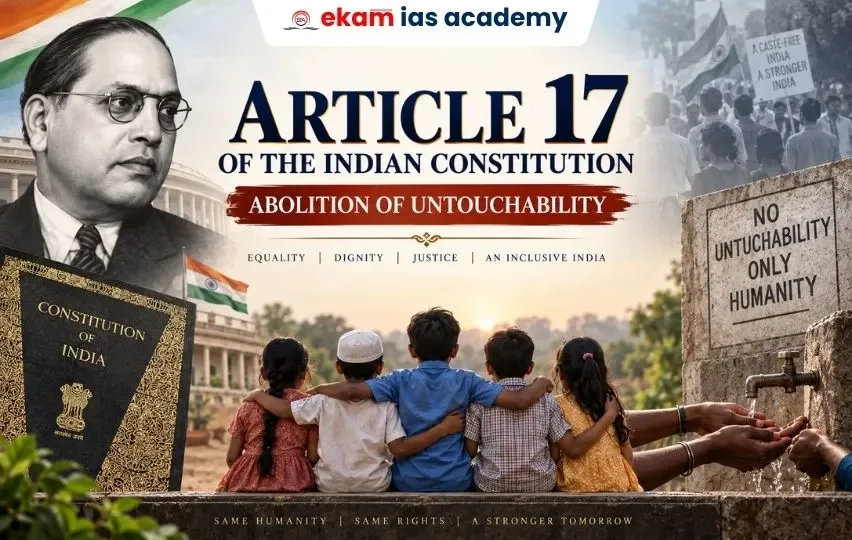
The provision of Article 17 of the Indian Constitution serves as a vital cornerstone for human dignity, individual freedom, and social equality. Positioned within Part III, this absolute right abolishes the historic institution of untouchability in all forms across Indian society. Mastering Article 17 UPSC concepts, its statutory enforcement laws, and milestone judicial precedents is essential for candidates covering Fundamental Rights UPSC topics in civil services preparation.
What is Article 17?
- Absolute Right: Unlike most fundamental rights, Article 17 Indian Constitution is absolute and subject to no constitutional exceptions or restrictions.
- Horizontal Enforcement: Operates directly against both state actions and private individuals who practice untouchability.
- Self-Executing Framework: Requires parliamentary legislation under Article 35 to prescribe penalties and criminal consequences.
- Egalitarian Engine: Serves as a primary legal instrument to dismantle deeply entrenched caste-based segregation.
Constitutional Text of Article 17
- Abolition Clause: Explicitly declares that “Untouchability” is abolished and its practice in any form is forbidden.
- Penal Clause: Mandates that the enforcement of any disability arising out of “Untouchability” shall be an offense.
- Punishable by Law: Dictates that such offenses shall be punishable strictly in accordance with parliamentary law.
- Concise Construction: Contains a short yet powerful constitutional declaration aimed at complete social reform.
Meaning of Untouchability Under Article 17
- Undefined Term: The term “Untouchability” is neither defined in the Constitution nor in parliamentary statutes.
- Judicial Interpretation: The Mysuru High Court (Devarajiah v. Padmanna) ruled that it refers to historical social practices, not literal touch.
- Social Disability: Denotes the traditional practice of imposing social disabilities on specific castes due to their birth.
- Narrow Scope: Does not cover social boycotts or temporary exclusions based on non-caste medical or health reasons.
Why Was Article 17 Included in the Constitution?
- Historical Redressal: Designed to eradicate centuries of institutionalized socio-religious oppression faced by Scheduled Castes.
- Constitutional Vision: Promoted Dr. B.R. Ambedkar’s vision of breaking caste hierarchies and restoring human dignity.
- Substantive Equality: Essential for establishing genuine fraternity and political democracy across a diverse population.
- National Integration: Aimed to unify Indian society by eliminating discriminatory social practices that divided citizens.
Article 17 and Fundamental Rights
- Part of Right to Equality: Complements Articles 14, 15, 16, and 18 to build a robust Right to Equality UPSC framework.
- Reinforcing Article 15: Strenghens Article 15(2) by prohibiting restrictions on accessing public places, wells, and shops.
- Article 21 Synergy: Interlinks with the Right to Life with Dignity, protecting individual self-respect.
- Article 25 Relationship: Balances religious freedom under Article 25 by barring discriminatory practices in public religious places.
Article 17 and the Protection of Civil Rights Act, 1955
- Legislative Origin: Originally enacted as the Untouchability (Offences) Act, 1955, under the authority of Article 35.
- Statutory Renaming: Comprehensively amended and renamed the Protection of Civil Rights Act 1955 in 1976.
- Punitive Scope: Prescribes imprisonment and fines for enforcing religious, social, or occupational disabilities.
- Disqualification Element: Disqualifies individuals convicted under this Act from contesting elections to Parliament or State Legislatures.
Article 17 and the SC/ST (Prevention of Atrocities) Act, 1989
- Enhanced Protection: Enacted to prevent violent crimes and severe social abuses against Scheduled Castes and Scheduled Tribes.
- Specialized Courts: Mandates the creation of Special Courts for speedy trials and rehabilitation of victims.
- Presumption of Offense: Establishes stringent bail provisions and procedural safeguards to deter caste-based atrocities.
- Evolving Mandate: Regularly amended to incorporate modern manifestations of caste harassment and hate speech.
Article 17 and Social Justice
- Social Transformation: Drives structural reform by empowering historically marginalized groups against discrimination.
- Dignity of Labor: Elevates the social status of informal workers by removing occupational stigmas associated with birth.
- Empowerment Vehicle: Works in tandem with positive discrimination policies to secure Article 17 and Social Justice.
- Eradicating Hegemony: Weakens traditional caste hierarchies in rural socio-economic environments.
Important Supreme Court Judgments Related to Article 17
- State of Karnataka v. Appa Balu Ingale (1993): Upheld that the main objective of Article 17 Important Cases is to abolish caste prejudices.
- People’s Union for Democratic Rights v. Union of India (1982): Held that Article 17 is enforceable against private individuals, placing a duty on the State.
- Safai Karamchari Andolan v. Union of India (2014): Linked manual scavenging directly to untouchability, demanding its absolute elimination.
- Prathvi Raj Chauhan v. Union of India (2020): Upheld the constitutional validity of the SC/ST Prevention of Atrocities Amendment Act.
Article 17 and Manual Scavenging
- Modern Untouchability: Recognized Article 17 and Manual Scavenging as a direct, modern continuation of untouchability practices.
- Statutory Prohibition: Led to the Prohibition of Employment as Manual Scavengers and their Rehabilitation Act, 2013.
- Judicial Mandate: The Supreme Court ordered strict rehabilitation, compensation, and technological transition for sewer workers.
- Systemic Remediation: Seeks to sever the historical link between birth-based caste expectations and hazardous sanitation labor.
Article 17 and Caste Discrimination
- Structural Eradication: Addresses systemic institutional prejudices that persist in housing, employment, and education.
- Behavioral Change: Leverages penal sanctions to shift societal behavior away from Article 17 and Caste Discrimination.
- Urban vs. Rural Divide: Combats subtle urban discrimination alongside explicit, overt rural practices.
- Inter-sectional Impact: Targets severe inter-sectional oppression experienced by Dalit women in traditional communities.
Article 17 and Directive Principles of State Policy
- Article 38 Alignment: Supports state efforts to secure a social order built on socio-economic and political justice.
- Article 46 Synergy: Operates alongside state directives to promote the educational and economic interests of SCs/STs.
- Welfare State Mandate: Provides a enforceable foundation for promotional welfare schemes designed for backward communities.
- Socio-Economic upliftment: Bridges legal rights under Part III with affirmative state goals under Part IV.
Article 17 and Fundamental Duties
- Article 51A(e) Duty: Mandates every citizen to renounce practices derogatory to the dignity of human beings.
- Article 51A(f) Synergy: Encourages valuing and preserving the rich heritage of India’s composite culture without caste bias.
- Individual Responsibility: Places a constitutional obligation on citizens to eliminate caste prejudices from private life.
- Civic Fraternity: Strengthens the spirit of common brotherhood among all citizens across diverse social backgrounds.
Issues and Challenges Related to Article 17
- Low Conviction Rates: Procedural delays, witness intimidation, and inadequate investigation hamper prosecution.
- Subtle Discrimination: Persistence of covert untouchability, such as segregated housing and separate dining utensils.
- Reporting Barriers: Victims face socio-economic pressure and police reluctance when filing reports under specialized acts.
- Implementation Gaps: Incomplete execution of rehabilitation schemes for liberated manual scavengers.
Article 17 and Constitutional Morality
- Ethical Standard: Upholds constitutional morality by prioritizing human dignity above traditional caste customs.
- Countering Majoritarianism: Ensures that majoritarian traditions do not violate fundamental egalitarian rights.
- Transformation Tool: Functions as an active instrument to transform a hierarchical society into an inclusive democracy.
- Judicial Compass: Guides constitutional courts when evaluating discriminatory customary practices.
Article 17 and Reservation
- Complementary Framework: Works alongside Articles 15(4) and 16(4) to ensure meaningful empowerment for marginalized groups.
- Level Playing Field: While Article 17 removes legal and social barriers, reservation provides affirmative economic and political access.
- Holistic Justice: Combines social emancipation with political and educational representation in public institutions.
- Breaking Stigmas: Enables backward classes to hold positions of public authority, dismantling traditional caste mindsets.
Article 17 and Constitutional Remedies
- Article 32 Access: Allows victims to directly petition the Supreme Court for enforcement of fundamental rights.
- Article 226 Scope: Authorizes High Courts to issue writs against state and private entities practicing untouchability.
- State Accountability: Makes state administration liable for failing to protect vulnerable citizens from caste atrocities.
- Public Interest Litigation: Enables civil society organizations to seek systemic judicial intervention against untouchability practices.
Conclusion
- Enduring Mandate: Upholding Article 17 Notes for UPSC highlights its role as a key instrument of social justice.
- Comprehensive Protection: Provides absolute constitutional protection strengthened by powerful statutory frameworks like the SC/ST Act.
- Path to Equality: Fulfilling these Article 17 Short Notes objectives ensures India advances toward an egalitarian society grounded in fraternity and human dignity.
UPSC Prelims: PYQs & Practice Questions
Previous Year Questions (Prelims)
Q: Which category of Fundamental Rights incorporates protection against untouchability as a form of discrimination?
(a) Right against Exploitation
(b) Right to Freedom
(c) Right to Constitutional Remedies
(d) Right to Equality
Answer: (d) Right to Equality
Explanation:
Articles 14 to 18 of the Indian Constitution collectively
constitute the Right to Equality.
Article 17 specifically provides for the Abolition of Untouchability and prohibits its practice in any form.
It forms an integral part of the Right to Equality along with Article 14 (Equality before law), Article 15 (Prohibition of discrimination), Article 16 (Equality of opportunity in public employment), and Article 18 (Abolition of titles).
Q: Which one of the following statements regarding Rights is correct?
(a) Rights are claims of the State against the citizens.
(b) Rights are privileges which are incorporated in the Constitution of a State.
(c) Rights are claims of the citizens against the State.
(d) Rights are privileges of a few citizens against the many.
Answer: (c) Rights are claims of the citizens against the State.
Explanation:
Fundamental Rights contained in Part III of the Constitution
primarily operate as limitations on arbitrary legislative and executive action.
They enable individuals to assert constitutionally protected claims against the State.
Article 17 has an important additional dimension because the prohibition of untouchability also operates against private individuals.
Therefore, the constitutional prohibition against untouchability has a horizontal application in addition to restricting State action.
Practice Questions
Q: With reference to Article 17 of the Indian Constitution, consider the following statements:
1. The term "Untouchability" is explicitly defined under the
Protection of Civil Rights Act, 1955.
2. Article 17 is an absolute right and carries no constitutional
exceptions or reasonable restrictions.
3. The right under Article 17 is enforceable only against the State and its authorities.
Which of the statements given above is/are correct?
(a) 1 and 2 only
(b) 2 only
(c) 2 and 3 only
(d) 1, 2 and 3
Answer: (b) 2 only
Explanation:
Statement 1 is incorrect: Neither the Constitution nor the
Protection of Civil Rights Act, 1955 defines the word
"Untouchability." Courts rely on its historical usage to determine its scope
(Devarajiah v. Padmanna).
Statement 2 is correct: Article 17 is an absolute right. Unlike Article 19 or Article 25, it contains no proviso or reasonable restriction permitting untouchability under any circumstance.
Statement 3 is incorrect: Article 17 has horizontal application, meaning that it is enforceable against both private individuals and State entities.
Q: Under the Indian Constitution, Parliament derives its exclusive power to enact penal laws for enforcing the abolition of untouchability under Article 17 through which of the following provisions?
(a) Article 32
(b) Article 35
(c) Article 368
(d) Article 246
Answer: (b) Article 35
Explanation:
Article 35(a)(ii) provides that Parliament has the
exclusive power to make laws prescribing punishment for acts
declared to be offences under Part III of the Constitution.
State Legislatures do not have the power to make such laws in respect of these constitutional provisions.
This includes offences connected with Article 17 (Abolition of Untouchability) and Article 23 (Prohibition of traffic in human beings and forced labour).
UPSC Mains – Previous Year & Practice Questions
Mains Previous Year Questions
Question: "Constitutional Morality is rooted in the Constitution itself and is founded on its essential elements." Discuss how Article 17 reinforces constitutional morality by eradicating social hierarchies. (UPSC GS Paper II – 2021, 15 Marks)
Question: Examine the scope and significance of Article 17 in promoting social democracy as envisioned by Dr. B.R. Ambedkar. (UPSC GS Paper II – 2018, 10 Marks)
Question: Analyze the role of the SC/ST (Prevention of Atrocities) Act, 1989 in fulfilling the constitutional mandate of Article 17. What major judicial developments have shaped its enforcement in recent years? (UPSC GS Paper II – 2020, 15 Marks)
Question: "While legal abolition of untouchability was achieved through Article 17, manual scavenging remains its modern manifestation." Critically comment on the judicial interventions in this regard. (UPSC GS Paper II – 2016, 12.5 Marks)
Question: Discuss the relationship between Article 17 – Abolition of Untouchability and Article 25 – Freedom of Religion. How have courts reconciled individual dignity with traditional religious practices? (UPSC GS Paper II – 2019, 15 Marks)
Mains Practice Questions
[15 Marks | 250 Words]
Question: "Article 17 is not merely a negative prohibition against State and private action, but a positive constitutional obligation to ensure human dignity." Critically evaluate.
[10 Marks | 150 Words]
Question: Despite stringent statutory frameworks enacted pursuant to Article 17, low conviction rates and procedural delays persist in caste atrocity cases. Analyze the underlying institutional bottlenecks.
[15 Marks | 250 Words]
Question: "Eliminating manual scavenging requires moving beyond penal laws to comprehensive socio-economic rehabilitation." Discuss in light of the Supreme Court's directives in the Safai Karamchari Andolan case.
Article 17 of the Indian Constitution-FAQs
What is Article 17 of the Indian Constitution?
Article 17 abolishes untouchability and forbids its practice in any form, making enforcement of any disability arising from untouchability punishable by law.
Is Article 17 enforceable against private individuals?
Yes. Article 17 has horizontal application, meaning it can operate against private individuals practicing untouchability.
Which law enforces Article 17?
The Protection of Civil Rights Act, 1955 enforces Article 17 by prescribing punishment for practicing untouchability.
How is Article 17 linked with manual scavenging?
Manual scavenging is treated as a modern continuation of caste-based untouchability and violates dignity, equality and social justice.
Why is Article 17 important for UPSC?
Article 17 is important because it connects Fundamental Rights, Right to Equality, social justice, caste discrimination, manual scavenging, SC/ST protection and constitutional morality.